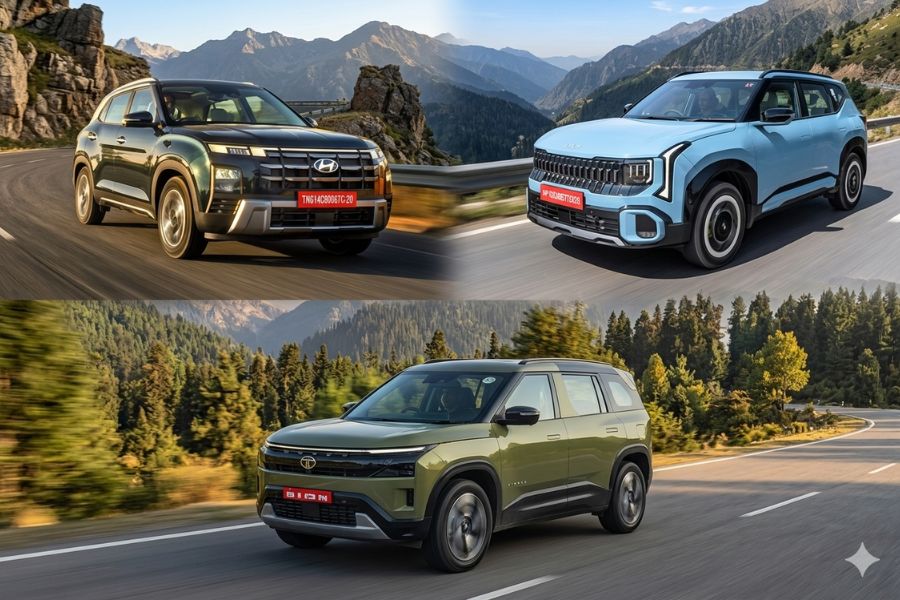
After more than four years on sale, Tata Motors has given the Punch its first major mid-cycle update. The 2026 Tata Punch facelift brings sharper styling, a more premium cabin, a significantly expanded feature list and, most importantly, a new turbo-petrol engine. With these upgrades, the Punch is now aiming squarely at established players in the entry-level SUV space.
In this comparison, we stack up the facelifted Punch against its closest competitors in India: the Hyundai Exter, Nissan Magnite, Renault Kiger and Citroen C3, to see how they compare on paper in terms of powertrains, size and pricing.
Engine and Gearbox Comparison
The biggest mechanical upgrade for the Punch facelift is the introduction of a 1.2-litre turbo-petrol engine, borrowed from the Nexon. This engine dramatically improves performance over the earlier naturally aspirated unit and gives the Punch the highest outright power output in this segment.
Powertrain Highlights
-
Tata Punch facelift is now the most powerful in this group with its 120hp turbo-petrol motor.
-
Citroen C3 turbo counters with the strongest torque figures, making it appealing for highway users.
-
Hyundai Exter is the only model here without a turbo-petrol option, but its 4-cylinder NA engine offers smoother refinement than rival 3-cylinder units.
-
Magnite and Kiger continue to offer both NA and turbo-petrol engines with CVT options.
Automatic Transmission Availability
-
Punch turbo-petrol is manual-only, unlike the C3, Magnite and Kiger.
-
The Citroen C3’s 6-speed torque converter remains the most sophisticated automatic gearbox in this segment.
-
Punch and Magnite stand out for offering AMT with CNG, a rare combination in this price band.
Dimensions and Road Presence
While all five models are marketed as sub-compact SUVs, there are notable differences in size and stance.
Key Observations
-
Magnite and Kiger are the largest overall, almost nudging into compact SUV territory.
-
Punch facelift is shorter but stands tall, giving it a chunky, upright stance.
-
Citroen C3 has the longest wheelbase, which helps interior space despite its understated SUV design.
-
Kiger and Magnite lead in ground clearance, making them better suited for rough roads.
Boot Space
-
Petrol Punch variants offer 366 litres, placing it mid-pack.
-
Renault Kiger tops the segment with a massive 405-litre boot.
-
Punch CNG’s 210-litre boot is officially disclosed, unlike most rivals.
Price Comparison (Ex-showroom, India)
Pricing is where the Punch facelift becomes particularly interesting.
Petrol Prices (Rs lakh)
-
Punch facelift: 5.59 – 9.79
-
Exter: 5.64 – 9.35
-
Magnite: 5.62 – 10.76
-
Kiger: 5.76 – 10.34
-
C3: 4.95 – 9.45
The Punch undercuts the Exter and Magnite at the entry level, but the Citroen C3 remains the most affordable petrol SUV here.
Automatic Variants
-
Punch AMT starts at Rs 7.54 lakh
-
Magnite AMT is the most affordable automatic
-
Kiger slots between the two
CNG Prices (Rs lakh)
-
Punch: 6.69 – 10.54
-
Exter: 6.95 – 8.85
-
Magnite: 6.34 – 9.70
-
Kiger and C3: Not available
Punch CNG is competitively priced at the lower end, though top variants command a premium.
Verdict: Which One Makes Sense?
The 2026 Tata Punch facelift is now far more competitive than before. Its new turbo-petrol engine, tall stance and wide range of powertrain options make it a strong all-rounder, especially for buyers prioritising performance and urban usability.
-
Choose the Punch facelift for maximum power and CNG + AMT flexibility.
-
Pick the Magnite or Kiger for better space, CVT options and road presence.
-
Go for the Exter if refinement and a feature-rich cabin matter more than outright performance.
-
Opt for the C3 if you want the lowest entry price and the smoothest automatic gearbox.
With this facelift, the Punch has firmly re-established itself as one of the most compelling choices in India’s entry-level SUV segment.