


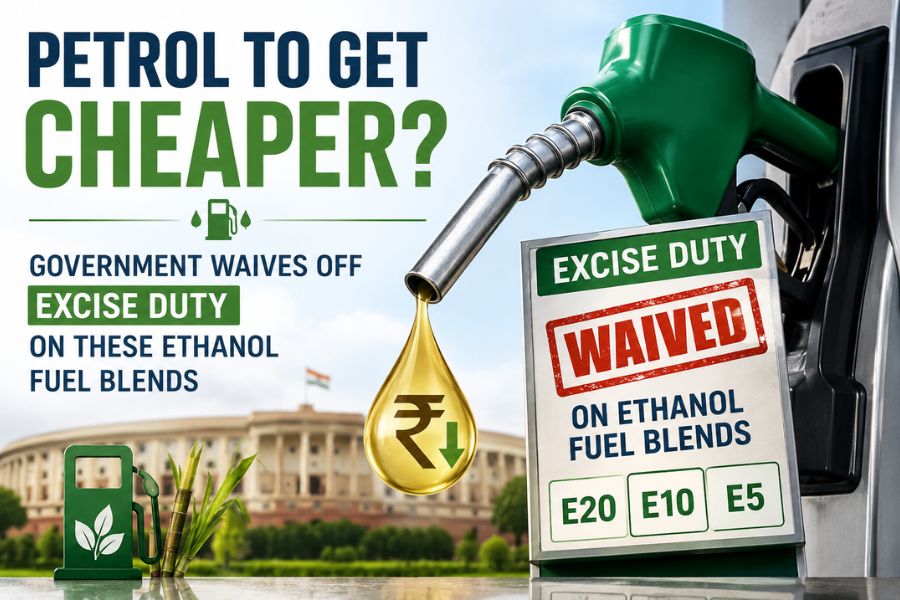
Fuel prices have been a sore point for Indian motorists this year, especially after petrol and diesel rates climbed by nearly Rs 7.50 per litre in the latter half of May 2026. Just when commuters were bracing for another expensive monsoon on the road, the Centre has dropped a fresh policy that could ease the pinch — but only for those willing to switch to higher ethanol-blended petrol. Here’s everything you need to know about the new excise duty waiver, what it means for your wallet, and whether your car is even ready for it.
Key Highlights
- The government has made central excise duty nil on E22, E25, E27, and E30 petrol variants.
- Special Additional Excise Duty and the Road and Infrastructure Cess have also been waived on these blends.
- The Agriculture Infrastructure and Development Cess gets concessional treatment under the new notification.
- The move follows the launch of India’s first E85 fuel station in Delhi earlier this month.
- Officials expect overall ethanol blending to touch nearly 26% by 2030-31.
- Most existing petrol vehicles in India are not yet certified for blends above E20.
What Has the Government Actually Announced?
In a notification issued by the finance ministry, the Centre confirmed that petrol containing 22%, 25%, 27%, or 30% ethanol will now attract zero central excise duty. Alongside this, the government has scrapped the Special Additional Excise Duty and Road and Infrastructure Cess on these blends, while offering relaxed treatment under the Agriculture Infrastructure and Development Cess framework.
In simple terms, oil marketing companies now have a strong fiscal incentive to produce and sell fuel with a higher ethanol content than the current E20 standard, which became the national norm across most of India in 2025 — five years ahead of the original 2030 target.
Why This Move, and Why Now?
The timing isn’t accidental. Crude oil prices have been volatile due to ongoing tensions in West Asia, and this had already pushed pump prices up sharply through May. Earlier in March 2026, the government had cut excise duty on petrol and diesel by Rs 10 per litre, giving up over Rs 1 lakh crore in annual revenue to cushion consumers from the global price surge.
This latest waiver builds on that strategy, but with a twist — instead of broadly subsidising fossil fuel, the Centre is nudging the market toward domestically produced ethanol, which reduces India’s reliance on crude imports, supports sugarcane and grain farmers, and lowers tailpipe emissions.
E20 vs E22-E30 vs E85: How Do They Compare?
| Fuel Type | Ethanol Content | Current Availability | Excise Duty Status | Vehicle Compatibility |
|---|---|---|---|---|
| E10 | 10% | Legacy/limited | Standard duty | Almost all petrol vehicles |
| E20 | 20% | Pan-India default since 2025 | Standard duty | Most BS-VI petrol vehicles |
| E22-E30 | 22-30% | Being scaled up | Now nil | Requires updated engine calibration |
| E85 | 80-85% | 48 outlets, expanding | Already discounted | Only flex-fuel vehicles |
For context, when India’s first E85 station opened in Delhi this month, the fuel was priced around Rs 82 per litre — roughly Rs 20 cheaper than regular E20 petrol and over Rs 27 cheaper than premium-grade XP95. However, because ethanol carries less energy per litre than petrol, flex-fuel vehicles running on E85 typically return 25-35% lower mileage, which can offset a chunk of the per-litre savings.
Pros and Cons of the Excise Duty Waiver
Pros:
- Potential for cheaper fuel at the pump for blends above E20, once retailers pass on the benefit.
- Strengthens India’s energy security by cutting dependence on imported crude.
- Boosts farmer incomes through higher ethanol procurement from sugarcane and grain.
- Encourages automakers to accelerate development of flex-fuel vehicles for the Indian market.
Cons:
- E22-E30 fuel isn’t widely available yet, so most buyers won’t see immediate savings.
- Vehicles not certified for higher blends could face long-term engine and fuel-system wear.
- Lower energy density of ethanol can reduce real-world fuel efficiency, narrowing actual savings.
- Retail price benefits depend on oil marketing companies passing on the duty cut, which isn’t guaranteed.
What This Means for Buyers Right Now
If you’re shopping for a new car or two-wheeler, this is a good moment to check whether the model you’re eyeing supports higher ethanol blends. Currently, the Maruti Suzuki Wagon R flex-fuel variant is the only production passenger vehicle in India built for E20-E85 compatibility, though it’s initially aimed at commercial buyers. Tata Motors has indicated a flex-fuel passenger car could arrive by late 2026, and Toyota has shown flex-fuel prototypes of the Innova Hycross.
For owners of regular E20-compatible vehicles, the practical advice is to wait. Running unapproved blends like E27 or E30 in an engine not calibrated for them could trigger fuel pump and injector issues, potentially affecting your warranty. If you want to understand how blend type affects your running costs, our detailed E20 vs E85 fuel comparison guide breaks down mileage, pricing, and compatible models.
The Road Ahead
The excise waiver is part of a larger ethanol roadmap. With E85 infrastructure set to expand from 48 outlets to around 500 by December 2026, and 5,000 by the end of 2027, the government is clearly betting on flex-fuel technology becoming mainstream within this decade. Whether petrol actually gets cheaper for the average driver, though, will depend on how quickly oil companies scale up E22-E30 supply chains and how many automakers follow Maruti’s lead.
Frequently Asked Questions (FAQs)
1. Does this excise duty waiver mean petrol prices will drop immediately? Not necessarily for most drivers. The waiver applies specifically to E22, E25, E27, and E30 blends, which aren’t yet widely sold. Standard E20 petrol prices remain unaffected for now.
2. Can I use E22-E30 fuel in my current petrol car? Only if your vehicle is specifically certified for higher ethanol blends. Most BS-VI vehicles sold today are approved for up to E20; using higher blends without manufacturer approval could damage fuel system components.
3. How is E85 different from the newly exempted E22-E30 blends? E85 contains 80-85% ethanol and is meant exclusively for flex-fuel vehicles. E22-E30 blends have a much lower ethanol share and are being positioned as a step between E20 and full flex-fuel options.
4. Will this waiver affect diesel prices too? No. The current notification is limited to ethanol-blended petrol variants and does not extend to diesel or biodiesel blends.
5. Which cars in India currently support flex-fuel technology? The Maruti Suzuki Wagon R flex-fuel variant is presently the only production passenger car built for E20-E85 compatibility, with more models from Tata and Toyota expected by late 2026 and beyond.
Conclusion
The government’s decision to waive excise duty on E22-E30 ethanol blends signals a clear long-term direction: India wants ethanol, not just imported crude, to power its vehicles. For now, the immediate impact on your fuel bill will be limited until these blends become widely available at retail pumps. But for buyers planning their next car purchase, factoring in flex-fuel compatibility could pay off as this infrastructure scales up over the next two to three years. Keep an eye on official rollout updates before assuming any savings at the pump just yet.
Read Also: