


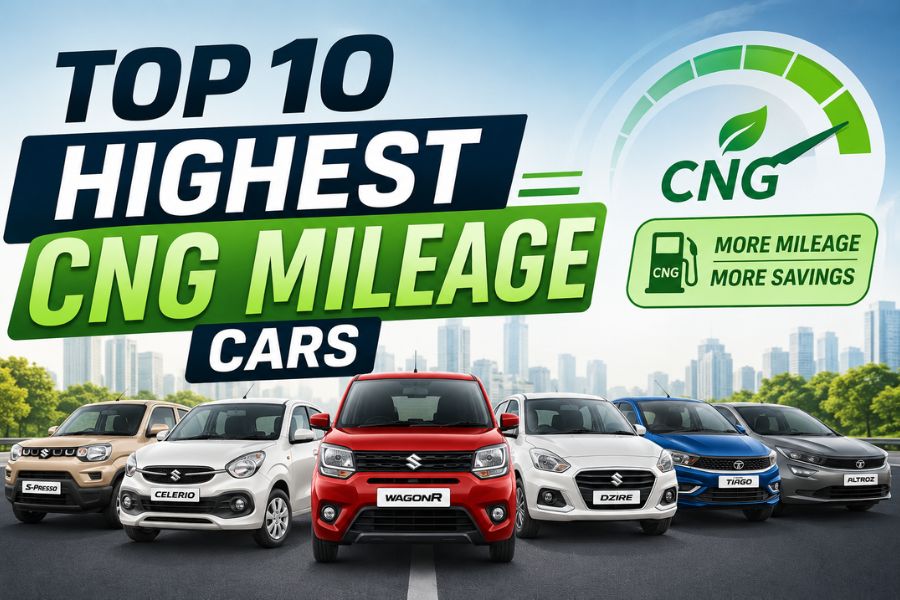
The Indian automotive landscape has undergone a massive paradigm shift. While the buzz around electric vehicles (EVs) continues, factory-fitted Compressed Natural Gas (CNG) vehicles remain the pragmatic choice for millions of car buyers. With petrol and diesel prices hovering at premium rates, shrinking the daily running cost is the ultimate priority for the Indian commuter.
Modern CNG cars are no longer sluggish, feature-stripped entry-level hatchbacks. In 2026, manufacturers like Maruti Suzuki, Tata Motors, and Hyundai have redefined the segment by introducing advanced dual-ECU technology, twin-cylinder space-saving packaging, and even factory-fitted CNG automatic variants. If your primary objective is to maximize every single kilogram of gas, this exhaustive guide highlights the top 10 highest CNG mileage cars in India currently dominant on the market.
Key Highlights of India’s CNG Market
-
The Mileage Champion: The Maruti Suzuki Celerio continues to wear the crown with an astonishing ARAI-certified mileage of 34.43 km/kg.
-
Boot Space Revolution: Tata’s innovative twin-cylinder technology has trickled down across multiple brands, effectively eliminating the problem of zero luggage room.
-
Premium Features: Modern CNG cars now come equipped with 360-degree cameras, multi-airbags, and premium infotainment screens.
-
Automatic Convenience: Automated Manual Transmissions (AMT) are now widely available in CNG models, solving the bumper-to-bumper city traffic dilemma.
Top 10 Highest CNG Mileage Cars in India
To help you make an informed decision, we have curated and ranked the most fuel-efficient factory-fitted CNG models available right now based on their ARAI-certified efficiency figures.
1. Maruti Suzuki Celerio CNG
-
ARAI Mileage: 34.43 km/kg
-
Price Range: ₹5.98 Lakh (Ex-showroom)
The Maruti Suzuki Celerio remains the absolute gold standard for pure efficiency. Driven by the highly optimized 1.0-litre, 3-cylinder K10C DualJet engine, it delivers a punchy yet ultra-frugal performance. Available primarily in the mid-tier VXi trim for its CNG avatar, it offers an uncompromised city commuting package.
2. Maruti Suzuki WagonR CNG
-
ARAI Mileage: 34.05 km/kg
-
Price Range: ₹5.89 Lakh – ₹6.42 Lakh (Ex-showroom)
The ubiquitous “Tallboy” hatchback continues its streak as one of India’s best-selling cars. Sharing the same 1.0L K10C engine platform as the Celerio, the WagonR balances exceptional fuel economy with massive headroom and practical cabin architecture. It is the definitive option for families and fleet operator businesses alike.
3. Maruti Suzuki Alto K10 CNG
-
ARAI Mileage: 33.85 km/kg
-
Price Range: ₹4.82 Lakh – ₹5.32 Lakh (Ex-showroom)
As the most budget-friendly factory-fitted CNG car in the country, the Alto K10 is the quintessential first car for tight budgets. Its lightweight construction allows the 1.0-litre engine to breathe easily, pushing out close to 34 km per kilo. It is compact, incredibly nimble to park, and costs pennies to maintain.
4. Maruti Suzuki Dzire CNG
-
ARAI Mileage: 33.73 km/kg
-
Price Range: ₹8.03 Lakh – ₹9.04 Lakh (Ex-showroom)
For those who prefer a traditional three-box silhouette, the Maruti Suzuki Dzire CNG dominates the compact sedan arena. Utilizing the Z-Series 1.2-litre engine, it yields a staggering fuel economy that surprisingly beats out its smaller hatchback siblings due to better aerodynamic calibration and precise weight tuning. It has also earned notable praise for its updated cabin premium feel and solid safety kit.
5. Maruti Suzuki Swift CNG
-
ARAI Mileage: 32.85 km/kg
-
Price Range: ₹7.45 Lakh – ₹8.39 Lakh (Ex-showroom)
The new-generation Swift brings sharp, sporty styling to the eco-conscious buyer. It balances a youthful design language with top-tier efficiency numbers. The 1.2-litre 3-cylinder engine is highly responsive inside city limits, ensuring you don’t feel a massive power drop when shifting between petrol and natural gas modes.
6. Maruti Suzuki S-Presso CNG
-
ARAI Mileage: 32.73 km/kg
-
Price Range: ₹4.62 Lakh – ₹5.12 Lakh (Ex-showroom)
Maruti’s micro-hatchback features an elevated, high-seating driving posture reminiscent of mini-SUVs. The S-Presso uses its low kerb weight to maximize gas usage, turning out exceptional efficiency numbers while providing excellent ground clearance to navigate rough city roads and deep potholes seamlessly.
7. Maruti Suzuki Baleno / Toyota Glanza CNG
-
ARAI Mileage: 30.61 km/kg
-
Price Range: ₹7.70 Lakh – ₹9.14 Lakh (Ex-showroom)
These badge-engineered premium hatchbacks are identical beneath the skin. Powered by a smooth 1.2-litre 4-cylinder engine, they are the first premium models on this list to break past the 30 km/kg barrier. They offer premium sound systems, connected car technology, and high-speed stability that budget hatchbacks lack.
8. Maruti Suzuki Fronx / Toyota Taisor CNG
-
ARAI Mileage: 28.51 km/kg
-
Price Range: ₹7.79 Lakh – ₹8.59 Lakh (Ex-showroom)
Representing the sub-compact crossover segment, the Fronx and Taisor pairs aggressive, muscular styling with sensible running costs. If you want the robust road presence of a compact SUV without dealing with single-digit fuel economy, these models provide a highly compelling middle ground.
9. Hyundai Aura CNG
-
ARAI Mileage: 28.40 km/kg
-
Price Range: ₹7.93 Lakh onwards (Ex-showroom)
Hyundai’s compact sedan entry stands out due to its supreme mechanical refinement. The 1.2-litre Kappa engine is incredibly quiet, and the transition between fuels is almost unnoticeable. The Aura also sweetens the deal with a distinctly premium interior design and excellent rear-seat comfort.
10. Tata Tiago / Tigor iCNG
-
ARAI Mileage: 28.06 km/kg
-
Price Range: ₹6.55 Lakh – ₹9.80 Lakh (Ex-showroom)
Tata Motors completely revolutionized the market with its iCNG platform. While its ARAI numbers are slightly lower than Maruti’s lineup due to a heavier, more rigid build structure, Tata wins big on safety metrics (boasting a 4-star Global NCAP safety pedigree) and absolute practicality thanks to their patented twin-cylinder configuration that hides the gas tanks beneath the luggage floor.
Comparative Efficiency & Pricing Matrix
| Car Model | ARAI CNG Mileage (km/kg) | Engine Specification | Base CNG Ex-Showroom Price |
| Maruti Celerio | 34.43 | 1.0L, 3-Cylinder | ₹5.98 Lakh |
| Maruti WagonR | 34.05 | 1.0L, 3-Cylinder | ₹5.89 Lakh |
| Maruti Alto K10 | 33.85 | 1.0L, 3-Cylinder | ₹4.82 Lakh |
| Maruti Dzire | 33.73 | 1.2L, 3-Cylinder | ₹8.03 Lakh |
| Maruti Swift | 32.85 | 1.2L, 3-Cylinder | ₹7.44 Lakh |
| Maruti S-Presso | 32.73 | 1.0L, 3-Cylinder | ₹4.62 Lakh |
| Maruti Baleno / Glanza | 30.61 | 1.2L, 4-Cylinder | ₹7.70 Lakh |
| Maruti Fronx / Taisor | 28.51 | 1.2L, 4-Cylinder | ₹7.79 Lakh |
| Hyundai Aura | 28.40 | 1.2L, 4-Cylinder | ₹7.93 Lakh |
| Tata Tiago / Tigor | 28.06 | 1.2L, 3-Cylinder | ₹6.55 Lakh |
Pros and Cons of Upgrading to a CNG Car
Before heading over to a dealership, weigh the practical advantages against the standard ecosystem limitations.
Pros
-
Unmatched Economy: Running costs can drop by up to 50-60% compared to conventional petrol vehicles.
-
Lower Carbon Footprint: CNG burns much cleaner than petrol or diesel, producing fewer harmful tailpipe emissions.
-
Dual-Fuel Flexibility: Can easily switch back to petrol at the flip of a switch if you run out of gas in remote areas.
-
Factory-Fitted Assurances: Modern factory kits include multi-year warranties and integrated safety switches.
Cons
-
Initial Cost Premium: CNG variants usually carry a ₹90,000 to ₹1,00,000 premium over equivalent pure petrol models.
-
Long Station Queues: Depending on your city, filling up during peak hours can mean waiting in long lines.
-
Performance Drop: You will experience a minor drop in peak power and torque output when running on gas mode.
Crucial Ownership Considerations
Owning a CNG vehicle requires keeping a few unique maintenance parameters in mind:
-
Hydro Testing Mandatory: Government regulations state that your car’s onboard CNG cylinder must undergo physical hydrostatic testing every 3 years to ensure safety compliance and structural integrity.
-
Suspension Upgrades: Factory CNG vehicles feature stiffer rear suspension setups out of the box to properly balance out the permanent 60-90 kg weight load of the tank.
-
Spark Plug Maintenance: CNG burns at a higher temperature than petrol, meaning you will need to replace spark plugs slightly more frequently to preserve smooth engine ignition.
Final Verdict: Which One Should You Buy?
Choosing the ideal vehicle depends completely on your specific daily requirements:
-
If your goal is maximum savings and lowest price, buy the Maruti Celerio or Alto K10.
-
If you want uncompromised highway safety and boot space, look closely at the Tata Tiago iCNG or Tata Tigor iCNG.
-
For a premium executive experience with impressive mileage metrics, the Maruti Dzire or Baleno fit perfectly.
Frequently Asked Questions (FAQs)
1. Is real-world CNG mileage identical to the advertised ARAI figures?
No, real-world mileage is typically 15-20% lower depending entirely on your driving style, payload, and heavy usage of the air conditioner in dense city traffic.
2. Do factory-fitted CNG cars start directly on gas mode?
Most modern cars are engineered to start automatically on petrol to properly lubricate the engine valves before transitioning smoothly over to CNG once optimal operational temperatures are reached. Tata’s iCNG cars are an exception, offering a direct-start CNG feature.
3. Does driving on CNG reduce my car’s total engine lifespan?
Not if you use a factory-fitted kit. Modern powerplants utilize hardened valve seats and specialized cylinder heads specifically engineered to manage the dry, high-heat properties of burning natural gas.
4. Can I safely install an aftermarket CNG kit on a new car?
While possible, it is highly discouraged. Aftermarket kits lack integrated dual-ECUs, can void your manufacturer vehicle warranty, and bypass critical integrated safety switches like automatic fuel cut-offs.
5. How much trunk space do I lose with a standard CNG cylinder installation?
Conventional single-cylinder setups take up 70-80% of your available boot area. However, if you opt for Tata’s twin-cylinder configuration, the tanks sit lower down in the spare wheel well, leaving a highly usable luggage area.
Read More: