


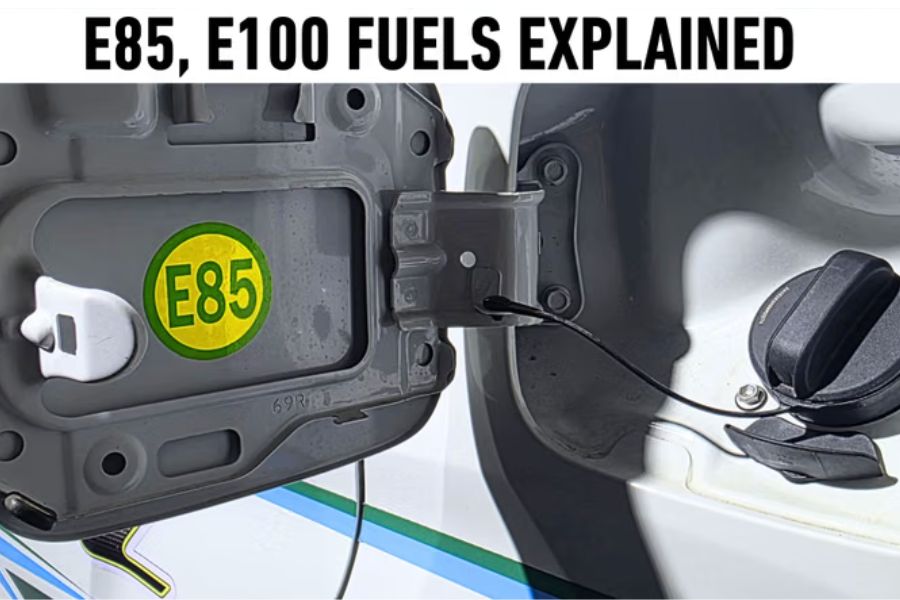
India just crossed a quiet but historic threshold. In June 2026, the country’s first E85 fuel dispensing station went live in Delhi — priced at ₹82.12 per litre, roughly ₹20 cheaper than regular E20 petrol. For the average Indian car buyer, that number sounds like good news. But before you start fantasising about halved fuel bills, there’s a crucial catch: your current car almost certainly cannot run on E85 or E100 — and upgrading isn’t just a software update.
From fuel composition and vehicle compatibility to real-world mileage impact and the government’s infrastructure rollout plan, this guide covers everything that matters about India’s next big fuel transition.
⚡ Key Highlights
- E85 = 85% ethanol + 15% petrol; E100 = 93–95% ethanol + 5–7% petrol/solvents
- India’s first E85 pump launched in Delhi in June 2026 at ₹82.12/litre
- E85/E100 vehicles require specially engineered fuel systems — your E20-compatible car cannot simply fill up
- Mileage drop of 25–35% expected on E85 versus conventional petrol
- Flex-fuel cars from Maruti, Tata, Hyundai, Hero MotoCorp are either available or imminent
- Government targets 500 E85 pumps by December 2026 and ~5,000 by end of 2027
- Ethanol is domestically produced — sugarcane, maize — supporting Indian farmers and energy independence
What Exactly Are E85 and E100?
The number in the name tells you the percentage of ethanol. E85 is a blend of 85% anhydrous (zero-water) ethanol and 15% petrol. E100, despite its name, is not pure ethanol — it’s typically 93–95% ethanol mixed with 5–7% petrol and other solvents. That small petrol fraction serves a real purpose: it prevents the fuel from freezing in cold conditions, aids cold-starts, and — importantly for safety — gives the flame a visible colour in case of a fire (pure ethanol burns with an almost invisible flame).
Both are fundamentally different from E20, the current standard petrol blend in India which contains just 20% ethanol. That distinction matters enormously because E20-compatible vehicles cannot run on E85 or E100 without significant hardware changes. It’s not a software fix — it’s a different fuel ecosystem entirely.
Why Ethanol-Heavy Fuels Behave Differently
Ethanol has roughly 34% less energy per litre than petrol. What it gains in return is a higher octane rating (around 108–113 RON versus petrol’s 91–95 RON), which means it resists knock better and allows engines to run at higher compression ratios or more aggressive ignition timing — both of which partially offset the energy disadvantage. In performance-tuned engines, this can translate into more horsepower. However, in most standard production engines calibrated for everyday use, the net result is lower fuel economy.
Ethanol is also highly corrosive to certain metals, rubbers, and plastics. Standard petrol fuel lines, injectors, and pump seals are not designed for sustained high-ethanol exposure, which is precisely why dedicated flex-fuel vehicles need upgraded components.
What Hardware Changes Does a Flex-Fuel Vehicle Need?
Running a car on E85 or E100 isn’t about willpower — it’s engineering. Here’s what automakers modify:
- Fuel injectors: Higher-flow injectors to compensate for ethanol’s lower energy density
- Fuel pump and lines: Ethanol-resistant materials to prevent corrosion and degradation
- Ethanol sensor: A sensor in the fuel line detects the blend ratio and signals the ECU
- ECU recalibration: New fuel maps, ignition timing maps, and lambda targets for high-ethanol blends
- Exhaust after-treatment: Adjustments to manage different combustion byproducts
According to industry experts, engineering a petrol car for E85/E100 compliance can raise its cost by approximately ₹50,000–₹1 lakh. On two-wheelers, the premium is smaller — the Hero Splendor+ Flex Fuel, for instance, carries a ₹5,153 premium over its standard petrol counterpart.
The Mileage Question: Will You Actually Save Money?
This is where many buyers get tripped up by headline numbers. Yes, E85 launched at ₹82.12 per litre in Delhi versus around ₹102–105 per litre for E20 petrol. That’s a 20% price advantage at the pump. The problem is what happens inside the engine.
Real-World Mileage Impact
| Fuel Type | Ethanol Content | Approx. Price (Delhi, June 2026) | Mileage Impact vs Petrol | Real-World Cost Saving |
|---|---|---|---|---|
| E20 (Regular Petrol) | 20% | ~₹102–105/litre | –2% to –4% | Negligible |
| E85 | 85% | ₹82.12/litre | –25% to –35% | Breakeven or marginal |
| E100 | 93–95% | ~₹82–87/litre (indicative) | –27% to –30% | Negative unless price drops further |
Brazil — the global benchmark for ethanol mobility — operates on the widely-cited “70% rule”: consumers only switch to ethanol when it is priced below 70% of petrol. At its current Delhi launch price, E85 sits at roughly 78–80% of petrol’s price. That gap isn’t wide enough to offset the mileage penalty for most buyers in 2026. The financial case will strengthen if ethanol prices fall further as domestic production scales up or if petrol taxes increase.
Flex-Fuel Vehicles in India: What’s Available or Coming
The Indian flex-fuel vehicle landscape is moving fast. Here’s a snapshot of where things stand as of June 2026, which you can cross-reference with our upcoming cars in India guide:
| Vehicle | Max Ethanol Blend | Status | Engine |
|---|---|---|---|
| Maruti Wagon R Flex Fuel | E85 (homologated) | Available (commercial sector) | 1.2-litre petrol |
| Maruti Fronx Flex Fuel | E85 | Showcased October 2025; launch TBA | Modified 1.2-litre petrol |
| Tata Punch Flex Fuel | E85–E100 | Showcased; retail launch late 2026/early 2027 | 1.2-litre Revotron, 88hp |
| Hyundai Creta Flex Fuel | E100 | Showcased at Auto Expo 2025 | 1.0-litre turbo-petrol, 120hp |
| Hero Splendor+ Flex Fuel | E100 | Available | 97.2cc single-cylinder |
| TVS Apache RTR 200 Fi E100 | E100 | Showcased | 197.75cc single-cylinder |
Notably, while the Wagon R is physically capable of running E100 fuel, it has been officially homologated for E85. This reflects the current infrastructure reality — E100 pumps are essentially non-existent in the country today. As part of your broader research on these models, our Maruti Suzuki price guide and Tata Punch variant review offer useful context on ownership costs.
India’s Ethanol Infrastructure: The Ground Reality
Arguably the biggest hurdle for E85/E100 adoption isn’t the vehicles — it’s the pumps. As of June 2026, approximately 50–100 E85 dispensing stations are operational, concentrated in the Delhi-NCR region and the Mumbai-Pune-Nagpur corridor. Compare that to over 60,000 fuel stations across the country and you understand the scale of the challenge.
The government’s stated roadmap: 500 stations by December 2026, and approximately 5,000 pumps across major Indian cities by end of 2027. Petroleum Minister Hardeep Singh Puri has committed to this expansion, and early rollouts are already visible in Delhi. For anyone considering a flex-fuel vehicle purchase today, it’s worth checking whether your city’s fuel network will realistically support it in the near term.
Where Is India’s Ethanol Coming From?
India’s ethanol is predominantly derived from sugarcane molasses, with growing contributions from maize, broken rice, and other agricultural feedstocks. This domestic sourcing is central to the government’s pitch: India imports roughly 85% of its crude oil, making it deeply exposed to global price shocks and geopolitical disruptions. Homegrown ethanol reduces that dependence while directly channelling income to farmers. Between 2014–15 and October 2025, farmers received ₹1.36 lakh crore from ethanol supply under the Ethanol Blended Petrol programme, and the country saved ₹1.55 lakh crore in foreign exchange.
Pros and Cons of E85 / E100 Flex-Fuel Vehicles
✅ Pros
- Lower fuel price at the pump (currently ~20% cheaper than petrol)
- Higher octane rating enables better engine performance in optimised flex-fuel engines
- Significantly lower carbon emissions compared to pure petrol
- Supports domestic agriculture and energy security
- Reduced dependence on imported crude oil
- Flex-fuel vehicles retain full petrol compatibility as a fallback
❌ Cons
- 25–35% mileage drop on E85 versus regular petrol
- Pump availability severely limited outside major corridors in 2026
- Vehicle premium of ₹50,000–₹1 lakh on four-wheelers
- No compelling net cost saving at current price ratios for four-wheelers
- E100 infrastructure virtually non-existent for private use
- Older or E20-only vehicles cannot run on high-ethanol blends at all
E85 vs E100: Which One Should You Care About?
For practical purposes in 2026, E85 is the actionable fuel. It has a live pump network (however limited), a confirmed price point, and homologated vehicles ready for retail. E100, while technically impressive and already demonstrated in models like the Hyundai Creta Flex Fuel concept, remains an infrastructure story — there are virtually no E100 pumps accessible to private buyers.
Think of E100 as the endgame that India is engineering toward. E85 is the stepping stone that arrives first. If you’re buying a flex-fuel vehicle today — and the Maruti Wagon R in the commercial space is the only retail option for now — E85 is what you’ll actually fill it with.
For a broader look at how alternative fuels stack up against EVs and CNG in India, our CNG vs petrol cost comparison provides a useful parallel framework. Also worth reading: our best fuel-efficient cars in India 2026 roundup for buyers weighing their options holistically.
Should You Buy a Flex-Fuel Car Right Now?
The honest answer: it depends on your city, your use case, and your timeline.
Buy now if: You’re in Delhi-NCR or the Mumbai-Pune corridor, you drive high annual kilometres (15,000+), and you’re looking at commercial or fleet use where even marginal per-litre savings compound significantly. The Hero Splendor+ Flex Fuel makes particularly strong sense for high-mileage two-wheeler riders in ethanol-available zones.
Wait if: You’re a private car buyer in Tier 2 or Tier 3 India, the infrastructure isn’t near you yet, or you’re evaluating a four-wheeler flex-fuel model for personal use. The economics tighten considerably on passenger cars once you account for the ₹50,000–₹1 lakh vehicle premium and the mileage penalty.
Watch the space if: You’re planning a car purchase in mid-to-late 2027. By then, the Tata Punch Flex Fuel and potentially a retail Maruti Fronx should be available, 500+ E85 stations should be operational, and real-world ownership data from early adopters will give buyers a clearer picture of running costs.
Frequently Asked Questions (FAQs)
Can I use E85 or E100 in my current petrol car?
No. E20-compatible vehicles — which covers virtually every modern petrol car in India — cannot run on E85 or E100. These high-ethanol blends require ethanol-resistant fuel systems, upgraded injectors, an ethanol sensor, and a specially calibrated ECU. Using E85 in a standard petrol car risks damage to fuel lines, seals, and injectors, and could cause serious engine problems.
How much cheaper is E85 compared to regular petrol in India?
At launch in Delhi in June 2026, E85 was priced at ₹82.12 per litre versus approximately ₹102–105 for E20 petrol — a saving of roughly ₹20 per litre. However, because E85 delivers 25–35% fewer kilometres per litre, the effective per-kilometre cost saving is much smaller, and may not offset the higher purchase price of a flex-fuel vehicle for private buyers at current pricing levels.
Which Indian cars can run on E85 or E100 today?
As of June 2026, the Maruti Wagon R Flex Fuel is available for the commercial sector and is homologated for E85. The Hero Splendor+ Flex Fuel and select TVS Apache variants support high-ethanol blends. The Tata Punch Flex Fuel and Maruti Fronx Flex Fuel are expected to reach retail buyers in late 2026 or 2027. The Hyundai Creta E100 has been showcased but has no confirmed retail launch date.
Will mileage drop noticeably when using E85?
Yes — significantly. Ethanol contains roughly 34% less energy per litre than petrol. In practice, vehicles on E85 typically see a 25–35% drop in fuel economy versus conventional petrol. Flex-fuel engines partially compensate through higher compression and ignition tuning, but the gap doesn’t fully close. The mileage penalty is one of the key reasons the financial case for E85 depends heavily on the fuel price differential staying wide.
How many E85 pumps are there in India and where can I find them?
As of June 2026, between 50 and 100 E85 dispensing stations are operational, concentrated in Delhi-NCR and the Mumbai-Pune-Nagpur corridor. The government has set targets of 500 stations by December 2026 and approximately 5,000 stations across major Indian cities by end of 2027. Availability outside these corridors remains negligible at this stage.
Does a flex-fuel vehicle work normally on regular petrol if E85 isn’t available?
Yes. This is one of the most important practical advantages of flex-fuel vehicles. They are engineered to run on any blend between E20 and their maximum rated ethanol concentration (E85 or E100). The onboard ethanol sensor detects the blend ratio and adjusts ECU maps in real time. So if you can’t find an E85 pump, simply fill up with regular E20 petrol — the car adapts automatically.
The Bottom Line
E85 and E100 represent India’s most ambitious step in homegrown fuel policy since the push for CNG in Delhi two decades ago. The vision is compelling — cheaper fuel, cleaner air, energy independence, and a revenue boost for farmers — and the government is clearly serious about execution, with real pumps and real prices now live.
But 2026 is still Year One of this transition. Infrastructure is thin, the financial maths only works in specific scenarios, and the vehicle options for private buyers are limited. The smart move for most car buyers today is to stay informed, watch the pump network expand, and consider flex-fuel as a serious option when purchasing in 2027 or beyond — by which point the models, the infrastructure, and the economics should all be in a far stronger place.
India has done this before with E20 — it achieved the nationwide 20% blending target ahead of schedule. If that track record is any guide, E85 could hit mainstream availability faster than the sceptics expect.
Read More: