


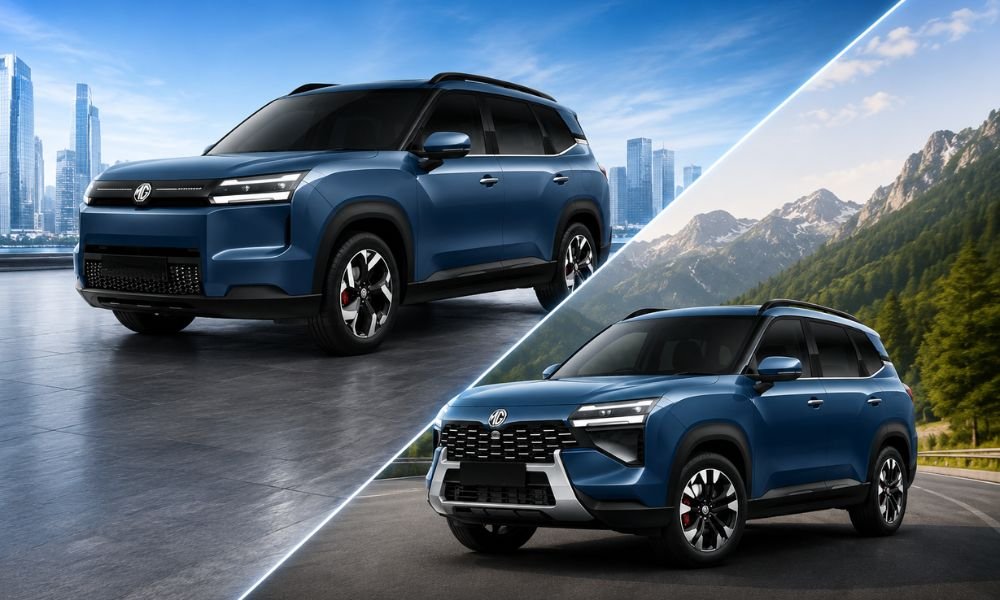
The new MG Hector Tomahawk has arrived in India with something the mainstream SUV market has rarely offered: a choice between a full-electric powertrain and a plug-in hybrid on the same SUV. Launched on August 26, 2026, the Tomahawk EV starts at ₹19.49 lakh, while the Tomahawk PHEV starts at ₹25.69 lakh, both ex-showroom. MG is also offering a Battery-as-a-Service (BaaS) ownership option for both versions.
But the decision is not simply about choosing between electricity and petrol. The EV offers a 517 km claimed range and zero tailpipe emissions, while the PHEV combines more than 115 km of electric-only driving with a claimed overall range of over 1,100 km. So, which version makes more sense for Indian buyers? Here is a detailed comparison.
Key Highlights
- MG Hector Tomahawk is available as an EV and PHEV.
- EV gets a 69.2 kWh battery and a claimed 517 km range.
- PHEV gets a 20.5 kWh battery and over 115 km electric-only range.
- PHEV’s claimed combined range exceeds 1,100 km.
- EV starts at ₹19.49 lakh; PHEV starts at ₹25.69 lakh.
- BaaS prices start at ₹13.99 lakh for the EV and ₹21.79 lakh for the PHEV.
- EV is available with five- and seven-seat layouts, while the PHEV is seven-seat only.
- The EV supports up to 90 kW DC fast charging and V2H functionality.
MG Hector Tomahawk EV vs PHEV: Price Comparison
The price gap between the two powertrains is significant. The Hector Tomahawk EV starts at ₹19.49 lakh, while the PHEV begins at ₹25.69 lakh for outright ownership.
MG’s BaaS programme lowers the initial purchase price to ₹13.99 lakh for the EV and ₹21.79 lakh for the PHEV, with separate per-kilometre battery rental charges. For the EV, the announced battery rental is ₹4.90 per km, while the PHEV attracts ₹3.20 per km.
| Parameter | Hector Tomahawk EV | Hector Tomahawk PHEV |
|---|---|---|
| Powertrain | Pure electric | Plug-in hybrid |
| Starting price | ₹19.49 lakh | ₹25.69 lakh |
| BaaS starting price | ₹13.99 lakh + ₹4.90/km | ₹21.79 lakh + ₹3.20/km |
| Seating | 5/7 seats | 7 seats |
| Battery | 69.2 kWh | 20.5 kWh |
| Electric-only range | 517 km claimed | 115+ km claimed |
| Overall range | 517 km claimed | 1,100+ km claimed |
| DC fast charging | Up to 90 kW | Up to 25 kW |
| Fuel engine | No | 1.5-litre petrol |
| Best suited for | EV-focused users | Frequent long-distance travellers |
Prices are introductory ex-showroom figures and may change.
MG Hector Tomahawk EV: What Does It Offer?
The Hector Tomahawk EV is the simpler of the two mechanically. It uses a 69.2 kWh battery connected to a permanent-magnet synchronous electric motor producing 150 kW, equivalent to around 204 PS, and 310 Nm of torque. MG claims a 0-100 km/h acceleration time of 8.2 seconds.
Its biggest advantage is range. The EV has a claimed MIDC range of 517 km on a full charge, making it considerably more practical for buyers who have access to dependable home or workplace charging.
Charging capability is also stronger than the PHEV. The Tomahawk EV supports up to 7.4 kW AC charging and up to 90 kW DC fast charging. MG says a 30-80 percent DC charge takes approximately 35 minutes.
Another standout feature is Vehicle-to-Home (V2H) capability, allowing the vehicle’s battery to supply power to a compatible home setup. It also supports V2L and V2V functionality, adding practical uses beyond simply driving the SUV.
MG Hector Tomahawk PHEV: Why Is It Different?
The Hector Tomahawk PHEV takes a more complicated but potentially more versatile approach. It combines a 1.5-litre petrol engine with a 20.5 kWh battery, electric motor and Dedicated Hybrid Transmission.
The electric motor produces 148 kW, while the system offers four operating modes: Pure EV, Series Hybrid, Parallel Hybrid and Engine Direct Drive. MG claims the SUV can accelerate from 0-100 km/h in approximately nine seconds.
The headline figure, however, is its claimed range. With a full battery and fuel tank, MG says the Tomahawk PHEV can travel more than 1,100 km. Its electric-only range exceeds 115 km, which means many daily commutes could potentially be completed without starting the petrol engine.
The PHEV supports AC charging at up to 3.3 kW and DC charging at up to 25 kW. MG’s published information indicates around 7.5 hours for a 10-100 percent AC charge, while a 30-80 percent DC charge takes roughly 35 minutes.
EV vs PHEV: Which Is Better for Daily Driving?
For city users with predictable driving patterns, the Hector Tomahawk EV is the more logical choice.
Its 517 km claimed range is substantially more than the PHEV’s 115 km electric-only range. If you can install a home charger, overnight charging can make everyday running extremely convenient. There is also no petrol engine, exhaust system or conventional engine maintenance.
The PHEV makes more sense when the SUV is regularly used for intercity journeys. Once its battery charge is depleted, the petrol engine provides additional range without requiring the driver to locate a charging station.
This distinction is particularly important for buyers living in areas where public EV charging remains inconsistent.
Features and Technology
Both versions are built around MG’s new ADAPT architecture and share the Tomahawk’s spacious three-row SUV character. The SUV measures 4,745 mm in length, has a 2,810 mm wheelbase and offers a technology-heavy cabin.
Depending on variant, highlights include:
- 15.6-inch touchscreen infotainment system
- 8.8-inch digital driver’s display
- Panoramic sunroof
- Ventilated front seats
- Wireless Apple CarPlay and Android Auto
- 10-speaker Infinity audio system
- 360-degree camera
- Level 2 ADAS
- Six airbags
- Powered tailgate
- 256-colour ambient lighting
- Connected-car technology
The EV’s five-seat configuration also gives buyers greater luggage flexibility, with reported boot capacity of up to 610 litres in that configuration.
Pros and Cons
MG Hector Tomahawk EV
Pros
- 517 km claimed range
- Strong 150 kW electric motor
- Faster DC charging
- Lower starting price
- Zero tailpipe emissions
- V2H capability
- Five- and seven-seat options
Cons
- Requires charging access for convenient ownership
- Highway journeys require charging planning
- Public charging availability varies by location
MG Hector Tomahawk PHEV
Pros
- 115+ km electric-only range
- 1,100+ km claimed combined range
- Petrol backup for long-distance trips
- Seven-seat configuration
- Less dependence on public charging infrastructure
Cons
- Significantly higher purchase price
- More mechanically complex than the EV
- Slower charging capability
- Electric-only range is much lower than the EV
Which MG Hector Tomahawk Should You Buy?
The answer depends primarily on your driving pattern rather than the badge on the tailgate.
Choose the Hector Tomahawk EV if:
- You have reliable home or office charging.
- Most of your driving is urban or semi-urban.
- You want lower day-to-day energy costs and simpler mechanicals.
- You regularly drive long distances but have access to DC fast chargers.
- You want the maximum electric range for your money.
Choose the Hector Tomahawk PHEV if:
- You frequently travel between cities.
- Charging infrastructure along your usual routes is uncertain.
- You want electric driving for daily commuting but petrol backup for holidays.
- You want a seven-seater without committing entirely to a battery-electric vehicle.
For most buyers with dependable charging at home, the Tomahawk EV is the stronger value proposition. The PHEV commands a sizeable premium, but that premium buys something the EV cannot: the ability to continue travelling long distances using petrol when charging is inconvenient.
Frequently Asked Questions (FAQs)
1. What is the price of the MG Hector Tomahawk EV?
The Hector Tomahawk EV starts at ₹19.49 lakh ex-showroom under outright ownership. MG also offers a BaaS option starting at ₹13.99 lakh plus a battery rental charge of ₹4.90 per km.
2. What is the price of the MG Hector Tomahawk PHEV?
The Tomahawk PHEV starts at ₹25.69 lakh ex-showroom. Under BaaS, the introductory starting price is ₹21.79 lakh plus ₹3.20 per km for battery rental.
3. What is the range of the MG Hector Tomahawk EV?
The EV has a claimed MIDC range of 517 km from its 69.2 kWh battery.
4. What is the electric range of the Hector Tomahawk PHEV?
MG claims more than 115 km of pure-electric driving range. Its claimed combined range with a full battery and fuel tank exceeds 1,100 km.
5. Which is better for highway driving, EV or PHEV?
The PHEV is more convenient for frequent long highway journeys because its petrol engine provides additional range when the battery is depleted. The EV can also handle highway travel, but drivers need to plan charging stops around available infrastructure.
6. Does the Hector Tomahawk EV support fast charging?
Yes. The EV supports up to 90 kW DC fast charging, with MG quoting approximately 35 minutes for a 30-80 percent charge.
7. Is the Hector Tomahawk PHEV a seven-seater?
Yes. The PHEV is offered as a seven-seater, while the EV is available in both five- and seven-seat configurations.
Conclusion
The MG Hector Tomahawk EV and PHEV are aimed at two different types of SUV buyers. The EV is the cleaner, simpler and more affordable option, with a strong 517 km claimed range, faster charging and useful V2H capability. The PHEV costs considerably more but offers a compelling combination of more than 115 km of electric driving and over 1,100 km of claimed total range.
For a buyer with home charging and predominantly urban usage, the Hector Tomahawk EV is the version to choose. For families that routinely undertake long intercity journeys and want to eliminate charging anxiety, the Hector Tomahawk PHEV offers greater flexibility.
Ultimately, the Tomahawk’s biggest strength is not either powertrain individually. It is the fact that MG has given Indian buyers a choice between two distinctly different approaches to electrified SUV ownership.
Read Also: