


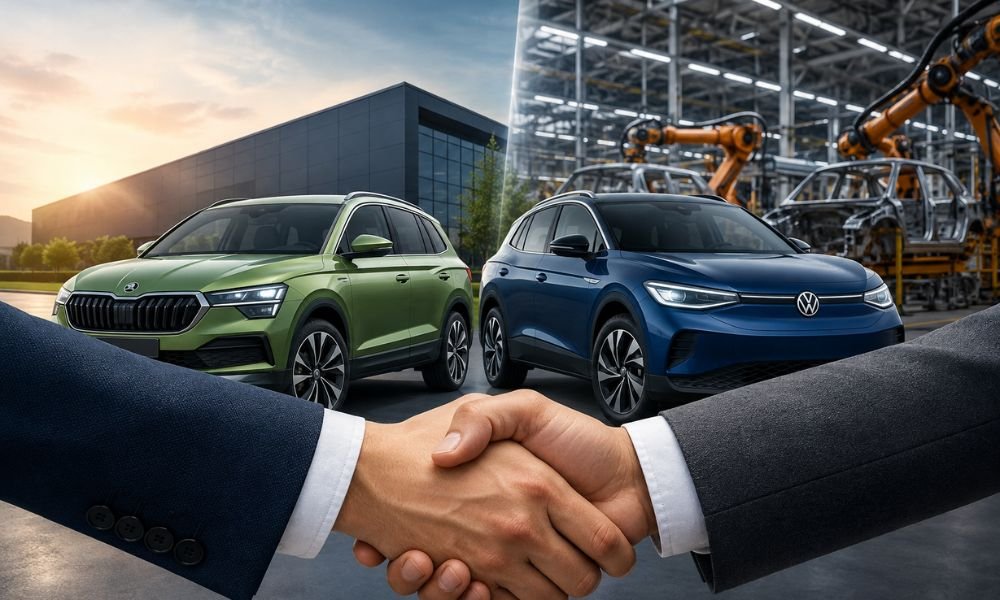
India’s automotive industry is about to witness one of its most significant power shifts in years. JSW Group and Skoda Auto Volkswagen India are reportedly in the final stages of talks for a manufacturing joint venture, with a non-binding memorandum of understanding (MoU) expected to be signed within the next two months. If this deal goes through, it could reshape everything from EV pricing to SUV localisation in the country. Here’s a complete breakdown of what’s happening, why it matters, and what buyers should watch for.
Key Highlights
- Skoda Auto Volkswagen India and JSW Group are nearing a non-binding MoU for a manufacturing joint venture
- The proposed structure is a 51:49 split, with JSW Group likely holding the majority stake
- Funds are expected to accelerate India Main Platform (IMP) based electric SUVs
- Higher localisation could reduce Skoda-VW’s reliance on imported components and bring down costs
- Senior Skoda and Volkswagen global executives are set to visit India in the second half of August 2026
- This would be JSW’s second major auto bet after its 2023 stake acquisition in MG Motor India
- The next-gen Kodiaq platform’s localisation is also reportedly under evaluation for a three-row SUV
Why This Deal Is Happening Now
Skoda Auto Volkswagen India, which oversees Skoda, Volkswagen, Audi, Porsche, Lamborghini and Bentley in the country, has struggled to convert its engineering reputation into meaningful sales volume. Despite launching India-specific products like the Kylaq compact SUV, the group’s mass-market performance has remained modest for over two decades.
A partnership with JSW could solve two problems at once. Volkswagen gets fresh capital and stronger local manufacturing muscle, while JSW gains access to European platforms, global engineering expertise, and internationally recognised brands. For an industrial conglomerate looking to expand its automotive footprint quickly, that access is far more valuable than building capability from scratch.
JSW’s Growing Automotive Ambitions
This wouldn’t be JSW’s first rodeo in passenger vehicles. The group already holds a 35 percent stake in JSW MG Motor India, a joint venture formed after acquiring stake from China’s SAIC in 2023, which began operations in 2024. Beyond that, JSW is separately developing a 636-acre EV manufacturing plant in Maharashtra worth an estimated Rs 27,200 crore, alongside a 30 GWh lithium-ion battery cell facility. A Skoda-VW tie-up would add an entirely different brand pillar, stretching from mass-market hatchbacks to Lamborghini and Bentley.
What The Money Will Fund
A large chunk of the proposed investment is expected to flow into vehicles built on the India Main Platform (IMP), Volkswagen Group’s EV architecture designed specifically for India. The IMP is derived from the China Main Platform (CMP) and is being adapted to Indian regulations, cost structures, and the local supplier base.
The platform is expected to underpin multiple electric SUVs across both Skoda and Volkswagen brands over the next few years, including a compact and a midsize e-SUV for each brand. There’s also talk of localising the next-generation Kodiaq platform, which could result in a three-row SUV built to rival the Mahindra XUV 7XO.
JSW-Skoda VW JV: Quick Comparison
| Aspect | Current Status | Post-JV Expectation |
|---|---|---|
| Ownership | Fully Volkswagen Group owned | 51:49, JSW likely majority |
| EV Strategy | IMP platform under development | Accelerated funding for IMP-based e-SUVs |
| Localisation | Moderate | Higher local sourcing, reduced import dependence |
| Market Share (FY2026) | 2.34% PV market share | Expected to strengthen with fresh capital |
| Product Range | Skoda, VW, Audi, Porsche, Lamborghini, Bentley | Same portfolio, stronger India focus |
Pros and Cons of the Proposed JV
Pros:
- Fresh capital could speed up EV and hybrid localisation
- Greater local sourcing may lower prices for future Skoda and VW models
- JSW’s manufacturing scale could improve production efficiency
- Broader product pipeline, including a possible three-row SUV
Cons:
- Deal terms remain unresolved and could still fall through
- Ownership changes typically involve long regulatory approval timelines
- Management control and brand direction under a new majority stakeholder are unclear
- Existing Skoda and VW owners may see little immediate change
What This Means For You As A Buyer
If you’re eyeing a Skoda or Volkswagen purchase right now, don’t expect immediate changes. Definitive agreements, due diligence, and regulatory clearances typically take many months, even after an MoU is signed. However, if you’re planning a purchase in 2027 or later, this deal could mean more competitively priced EVs and a stronger service network backed by JSW’s industrial scale.
Frequently Asked Questions (FAQs)
1. Has the JSW-Skoda Volkswagen JV been officially confirmed?
No. Both companies have not officially confirmed the deal. It is currently reported as being in advanced discussion stages, with a non-binding MoU expected within two months.
2. What stake will JSW Group hold in the joint venture?
Discussions currently centre around a 51:49 structure, with JSW Group expected to hold the majority stake, though the final equity split will depend on further negotiations.
3. Will this affect the price of existing Skoda and Volkswagen cars?
Not immediately. Any pricing impact would only be visible once localisation initiatives under the new venture start reflecting in future models.
4. What is the India Main Platform (IMP)?
The IMP is a Volkswagen Group EV architecture derived from the China Main Platform, adapted specifically for Indian regulations, road conditions, and cost requirements.
5. Does JSW already have automotive experience in India?
Yes. JSW holds a 35 percent stake in JSW MG Motor India, a joint venture with SAIC that has been operational since 2024, particularly strong in the EV segment.
6. When can we expect the joint venture to be finalised?
Following the MoU, both sides need to finalise equity structure, investment commitments, and regulatory approvals, a process that typically extends well beyond the initial signing.
Conclusion
The proposed JSW-Skoda Volkswagen joint venture could be one of the most consequential automotive stories of 2026. For a legacy player like Volkswagen Group, partnering with an aggressive Indian conglomerate offers a genuine shot at relevance in a market it has struggled to crack for years. For JSW, it’s another calculated step toward becoming a serious force in India’s passenger vehicle industry. Whether this translates into better products and pricing for buyers will depend entirely on how the next few months of negotiations unfold. CarQuestIndia will keep tracking this story as it develops.
Read Also: