


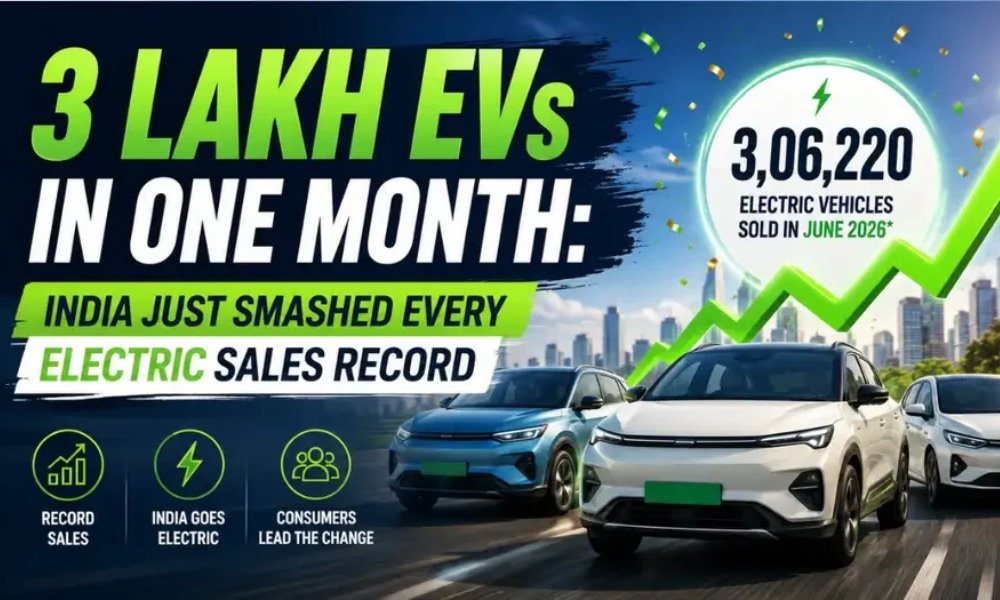
India’s electric passenger vehicle sales have crossed the 3 lakh mark for the first time in a calendar year, reaching 3,04,701 units between January 1 and November 9, 2026. According to Vahan registration data, this represents 66% year-on-year growth compared with the same period in 2025. Tata Motors continues to lead the market, followed by Mahindra and JSW MG Motor India.
The milestone has been achieved with more than seven weeks remaining in 2026, highlighting the growing demand for electric cars and SUVs in the country.
Key Highlights
-
India’s electric passenger vehicle sales reached 3,04,701 units by November 9, 2026.
-
Sales increased 66% year-on-year.
-
The previous full-year record was 1,95,571 units in 2025.
-
Tata Motors leads with 1,20,895 units and a 39.67% market share.
-
Mahindra occupies second position with 69,660 units.
-
September recorded the highest monthly sales at 38,440 units.
Monthly EV Sales in India: 2026 Performance
The growth in electric passenger vehicle sales has been consistent throughout 2026. Monthly registrations crossed 30,000 units for the first time in June and remained above that level for five consecutive months.
September emerged as the strongest month, recording 38,440 electric passenger vehicle registrations. October followed with 37,516 units, representing 79% growth compared with October 2025.
| Month | EV sales in 2026 | Growth YoY |
|---|---|---|
| January | 21,568 | 62% |
| February | 16,300 | 56% |
| March | 25,502 | 77% |
| April | 25,984 | 76% |
| May | 28,416 | 93% |
| June | 33,640 | 120% |
| July | 34,717 | 94% |
| August | 32,587 | 61% |
| September | 38,440 | 108% |
| October | 37,516 | 79% |
| November 1-9 | 10,031 | Partial month |
Source: Vahan retail registration data. November figures cover only the first nine days.
The quarterly performance also highlights the acceleration in demand. January to March recorded 63,370 units, while April to June increased to 88,040 units. July to September delivered the strongest quarterly performance, with 1,04,744 registrations, an 87% increase year-on-year.
If the current momentum continues, India’s electric passenger vehicle market could finish 2026 with approximately 3.5 lakh to 3.6 lakh registrations.
Tata Motors Leads India’s Electric Car Market
Its EV sales have increased by approximately 58% compared with the 76,644 units registered during the entire 2025 calendar year.
The Nexon EV remains Tata’s biggest-selling electric model, while the Tiago EV and Punch EV also contribute to its volumes. The company’s portfolio now covers multiple price and body-style categories, helping it reach a wider customer base.
Mahindra occupies second position with 69,660 registrations and a 22.86% market share. Its electric portfolio includes the BE 6, XEV 9e, XEV 9S and XUV 3XO EV.
JSW MG Motor India ranks third with 56,988 units and an 18.70% share. The Windsor EV continues to be its highest-selling electric model.
Brand-Wise Electric Car Sales in India 2026
The competition behind the top three manufacturers is also becoming more interesting. VinFast has secured fourth position, while Maruti Suzuki and Kia are expanding their presence.
| Manufacturer | Sales (Jan 1-Nov 9) | Market share |
|---|---|---|
| Tata Motors | 1,20,895 | 39.67% |
| Mahindra | 69,660 | 22.86% |
| JSW MG Motor | 56,988 | 18.70% |
| VinFast | 15,867 | 5.20% |
| Maruti Suzuki | 12,390 | 4.06% |
| Kia | 7,612 | 2.49% |
| BYD | 6,755 | 2.21% |
| Hyundai | 6,013 | 1.97% |
| BMW | 4,273 | 1.40% |
| Mercedes-Benz | 1,416 | 0.46% |
| Tesla | 1,153 | 0.37% |
Figures are retail registrations.
VinFast has registered 15,867 units since entering the Indian market, supported by its VF6, VF7 and VF MPV 7 models. Maruti Suzuki has recorded 12,390 registrations of the e-Vitara, while Kia has reached 7,612 units.
BYD and Hyundai have registered 6,755 and 6,013 units, respectively.
Why Are Electric Car Sales Growing in India?
Several factors are contributing to the growth of India’s electric passenger vehicle market.
1. More electric SUVs to choose from
The availability of models such as the Tata Harrier EV, Mahindra BE 6, XEV 9e, MG Windsor EV and VinFast VF7 has expanded customer choice. Buyers can now consider electric vehicles across different sizes and price categories.
2. Improved driving range
Newer electric vehicles offer more competitive claimed driving ranges, reducing concerns about frequent charging. However, actual range still depends on driving conditions, speed, temperature and air-conditioning usage.
3. Lower running expenses
Electric cars generally have lower energy costs per kilometre than comparable petrol vehicles. Their ownership economics can be attractive for customers with regular daily driving and convenient home charging.
4. Growing charging infrastructure
The expansion of public charging facilities is improving the practicality of electric vehicles, particularly in major cities and along important highways. Home charging remains an important advantage for owners.
Luxury Electric Car Sales Also Increase
The growth is not restricted to affordable and mass-market electric vehicles. India’s luxury electric passenger vehicle segment has also recorded positive momentum.
Nine luxury manufacturers collectively registered 7,323 units during the period, representing 29% growth compared with 5,669 units in the whole of 2025.
BMW leads this category with 4,273 units and approximately 58% of luxury EV sales. Mercedes-Benz follows with 1,416 units, while Tesla has recorded 1,153 units.
Pros and Cons of India’s Growing EV Market
Pros
-
More electric car choices across price segments.
-
Improved claimed driving ranges.
-
Lower energy costs for regular usage.
-
Increasing availability of charging infrastructure.
-
Stronger competition among manufacturers.
Cons
-
Public charging availability remains uneven across locations.
-
Electric SUVs generally have higher initial purchase prices than comparable petrol models.
-
Battery replacement can be expensive outside warranty coverage.
-
Resale values and long-term battery performance require consideration.
Frequently Asked Questions
1. Have electric car sales crossed 3 lakh in India in 2026?
Yes. India’s electric passenger vehicle registrations reached 3,04,701 units between January 1 and November 9, 2026. This is the first time the segment has crossed three lakh registrations within a calendar year.
2. Which company sells the most electric cars in India in 2026?
Tata Motors leads India’s electric passenger vehicle market with 1,20,895 registrations and a 39.67% market share as of November 9, 2026. Mahindra ranks second, followed by JSW MG Motor India.
3. How much did electric car sales grow in India in 2026?
Electric passenger vehicle registrations increased by 66% year-on-year during January 1 to November 9, 2026. The total has already exceeded the 1,95,571 units registered during the entire 2025 calendar year.
4. Which month recorded the highest EV sales in India in 2026?
September recorded the highest monthly electric passenger vehicle registrations in 2026, with 38,440 units. October followed with 37,516 units, maintaining the market’s momentum above 30,000 monthly registrations.
5. Which are the top three electric car manufacturers in India?
Tata Motors, Mahindra and JSW MG Motor India are the top three electric passenger vehicle manufacturers in 2026. Together, they account for approximately 81% of the 3,04,701 registrations recorded by November 9.
6. How many electric cars could India sell in 2026?
Based on the sales momentum through November 9, India’s electric passenger vehicle market could finish 2026 with approximately 3.5 lakh to 3.6 lakh registrations. This remains a projection, not a confirmed full-year figure.
Conclusion
Crossing three lakh electric passenger vehicle registrations is a significant milestone for India’s EV market. Tata Motors continues to hold the largest share, but Mahindra and JSW MG Motor are strengthening competition with expanding electric SUV portfolios.
The estimated 3.5 lakh to 3.6 lakh full-year total would establish another record. For buyers, the expanding choice is encouraging, although charging access, battery warranty and total ownership costs should remain central to the purchase decision.
Read More: