


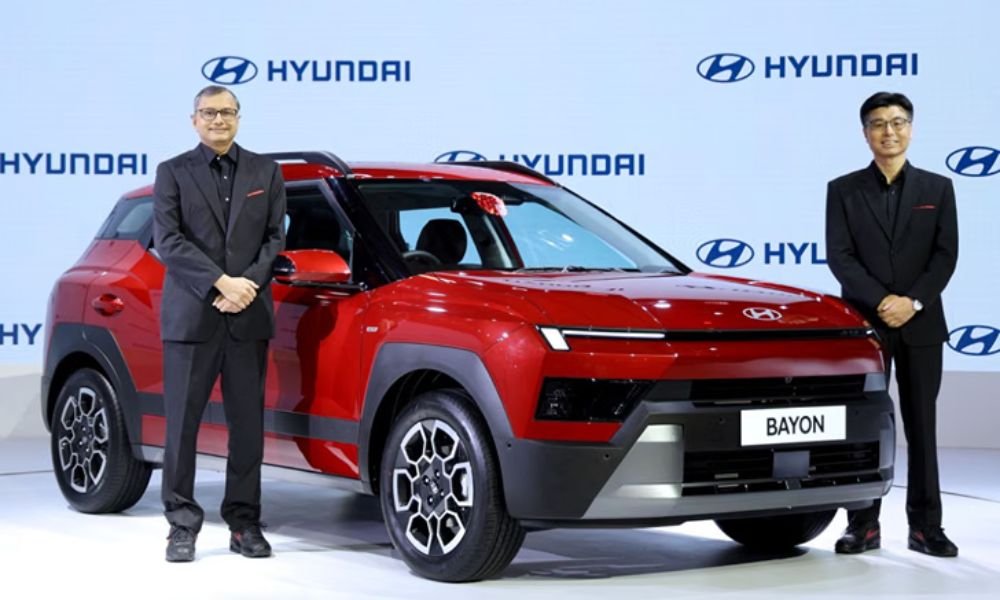
The Hyundai Bayon is a compact SUV designed for buyers who want the practicality of a raised driving position in a relatively small footprint. However, the reported headline that the Hyundai Bayon has launched at Rs 10 lakh in India needs verification before it can be published as a confirmed launch story. A reported price alone does not establish an official Indian launch, variant lineup or showroom availability.
Key Highlights
-
Starting price: Rs 9.99 lakh, ex-showroom, at launch.
-
Engine: 1.5-litre naturally aspirated petrol, producing 115 PS and 143.8 Nm.
-
Gearbox options: Six-speed manual and Intelligent Variable Transmission (iVT).
-
Technology: Dual 12.3-inch displays, a generative AI voice assistant and connected-car functions.
-
Safety: Six airbags as standard, with Level 2 Pro ADAS available as part of the equipment package.
-
Practicality: 505-litre boot, 205 mm ground clearance and a 2,600 mm wheelbase.
Hyundai Bayon Price in India and Variants
Hyundai Motor India launched the Bayon on October 26, 2026, at an introductory starting price of Rs 9,99,900 (approximately Rs 10 lakh), ex-showroom. The model expands Hyundai’s SUV portfolio alongside the Venue and Creta, targeting buyers looking for a larger vehicle with a technology-focused cabin.
The announced lineup includes seven variant names: HX2, HX3, HX3+, HX5, HX6, HX8 and HX10. The six-speed manual gearbox is offered across the range, while the iVT automatic is available with selected higher variants.
A complete variant-wise price list has not been established here, so buyers should confirm the price of their preferred configuration with a Hyundai dealership. The introductory price should also not be confused with the on-road cost, which includes applicable road tax, registration, insurance and other charges.
On-road prices will vary by city and selected variant. Buyers in Delhi, Mumbai, Bengaluru and other cities should request a written quotation before booking.
Bookings are open through Hyundai dealerships and the manufacturer’s website, with a booking amount of Rs 11,000. Deliveries are scheduled to begin during the festive season, with individual delivery timelines depending on the dealership and variant.
Hyundai Bayon Engine and Performance
The India-spec Hyundai Bayon uses a four-cylinder, 1.5-litre MPi naturally aspirated petrol engine. It develops 115 PS at 6,300 rpm and 143.8 Nm of torque at 4,500 rpm.
Buyers can choose between a six-speed manual transmission and Hyundai’s Intelligent Variable Transmission. The automatic option is aimed at drivers who regularly encounter stop-and-go traffic.
The iVT version receives additional driving technologies, including Dash Boost Mode, Sporty Drive Tech and paddle shifters. Eco, Normal and Sport driving modes allow the driver to adjust the car’s response to different conditions.
| Specification | Hyundai Bayon |
|---|---|
| Engine | 1.5-litre MPi petrol |
| Cylinders | Four |
| Maximum power | 115 PS |
| Maximum torque | 143.8 Nm |
| Manual gearbox | Six-speed |
| Automatic gearbox | Intelligent Variable Transmission |
| Drive layout | Front-wheel drive |
| Fuel tank | 43 litres |
An official fuel-efficiency figure has not been confirmed in the information available for this article. Buyers should avoid treating unverified mileage claims as official figures and assess real-world consumption after deliveries begin.
Hyundai Bayon Features and Interior
The Bayon’s cabin puts considerable emphasis on digital technology. Its headline feature is a pair of 12.3-inch curved panoramic displays, combining the instrument cluster and infotainment functions.
Hyundai has also introduced a generative AI voice assistant featuring Perplexity intelligence and SoundHound AI voice technology. The system is designed to support natural-language interactions for information and everyday travel-related requests.
Other announced technology and convenience features include:
-
Hyundai Bluelink with more than 70 connected features.
-
Wireless Android Auto and Apple CarPlay.
-
Over-the-air updates for supported vehicle controllers.
-
Bose premium audio system.
-
Wireless smartphone charging.
-
Automatic climate control and rear AC vents.
-
Front ventilated seats and an electrically adjustable driver seat.
-
Panoramic sunroof.
-
Smart key with push-button start.
-
Paddle shifters on applicable automatic variants.
Equipment availability will depend on the variant. Buyers should check whether features such as the panoramic sunroof, premium audio and powered driver’s seat are included in the specific version they intend to purchase.
Dimensions, Ground Clearance and Boot Space
The Hyundai Bayon measures 4,245 mm in length, 1,810 mm in width and 1,605 mm in height, including roof rails. Its wheelbase measures 2,600 mm, while ground clearance is rated at 205 mm.
The 505-litre boot is a notable practical advantage for families carrying luggage, shopping or weekend travel bags. The rear seats split in a 60:40 configuration, allowing owners to balance passenger seating and additional cargo space.
The SUV also has a stated turning radius of 5.16 metres, which should help when negotiating tighter urban streets and parking areas. However, buyers should test the vehicle in person to judge rear-seat comfort, visibility and ease of parking.
Hyundai Bayon Safety Features
Safety is a major part of the Bayon’s equipment package. Hyundai says the model is engineered for five-star Indian safety standards and uses a body structure incorporating 69% advanced multi-grade high-strength steel.
The company has announced more than 80 safety features, including six airbags as standard across variants, Electronic Stability Control, Hill-start Assist Control and a high-line Tyre Pressure Monitoring System.
Higher-specification equipment includes Hyundai SmartSense Level 2 Pro ADAS with 23 driver-assistance features. Depending on the configuration, the package includes Highway Driving Assist, navigation-based cruise-control functions, a Surround View Monitor and a Blind-spot View Monitor.
These systems can assist with driving and parking, but the driver remains responsible for controlling the vehicle. Hyundai’s engineering target should not be mistaken for an independently awarded crash-test rating. An official Bharat NCAP result should be checked separately when available.
Hyundai Bayon vs Rivals
The Bayon enters a competitive Indian SUV market where buyers can choose from established compact and mid-size SUVs. Its appeal will depend on how its equipment, cabin space and automatic transmission compare with similarly priced alternatives.
| Model | Key selling point | What buyers should consider |
|---|---|---|
| Hyundai Bayon | Dual-screen cabin, AI assistant, ADAS | Variant pricing and real-world mileage |
| Hyundai Creta | Established family-SUV appeal | Entry variants versus Bayon’s equipment |
| Maruti Suzuki Victoris | Multiple powertrain options, including hybrid technology | Powertrain choice and running costs |
| Kia Seltos | Feature-rich cabin and multiple engine options | Price and equipment at comparable trims |
| Hyundai Venue | Smaller footprint for urban use | Rear-seat space and overall size |
The Bayon’s 4,245 mm length and 505-litre boot give it useful family-car credentials. However, its actual value will depend on the prices of higher variants, particularly those with the automatic gearbox and advanced driver-assistance systems.
Buyers comparing the Bayon with the Creta should also check the equipment offered at similar prices. A lower starting price does not automatically make one model the better purchase if essential features are restricted to more expensive variants.
Hyundai Bayon: Pros and Cons
Pros
-
115 PS petrol engine with manual and automatic transmission choices.
-
Large dual-screen digital cockpit and generative AI voice assistant.
-
Six airbags as standard, according to Hyundai.
-
505-litre boot and 205 mm ground clearance.
-
Level 2 Pro ADAS and a surround-view camera system on applicable variants.
Cons
-
Full variant-wise pricing needs to be checked before choosing a trim.
-
Official fuel-efficiency figures need confirmation.
-
Advanced features may be limited to higher variants.
-
An independently awarded Bharat NCAP crash-test rating should not be assumed.
Should You Buy the Hyundai Bayon?
The Hyundai Bayon deserves consideration from buyers seeking a petrol-powered family SUV with modern connectivity, substantial boot space and a choice of manual or automatic transmission. Its introductory price of Rs 9.99 lakh makes the entry-level model worth investigating, but the value equation will depend on the final price of the variant that offers the features you actually need.
For city driving, the iVT automatic is likely to be the more convenient choice. Buyers who prefer greater control over gear selection may find the manual version more appealing. Families should inspect the rear seat and luggage compartment before making a decision.
Before booking, obtain a complete on-road quotation, confirm the equipment included in the selected variant and ask the dealership about delivery timing, warranty coverage and scheduled servicing costs. Buyers who prioritise fuel economy should wait for reliable consumption data, while safety-conscious customers should look for independently published crash-test results.
Frequently Asked Questions
1. What is the Hyundai Bayon price in India?
The Hyundai Bayon was launched at an introductory starting price of Rs 9,99,900, approximately Rs 10 lakh, ex-showroom. The on-road price varies by location, variant and insurance selection.
2. Which engine does the Hyundai Bayon use?
The India-spec Bayon uses a 1.5-litre, four-cylinder naturally aspirated petrol engine producing 115 PS and 143.8 Nm of torque.
3. Is the Hyundai Bayon available with an automatic gearbox?
Yes. Selected variants are offered with Hyundai’s Intelligent Variable Transmission (iVT), alongside the six-speed manual option.
4. What is the mileage of the Hyundai Bayon?
A verified official fuel-efficiency figure has not been established here. Actual mileage will depend on traffic, driving style, road conditions and transmission choice.
5. What are the key features of the Hyundai Bayon?
Highlights include dual 12.3-inch displays, a generative AI voice assistant, wireless smartphone connectivity, Bluelink connected services, a panoramic sunroof and a Bose audio system on applicable variants.
6. Is the Hyundai Bayon a safe SUV?
Hyundai has announced six airbags as standard, electronic stability control and Level 2 Pro ADAS on applicable variants. An independently awarded Bharat NCAP safety rating should be verified separately.
7. How much boot space does the Hyundai Bayon offer?
The Hyundai Bayon offers 505 litres of boot space, along with 60:40 split-folding rear seats.
8. When do Hyundai Bayon deliveries begin?
Hyundai has scheduled deliveries to begin during the festive season. Buyers should confirm the expected delivery date with their local dealership.
9. How much does it cost to book the Hyundai Bayon?
The announced booking amount is Rs 11,000 through Hyundai dealerships or its official online booking channel.
Conclusion
The Hyundai Bayon brings a 115 PS petrol engine, a large digital cockpit, advanced connectivity and useful luggage capacity to the Indian SUV market. Its introductory price of Rs 9.99 lakh makes it an interesting alternative for buyers considering the lower end of the mid-size SUV segment.
The best buying decision will depend on variant-wise pricing, real-world fuel economy and the availability of key safety and comfort features. Buyers should compare the Bayon’s on-road price with equivalent versions of the Creta, Victoris and Seltos before committing to a purchase.
Read More: