


What Global NCAP Actually Tested
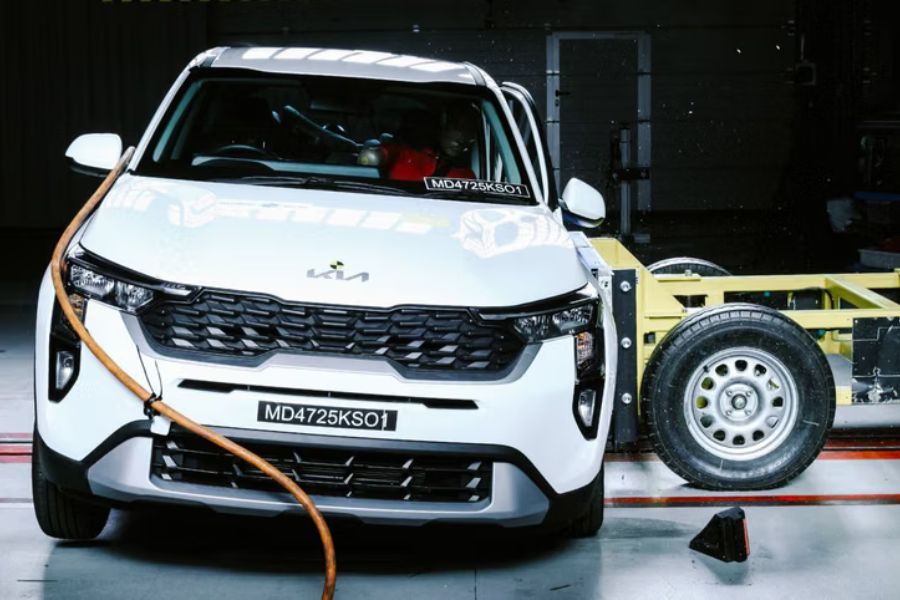
This marks the first time any NCAP organisation has put the Kia Sonet through a formal crash test programme. The unit tested by Global NCAP was a Kia Sonet produced at Kia’s India plant and bound for South Africa — a market where the entry-level configuration includes only dual front airbags and no ESC fitted as standard.
The testing agency assessed the car across two primary dimensions: how well it protects adult occupants in a crash, and how effectively it accommodates child restraint systems.
Adult Occupant Protection: The Weak Points
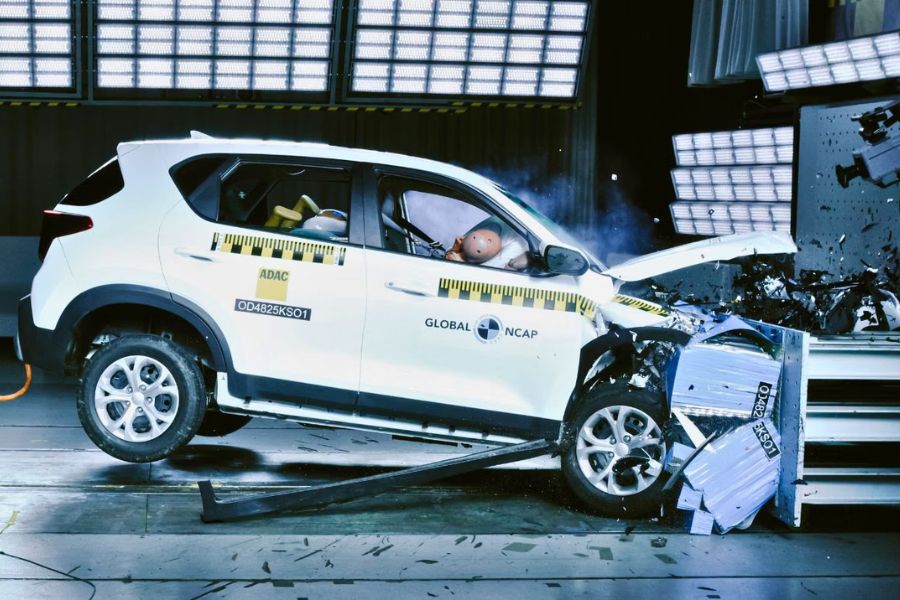
In the frontal offset deformable barrier test, the Sonet returned a score of 9 out of 16 points. Head and neck protection for both front-seat occupants was rated satisfactory, as was chest protection for the front passenger and left lower leg protection for the driver. However, the results became concerning in other areas.
| Body Region | Occupant | Rating |
|---|---|---|
| Head & Neck | Driver & Co-driver | Good |
| Chest | Co-driver | Good |
| Chest | Driver | Adequate |
| Tibia (Left) | Driver | Good |
| Tibia (Right) | Driver | Adequate |
| Both Tibia | Co-driver | Adequate |
| Knees | Both front occupants | Marginal |
| Feet | Driver | Poor |
| Head & Pelvis (Side) | Driver | Good |
| Abdomen (Side) | Driver | Adequate |
| Chest (Side) | Driver | Poor |
Knee protection was flagged as marginal because both occupants’ knees risk contact with structural components behind the dashboard fascia. Driver foot protection was rated poor. The side pole impact test — a standard component in NCAP assessments — could not be conducted at all, as the tested unit lacked curtain airbags entirely.
Global NCAP additionally noted structural concerns: both the footwell area and the bodyshell showed signs of instability during testing, and the agency concluded the bodyshell would not withstand additional loading beyond what was applied. The seat belt reminder system met NCAP standards only on the driver’s seat.
Child Occupant Protection: A More Encouraging Picture
The Sonet performed significantly better in the child occupant protection category, though it still fell short of a top-tier score due to provisions-related deductions rather than crash dynamics.
Child safety seats representing an 18-month-old and a 3-year-old child were mounted rearward-facing using ISOFIX anchorages with a support leg. Both dummies scored the maximum possible in frontal and side impact scenarios — a clean 12 out of 12 in dynamic testing.
Points were lost on the vehicle assessment side. The rear centre seating position uses a lap-only belt rather than a three-point unit, which restricts safe CRS installation there. The car also provides no mechanism to deactivate the front passenger airbag — a feature needed when a rearward-facing child seat is placed in that position.
Key Structural Note
Despite a perfect dynamic score in child protection testing, the Sonet lost over 20 points across CRS installation assessment and vehicle-level provisions — dragging an otherwise strong result down to 3 stars.
How the Sonet’s Rivals Compare on Safety
The Kia Sonet competes in one of India’s most crowded segments. Among its key rivals, safety certification results vary significantly.
| Model | Test Agency | AOP Stars |
|---|---|---|
| Tata Nexon | Global NCAP | ⭐⭐⭐⭐⭐ 5 Stars |
| Nissan Magnite | Global NCAP | ⭐⭐⭐⭐⭐ 5 Stars |
| Kia Syros | Bharat NCAP | ⭐⭐⭐⭐⭐ 5 Stars |
| Hyundai Venue | Bharat NCAP | ⭐⭐⭐⭐⭐ 5 Stars |
| Skoda Kylaq | Bharat NCAP | ⭐⭐⭐⭐⭐ 5 Stars |
| Mahindra XUV 3XO | Bharat NCAP | ⭐⭐⭐⭐⭐ 5 Stars |
| Kia Sonet (export spec) | Global NCAP | ⭐ 1 Star |
It is worth noting that Bharat NCAP and Global NCAP use different test protocols and standards, so direct star-for-star comparisons across agencies require caution. That said, the gap is stark on paper and will likely invite scrutiny — even if the India-spec Sonet is a different proposition from what was tested.
Should India-Spec Sonet Buyers Be Concerned?
Based on available information, the 1-star rating should not be applied to the Kia Sonet as sold in India. The vehicle that entered the test bay was configured to an export specification that omits safety equipment — six airbags and ESC — that Kia supplies as standard across the Indian lineup. These features meaningfully change crash outcomes, and it would be misleading to suggest otherwise.
That said, the structural findings — instability in the footwell and bodyshell — do raise questions that Kia may want to address publicly, since those characteristics are not airbag-dependent.
For buyers comparing within the segment, the India-spec Sonet has not yet been independently crash-tested by any NCAP body. Until Bharat NCAP or Global NCAP evaluates the India-market variant, its real-world structural safety remains officially unverified.
Frequently Asked Questions
Is the Kia Sonet sold in India safe?
The Global NCAP 1-star result applies to an export-spec Kia Sonet with 2 airbags and no ESC — not the India-market model, which carries 6 airbags and ESC as standard on all trims. The India-spec Sonet has not yet been officially crash-tested by any NCAP body.
Why was the side pole test not conducted?
The tested variant did not have curtain airbags. Global NCAP’s protocol requires curtain airbags to be present before the side pole impact test can be carried out, so that element of the assessment was skipped entirely.
Does the India-spec Kia Sonet come with ESC?
Yes. Electronic Stability Control is offered as standard across all Kia Sonet variants sold in India — unlike the South Africa-bound export unit used in this test.
Which compact SUVs have the highest NCAP safety ratings in India?
The Tata Nexon and Nissan Magnite both carry 5-star Global NCAP ratings. The Kia Syros, Hyundai Venue, Skoda Kylaq, and Mahindra XUV 3XO have all earned 5-star ratings under Bharat NCAP’s programme.
Read More: