


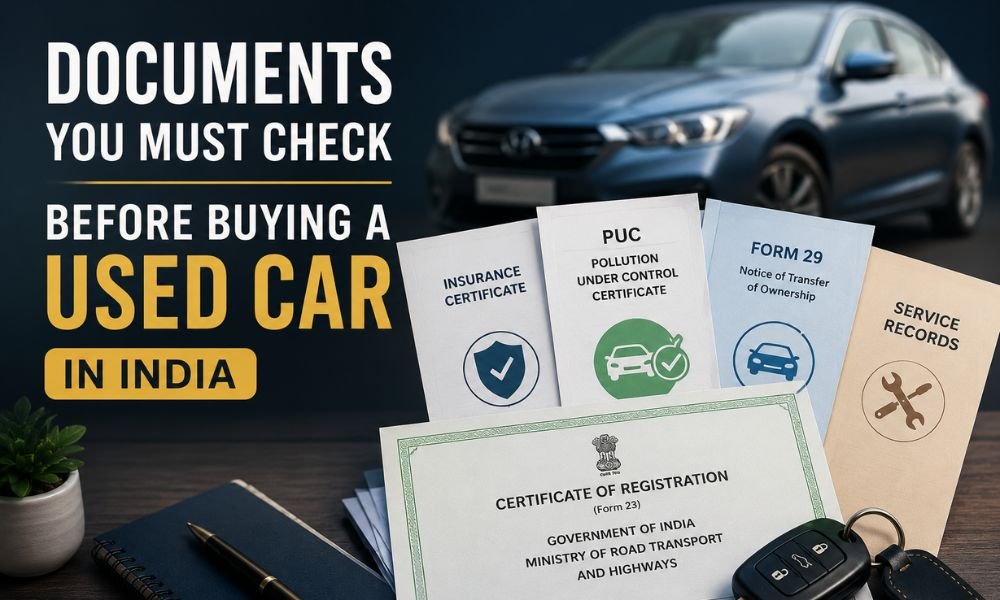
A used car can look like a great deal until a missing document, unpaid loan or ownership mismatch turns the purchase into a legal and financial headache. Before handing over even a token amount, buyers should verify the car’s Registration Certificate (RC), insurance, PUC certificate, ownership history, loan status, challans and transfer paperwork.
The paperwork also tells you things that a physical inspection cannot. A hypothecation entry can reveal an outstanding finance arrangement, while the RC can expose inconsistencies in the seller’s identity, engine number or chassis number. For an interstate purchase, additional documentation may be required.
Key Highlights
- Verify the original RC and match the registration, chassis and engine numbers with the car.
- Check active motor insurance and PUC before completing the transaction.
- Search the vehicle’s online records for pending challans, insurance and PUCC status.
- If the RC shows hypothecation, insist on the lender’s clearance and proper termination of the loan entry.
- Form 29 and Form 30 are central to the ownership-transfer process.
- Interstate purchases can require an RTO NOC and additional paperwork, so do not treat them like a same-state transfer.
1. Registration Certificate (RC)
The RC is the most important document to examine because it establishes the vehicle’s registered ownership and identifies the car officially.
Check the seller’s name against the name shown on the RC. Then match the following details with the vehicle:
- Registration number
- Chassis number
- Engine number or motor number
- Fuel type
- Colour
- Manufacturing and registration details
- Seating capacity, where applicable
Any mismatch should be investigated before you pay. Do not accept a seller’s assurance that the discrepancy can be corrected later.
You should also check the vehicle’s online record through the government’s vehicle-information services. The Parivahan system provides basic vehicle details and services related to registration and ownership transfer.
2. Insurance Certificate and Policy
A valid motor insurance policy is another essential document. Check the policy number, registration number, insured’s name, policy validity and type of coverage.
The policy can also provide useful clues about the car’s ownership history and previous claims, although the extent of claim information available to a buyer depends on the insurer and records provided.
Insurance must be transferred into the buyer’s name after the sale. IRDAI states that the insurance can be transferred to the purchaser, but the transfer needs to be recorded with the insurer. The seller’s No Claim Bonus does not transfer with the vehicle.
Do not continue driving indefinitely with insurance in the previous owner’s name. The registration and insurance details should be brought into alignment after purchase.
3. Pollution Under Control (PUC) Certificate
Check the car’s PUC certificate and its validity before buying.
A valid PUC confirms that the vehicle’s measured emissions comply with applicable limits at the time of testing. More importantly for a used-car buyer, an expired PUC can indicate that basic documentation has not been kept current.
The PUC is also relevant to insurance. IRDAI states that a valid PUC is required when renewing motor insurance.
For an electric car, the documentation requirements differ because battery-electric vehicles do not have tailpipe emissions.
4. Form 29 and Form 30
These are the key documents used for transferring ownership.
Form 29 is the notice of transfer of ownership, while Form 30 is the application/report for transfer of ownership. Both are official forms listed by Parivahan.
Do not simply exchange the keys, payment receipt and RC. Make sure the ownership-transfer application is actually initiated and processed.
Under the Motor Vehicles Act, the transferor has to report the transfer within 14 days for a vehicle registered within the same state, while the transferee has to report the transfer to the registering authority within 30 days. Different requirements apply to vehicles registered outside the state.
The current Parivahan process also supports online initiation, document uploads and payment for eligible transactions.
5. Check for Hypothecation or Outstanding Loan
This is one document check you should never skip.
Look at the RC for a hypothecation entry, which indicates that the vehicle has been financed. If the seller claims the loan has already been repaid, ask for the lender’s clearance documents and ensure the hypothecation has been properly terminated in the registration records.
Do not buy a financed car simply because the seller promises to clear the loan later. The transfer process can involve the financier, and Parivahan separately provides a hypothecation-termination service.
For a clean transaction, confirm that the lender’s interest has been removed before, or as part of, the ownership transfer.
6. Check Pending Challans and Vehicle Records
Before finalising the price, check the registration number for pending traffic challans and available vehicle records.
The Parivahan vehicle-status system provides facilities to check insurance, PUCC and pending challans, making it a useful pre-purchase verification step.
Do not assume that an unpaid challan automatically disappears when the vehicle changes hands. Clarify and settle outstanding liabilities with the seller before completing the transaction, and keep documentary proof of the settlement.
7. Interstate Used Cars Need Extra Attention
An interstate used-car purchase can involve additional paperwork, including an RTO No Objection Certificate (NOC) and tax-related formalities.
Parivahan’s transfer guidelines specify additional documentation for vehicles registered outside the state, including the relevant NOC documentation.
This is also where buyers should be particularly careful about re-registration, applicable state taxes and the exact requirements of the destination RTO. Verify these costs before negotiating the final price.
Documents to Collect From the Seller
Before taking delivery, keep copies of the important paperwork, including:
| Document | What to verify |
|---|---|
| RC | Seller’s name, registration, chassis and engine/motor number |
| Insurance | Validity, policy details and transfer requirements |
| PUC | Validity and registration number |
| Form 29 | Correct transferor and vehicle details |
| Form 30 | Correct transferee and vehicle details |
| Loan clearance | Required if hypothecation is recorded |
| RTO NOC | Required for applicable interstate transfers |
| Service records | Maintenance history and major repairs |
| Purchase invoice | Useful supporting ownership documentation |
| Challan status | No unresolved liabilities before purchase |
Service invoices and the original purchase invoice are not substitutes for the RC, but they are extremely useful supporting documents. They can help establish the car’s maintenance history and make it easier to spot inconsistencies in the seller’s story.
Pros and Cons of Buying With Complete Documentation
Pros
- Clearer ownership history
- Easier RC transfer
- Lower risk of undisclosed finance or documentation problems
- Better evidence of maintenance and previous ownership
- Fewer surprises after payment
Cons
- Collecting and verifying every document takes time
- Interstate vehicles can involve additional paperwork and taxes
- Missing historical records can make a seemingly cheap car less attractive
FAQs
Which documents should I check before buying a used car in India?
At minimum, verify the RC, insurance, PUC, ownership details, pending challans and loan or hypothecation status. You should also complete the required ownership-transfer paperwork.
Is the original RC necessary when buying a used car?
You should verify the official registration record and obtain the appropriate RC documentation. Do not rely solely on a photocopy supplied by the seller.
What are Form 29 and Form 30?
Form 29 is the notice of transfer of ownership, while Form 30 is used for the ownership-transfer application/report.
Can I buy a used car that still has a bank loan?
It is possible, but the loan and financier’s interest must be dealt with properly. Do not complete the purchase on a verbal promise that the seller will clear the loan later.
How do I check pending challans on a used car?
Use the government’s available vehicle-status services and check the registration number for pending challans and other available vehicle information.
Does car insurance automatically transfer to the new owner?
The insurance needs to be transferred to the purchaser. IRDAI specifically advises that the transfer should be recorded with the insurer, and the insurance and registration should be in the same owner’s name.
What should I do if the RC and car’s chassis number do not match?
Stop the transaction until the discrepancy is explained and officially corrected. A mismatch between the physical vehicle and registration records is a serious warning sign.
Conclusion
The safest used-car purchase starts with paperwork, not a test drive. A clean RC, valid insurance and PUC, no unresolved finance, clear challan status and properly initiated ownership transfer give you a much stronger foundation for the purchase.
Before paying the balance, verify every important number against the car itself and the official records. If the seller is reluctant to provide documents or insists that paperwork can be sorted out after payment, walk away from the deal. A genuinely good used car should withstand a document check just as easily as it passes a mechanical inspection.
Read Also: