


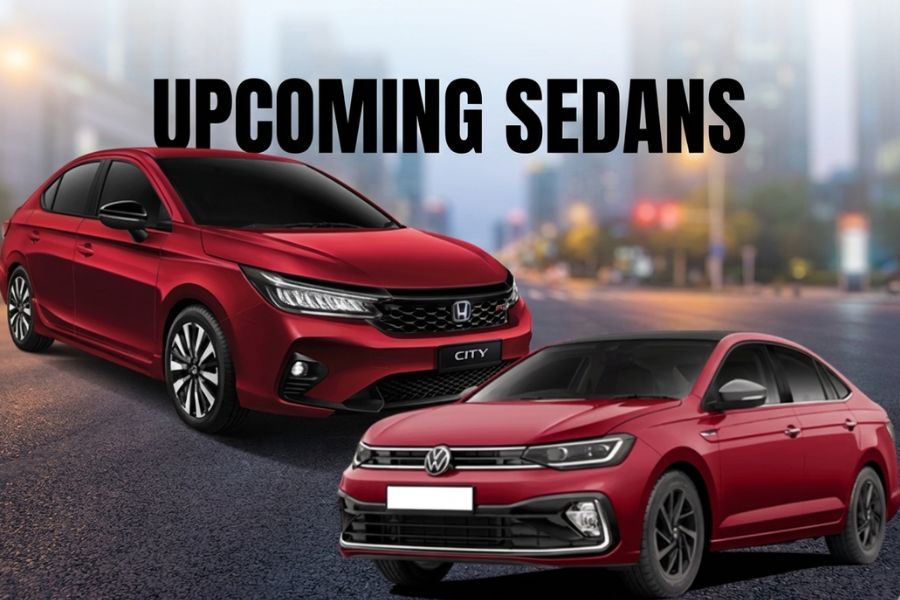
While SUVs and EVs will continue to dominate new car launches in India, 2026 will also be an important year for sedan enthusiasts. All four major midsize sedans currently on sale – Hyundai Verna, Honda City, Skoda Slavia and Volkswagen Virtus – are scheduled to receive facelifts, giving the segment a much-needed refresh.
These updates will focus on updated styling, new technology, improved safety features and, in some cases, hybrid powertrains. Here’s a detailed look at the sedans launching in India in 2026 and what each facelift is expected to bring.
Hyundai Verna Facelift (2026)
Expected launch: Q2 2026
Estimated price: ₹11 lakh – ₹18 lakh
Engine options: 1.5L petrol, 1.5L turbo-petrol
The fourth-generation Hyundai Verna is set for its first major update in the first half of 2026. On the outside, the facelifted model is likely to draw design inspiration from Hyundai’s global sedans like the Sonata, with revised lighting signatures, refreshed bumpers and newly designed alloy wheels.
Inside the cabin, Hyundai is expected to upgrade the Verna with a dual 12.3-inch screen layout similar to the Venue and Creta, along with a redesigned steering wheel and new interior colour themes. Feature additions could further strengthen its appeal as one of the most tech-loaded sedans in the segment.
Mechanically, the Verna facelift will continue with the familiar 1.5-litre naturally aspirated petrol (115hp) and 1.5-litre turbo-petrol (160hp) engines. Transmission choices will remain unchanged, including manual, CVT and DCT options. Hyundai may also introduce a petrol-hybrid variant at a later stage, aligning with its broader hybrid strategy for India.
Honda City Facelift (2026)
Expected launch: H2 2026
Estimated price: ₹12 lakh – ₹20 lakh
Engine options: 1.5L petrol, 1.5L petrol-hybrid
Honda plans to roll out a second facelift for the fifth-generation City in the latter half of 2026. This update will largely focus on subtle cosmetic changes, with the exterior expected to take cues from newer global Honda models such as the Civic.
The interior layout is likely to remain familiar, though Honda could introduce new upholstery options and trim finishes. Feature additions may be limited, but a 360-degree camera system could be added to keep the City competitive.
Under the hood, the City will retain its existing powertrains: the 1.5-litre petrol engine producing 121hp, paired with a manual or CVT, and the City e:HEV strong-hybrid, which delivers excellent fuel efficiency via an e-CVT setup. This facelift is expected to be the final update before an all-new City arrives around 2028.
Skoda Slavia Facelift (2026)
Expected launch: Q4 2026
Estimated price: ₹10 lakh – ₹18 lakh
Engine options: 1.0L turbo-petrol, 1.5L turbo-petrol
The Skoda Slavia facelift has already been spotted testing in India, indicating a launch towards the end of 2026. Visual updates will be subtle, with changes expected to the headlights, tail-lights, grille design, bumpers and alloy wheels.
Inside, Skoda is likely to refresh the cabin with new colour schemes, updated materials and improved displays for both the digital instrument cluster and infotainment system. A key upgrade could be the addition of Level 2 ADAS, along with a 360-degree camera, significantly improving safety credentials.
Engine options will remain unchanged, with the 1.0-litre (115hp) and 1.5-litre (150hp) turbo-petrol units continuing. However, the current 6-speed automatic paired with the smaller engine is expected to be replaced by a new 8-speed torque-converter, while the 1.5-litre retains its 7-speed DSG.
Volkswagen Virtus Facelift (2026)
Expected launch: Q4 2026
Estimated price: ₹12 lakh – ₹18 lakh
Engine options: 1.0L turbo-petrol, 1.5L turbo-petrol
Volkswagen will update the Virtus alongside the Slavia, with both sedans sharing most of their mechanical and feature upgrades. The Virtus facelift will receive minor exterior revisions, including refreshed bumpers, lighting elements and new alloy wheel designs to keep it visually distinct.
On the inside, the Virtus is expected to mirror the Slavia’s enhancements, including ADAS technology, updated infotainment software and improved cabin features. Powertrain options will continue unchanged, but like the Slavia, the 1.0-litre automatic is likely to switch to an 8-speed torque-converter gearbox, improving drivability.
2026: A Turning Point for Sedans in India?
With four major midsize sedan facelifts launching in 2026, buyers will have more refined, safer and better-equipped options than ever before. While SUVs remain the dominant choice, these updates show that manufacturers are still committed to keeping sedans relevant through design refreshes, hybrid tech and advanced safety features.
For enthusiasts who prefer low-slung comfort, sharp handling and strong highway performance, 2026 could be one of the best years yet for buying a sedan in India.
Read More: