


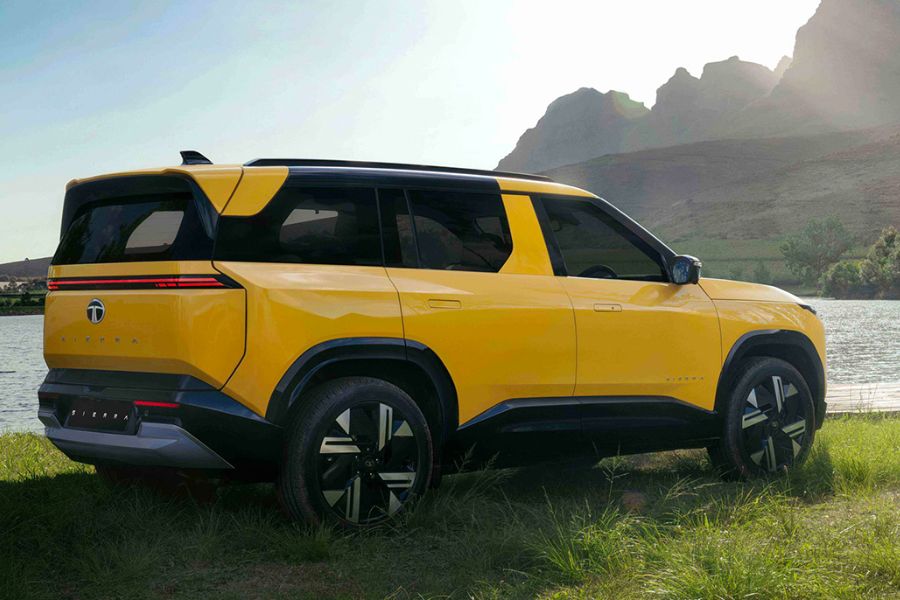
Tata Motors is gearing up to add yet another landmark model to its ever-growing electric vehicle lineup. The Tata Sierra EV is officially confirmed for launch in Q1 FY2027, which falls between April and June 2026 — widely referred to in the automotive press as Q2 of calendar year 2026. This makes the Sierra EV one of the most eagerly awaited electric SUVs in India, carrying not just the legacy of an iconic nameplate but also Tata’s most advanced EV technology.
Whether you are a nostalgic fan of the original 1991 Sierra or simply an EV enthusiast hunting for the best midsize electric SUV, this comprehensive guide covers every detail you need to know about the upcoming Tata Sierra EV.
Quick Summary: Tata Sierra EV at a Glance
| Feature | Details |
|---|---|
| Expected Launch | April–June 2026 (Q1 FY2027) |
| Expected Price | ₹20 lakh – ₹25 lakh (ex-showroom) |
| Platform | Acti.ev+ (Gen 2, dedicated EV architecture) |
| Battery Options | 55 kWh (base) / 65 kWh (top) |
| Expected Range | Up to 450–500 km (real-world) |
| Drivetrain | RWD (standard) / AWD (top variants) |
| Seating | 5 seats |
| Key Rivals | Mahindra BE 6, Hyundai Creta Electric, Maruti e Vitara, MG ZS EV |
Launch Timeline: When Is the Tata Sierra EV Coming?
Tata Motors has confirmed the Sierra EV will enter Indian showrooms during Q1 FY2027, i.e., April to June 2026. This timeline was revealed during the company’s quarterly earnings call and validated by multiple industry sources as of February 25, 2026.
Earlier speculation had pointed to a Q1 2026 (January–March) launch, but the automaker is believed to have pushed the date slightly to ensure final validation and series production readiness. The ICE-powered Sierra, launched on November 25, 2025, has already notched over 1 lakh bookings and commands a 6–7 month waiting period — a strong tailwind for the electric version.
The Sierra EV will become Tata’s seventh electric passenger vehicle in India, cementing the brand’s position as the country’s most prolific mainstream EV manufacturer.
Design: A Bold Electric Identity
The Tata Sierra EV retains the iconic boxy silhouette and upright stance of its ICE sibling but gets a distinct set of EV-specific visual cues that make it stand out on the road.
Exterior Highlights
The front end features a fully sealed-off fascia finished in body colour — a clear departure from the grille-equipped ICE model. A slim LED light bar spans the full width of the nose, flanked by split headlamp clusters with integrated DRLs. The bonnet is notably high-set, giving the SUV a commanding road presence.
At the sides, you will notice aerodynamically optimised alloy wheels unique to the EV variant, along with flush-type door handles that further cut drag. The short overhangs and squared-off proportions are hallmarks of the Sierra’s retro-modern design philosophy.
The rear is defined by a full-width connected LED tail-light bar and the iconic wraparound alpine glass that made the original Sierra famous. This panoramic rear glass — one of the most distinctive design signatures on any Indian SUV — carries over beautifully into the electric era.
Platform and Engineering: Acti.ev+ Architecture
The Sierra EV is built on Tata’s Gen 2 Acti.ev+ skateboard platform — a dedicated born-EV architecture that also underpins the Curvv EV and the Harrier EV. Unlike older converted platforms, the Acti.ev+ is engineered ground-up for electric vehicles.
Key advantages of this architecture include:
- A completely flat floor, maximising cabin space
- Flexible battery placement for optimised weight distribution
- Support for both single-motor (RWD) and dual-motor (AWD) configurations
- Compatibility with multiple battery pack sizes
Tata is also likely to adopt an Integrated Drive Unit (IDU) — a compact module that consolidates the motor and its ancillaries — as seen on the Punch EV. This not only improves packaging efficiency but also helps in cost management, potentially allowing the Sierra EV to be priced competitively.
Battery and Range: How Far Will It Go?
Two battery pack options are expected at launch:
55 kWh Pack (Base Variants) This unit is shared with the Curvv EV and is expected to power the entry-level and mid-range trims of the Sierra EV. Real-world range is estimated at around 400–430 km under typical Indian driving conditions.
65 kWh Pack (Top Variants) The larger battery, already used in the Harrier EV, is expected on higher-spec Sierra EV trims. This pack is anticipated to deliver over 500 km of realistic range on a single charge — one of the strongest figures in its segment.
For charging, the Sierra EV is expected to support DC fast charging at rates similar to the Harrier EV (up to 150 kW), making long-distance travel far more practical.
Drivetrain: RWD and AWD Options
The Sierra EV will be offered in both Rear-Wheel Drive (RWD) and All-Wheel Drive (AWD) configurations. The AWD setup — using a dual-motor arrangement — will be reserved for the top-spec variants paired with the 65 kWh battery.
If confirmed, it will make the Sierra EV only the second Tata EV after the Harrier EV to offer AWD — a compelling proposition for performance-oriented buyers and those who frequently tackle challenging terrain.
Interior and Features: A Digital-First Cabin
The Sierra EV’s cabin is expected to closely mirror the well-received interior of the ICE Sierra but with a refreshed colour scheme and EV-specific elements.
Dashboard and Infotainment
Spy shots and design patents filed by Tata Motors reveal a triple-screen cockpit layout — comprising a digital instrument cluster, a central infotainment display, and a separate panel for climate or vehicle controls. A twin-display setup (10.25-inch instrument cluster + infotainment) is also possible for base variants, based on a 2025 design patent.
The steering wheel is expected to be the four-spoke unit with an illuminated Tata logo, already seen on the Harrier EV and the new Sierra ICE.
Key Features Expected
- Ventilated and powered front seats
- Panoramic sunroof
- 360-degree surround-view camera
- Wireless phone charging
- Connected car technology (over-the-air updates)
- Level 2+ ADAS (Automatic Emergency Braking, Lane Keep Assist, Adaptive Cruise Control, and more)
- Multiple drive modes (Eco, City, Sport)
Safety
Tata has built a strong reputation for safety, with multiple 5-star Bharat NCAP ratings across its lineup. The Sierra EV is expected to come with 6 airbags as standard, Electronic Stability Control (ESC), Hill Hold Assist, TPMS, and a comprehensive ADAS suite. Excellent crash test scores are anticipated.
Expected Price: How Much Will the Tata Sierra EV Cost?
The Tata Sierra EV is expected to be priced between ₹20 lakh and ₹25 lakh (ex-showroom), strategically positioning it between the Curvv EV (₹17.49–21.99 lakh) and the Harrier EV (₹21.49–29.48 lakh) in Tata’s own EV portfolio.
Tata may also offer a Battery-as-a-Service (BaaS) option, similar to the Punch EV, which would allow buyers to purchase the car without the battery pack at a significantly lower upfront cost and instead pay a per-kilometre charge for battery usage. This could bring the effective entry price well below ₹20 lakh, dramatically widening the Sierra EV’s potential buyer base.
Competition: Who Does the Tata Sierra EV Rival?
The midsize electric SUV segment in India is heating up rapidly. Here is how the Sierra EV stacks up against its key competitors as of February 2026:
| Model | Price Range (ex-showroom) | Key Strength |
|---|---|---|
| Hyundai Creta Electric | ₹18.02 – ₹24.70 lakh | All-rounder, trusted brand |
| Mahindra BE 6 | ₹18.90 – ₹27.65 lakh | Performance, design, long range |
| Maruti Suzuki e Vitara | ₹15.99 – ₹20.01 lakh | Affordability, Maruti service network |
| MG ZS EV | ₹18.98 – ₹25.00 lakh | Feature-rich, value proposition |
| Tata Curvv EV | ₹17.49 – ₹21.99 lakh | Tata’s own sibling (lower tier) |
The Sierra EV enters this space with a heritage brand name, a distinctly retro-modern design, and Tata’s proven EV track record. Its AWD option and expected 500 km range could give it a decisive edge over several rivals, especially in the premium midsize EV category.
Why the Sierra EV Matters for Tata and India’s EV Market
The Tata Sierra EV is not just another product launch. It is a statement of intent. As of early 2026, Tata Motors remains the dominant player in India’s passenger EV segment, with models like the Nexon EV and Punch EV having become household names.
However, competition is intensifying. Mahindra’s INGLO-based EVs (BE 6, XEV 9e) have received strong early sales responses, Hyundai’s Creta Electric has topped the midsize EV charts, and new entrants like the Maruti e Vitara and Toyota Urban Cruiser eBella are widening the field.
The Sierra EV allows Tata to:
- Defend its midsize EV turf against the Creta Electric and BE 6
- Leverage the massive booking momentum of the Sierra ICE (1 lakh+ orders)
- Introduce its most advanced Acti.ev+ platform and AWD technology to a price-sensitive but aspirational audience
- Expand its total EV portfolio to seven models — unmatched by any mainstream brand in India
Tata’s Broader EV Roadmap in 2026
The Sierra EV is part of a broader wave of electric launches from Tata Motors. Following the Punch EV facelift (launched February 20, 2026), the Sierra EV is expected to be the next major reveal. After that, Tata has the Avinya EV — its premium brand foray — and the Safari EV (expected flagship electric SUV) in the pipeline.
This aggressive rollout reflects the company’s commitment to its EV roadmap through 2027 and reinforces its position as India’s leading domestic EV manufacturer.
Frequently Asked Questions (FAQs)
Q: What is the confirmed launch date of the Tata Sierra EV? A: Tata Motors has confirmed the Sierra EV will launch in Q1 FY2027, which falls between April and June 2026.
Q: What is the expected price of the Tata Sierra EV? A: The Sierra EV is expected to be priced between ₹20 lakh and ₹25 lakh (ex-showroom). A Battery-as-a-Service option could lower the effective entry price further.
Q: What is the expected range of the Tata Sierra EV? A: The base 55 kWh variant is estimated to offer around 400–430 km of real-world range, while the top 65 kWh variant is expected to exceed 500 km.
Q: Will the Tata Sierra EV have AWD? A: Yes. The top-spec Sierra EV is expected to offer a dual-motor AWD setup, likely paired with the 65 kWh battery pack.
Q: Which platform is the Tata Sierra EV built on? A: It is built on Tata’s Gen 2 Acti.ev+ dedicated EV architecture — the same platform used by the Curvv EV and Harrier EV.
Q: Who are the main rivals of the Tata Sierra EV? A: Its primary competitors are the Hyundai Creta Electric, Mahindra BE 6, Maruti Suzuki e Vitara, and MG ZS EV.
Q: Will the Tata Sierra EV support fast charging? A: Yes. DC fast charging support is expected, in line with other Acti.ev platform vehicles like the Harrier EV.
Final Verdict
The Tata Sierra EV is shaping up to be one of the most significant electric vehicle launches in India in 2026. With an iconic nameplate, a purpose-built EV platform, competitive battery options, an expected AWD variant, and a price range that challenges established segment leaders, the Sierra EV has all the ingredients to make a strong impact.
If Tata executes the launch well — ensuring competitive pricing, a wide service network, and smooth production ramp-up — the Sierra EV could very well become the go-to choice for buyers looking to graduate from smaller EVs like the Nexon EV or take on the Mahindra BE 6 with a more mainstream, trusted brand.
Mark your calendars for April–June 2026. The electric Sierra is coming.
Read More: