


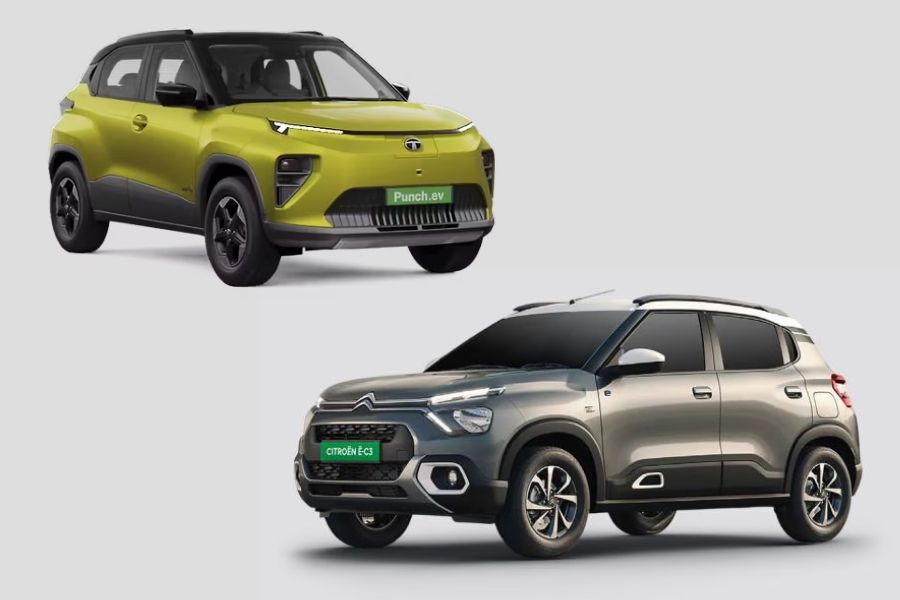
The budget electric car segment in India is heating up fast, and two names consistently top the shortlist for first-time EV buyers — the 2026 Tata Punch EV and the Citroen eC3. Both sit in a similar price bracket, target urban commuters, and promise affordable electric mobility. But they are very different cars in almost every other way.
This in-depth comparison covers prices, battery options, range, charging, features, safety, and who each car is really for — so you can make the right decision.
2026 Tata Punch EV: What’s New?
Tata Motors launched the Punch EV facelift on February 20, 2026, giving it a substantial refresh just over two years after its initial debut. The updated model brings revised styling front and rear (connected LED tail lamps, reworked front fascia with stacked headlamps), larger battery packs, a new BaaS (Battery-as-a-Service) pricing model, and additional feature upgrades including ventilated front seats and a dual 10.25-inch screen setup.
Price Comparison: Tata Punch EV vs Citroen eC3
This is where the two cars diverge most dramatically.
2026 Tata Punch EV Variant-Wise Price (Ex-Showroom, Introductory)
| Variant | Battery | Price |
|---|---|---|
| Smart | 30 kWh | ₹9.69 lakh |
| Smart+ | 30 kWh | ~₹10.49 lakh |
| Adventure | 30 / 40 kWh | ~₹11.19–11.99 lakh |
| Empowered | 40 kWh | ~₹12.09 lakh |
| Empowered+S | 40 kWh | ₹12.59 lakh |
Battery-as-a-Service (BaaS) pricing starts at just ₹6.49 lakh (ex-showroom), with battery usage charged at ₹2.6 per km — a game-changer for buyers with limited upfront budgets.
Citroen eC3 Variant-Wise Price (Ex-Showroom)
| Variant | Battery | Price |
|---|---|---|
| Feel | 29.2 kWh | ₹12.90 lakh |
| Shine | 29.2 kWh | ₹13.20 lakh |
| Shine Vibe Pack (DT) | 29.2 kWh | ₹13.53 lakh |
Key Takeaway: The Punch EV’s base variant is over ₹3 lakh cheaper than the cheapest eC3, and with BaaS, the gap widens further to over ₹6 lakh. On pricing alone, the Punch EV is a clear winner for budget-conscious buyers.
Battery, Range & Charging Comparison
This is where the two cars tell very different stories.
Tata Punch EV (2026 Facelift)
The new Punch EV is available with two battery options:
- 30 kWh battery: 88 hp / 154 Nm | ARAI range: 365 km | AC charging: 7.2 kW (4.5 hrs, 10–100%) | DC fast charge: 20–80% in 26 min | 110 km added in 15 minutes
- 40 kWh battery: 129 hp / 154 Nm | ARAI range: 468 km | AC charging: 7.2 kW (5.3 hrs, 10–100%) | DC fast charge: 20–80% in 26 min | 135 km added in 15 minutes
The 40 kWh variant also comes with a lifetime unlimited-kilometre battery warranty for the first owner — a segment-first assurance.
Citroen eC3
The eC3 offers a single powertrain configuration:
- 29.2 kWh battery: 57 hp / 143 Nm | ARAI range: 320 km | Real-world range (tested): ~219 km | AC charging: ~10.5 hrs (0–100%) | DC fast charging: supported (limited to 30 kW)
Key Takeaway: The Punch EV wins on every charging and range metric. Its larger batteries, faster AC and DC charging, and substantially higher ARAI-certified range make it the stronger performer. The eC3’s real-world range of around 219 km is notably lower than its claimed figure, which could be a concern for longer commutes.
Performance & Driving Experience
The Punch EV is the more engaging drive of the two. With the 40 kWh pack producing 129 hp, it can sprint from 0–100 km/h in under 9 seconds. Three drive modes (City, Eco, Sport) and four regenerative braking levels give drivers good control over the driving experience.
The Citroen eC3 produces just 57 hp, which is adequate for city driving but noticeably less spirited. Its ride quality, however, is a highlight — Citroen’s suspension tuning is comfortable and confident over rough roads. The eC3’s lighter weight also helps manoeuvrability in tight urban traffic. It’s a calm, comfortable car rather than a performance-focused one.
Dimensions Comparison
| Parameter | Tata Punch EV | Citroen eC3 |
|---|---|---|
| Length | 3,827 mm | 3,981 mm |
| Width | 1,742 mm | 1,733 mm |
| Height | 1,615 mm | 1,604 mm |
| Wheelbase | 2,445 mm | 2,540 mm |
| Boot Space | 366 litres | 315 litres |
| Ground Clearance | 190 mm | 170 mm |
The eC3 is longer with a longer wheelbase, meaning slightly more rear legroom. However, the Punch EV offers more boot space (366 vs 315 litres) and significantly better ground clearance (190 mm vs 170 mm), making it more suitable for Indian roads with their inconsistent surfaces.
Features Comparison
Tata Punch EV (Empowered+S, Top Variant)
- Dual 10.25-inch screens (instrument cluster + infotainment)
- Wireless Android Auto & Apple CarPlay
- Ventilated front seats
- 360-degree camera
- Blind spot monitor
- Auto-dimming IRVM
- Single-pane sunroof
- Cabin air purifier
- Cooled glove box
- Rain-sensing wipers
- LED fog lamps
- Connected car technology (Tata iRA)
- Front and rear USB Type-C charging ports
- TPMS
Citroen eC3 (Shine, Top Variant)
- 10.2-inch touchscreen infotainment
- Wireless Android Auto & Apple CarPlay
- 4 speakers
- Height-adjustable driver’s seat
- Steering-mounted controls
- 15-inch steel wheels with covers (alloys available on some packs)
Key Takeaway: The Punch EV is dramatically better equipped, particularly in top variants. The eC3’s feature list is quite basic by today’s standards — there’s no sunroof, no ventilated seats, no 360-degree camera, and no connected car technology.
Safety Comparison
This is arguably the most important differentiator between these two cars.
Tata Punch EV holds a 5-star Global NCAP safety rating (awarded to the ICE Punch, with the EV built on the same platform). It comes equipped with 6 airbags as standard, ABS with EBD, electronic stability control, hill hold control, and TPMS.
Citroen eC3 received a 0-star adult occupant protection rating from Global NCAP in March 2024, and just 1 star for child occupant protection. This is a critical concern for family buyers and safety-conscious consumers. The base variants come with only 2 airbags.
Key Takeaway: If safety is a priority — and it should be — the Punch EV has a decisive advantage. A 0-star NCAP rating on the eC3 is hard to overlook.
After-Sales Service & Network
Tata Motors has one of the largest dealership and service networks in India, making service, spare parts, and warranty support significantly more accessible — especially in Tier 2 and Tier 3 cities.
Citroen’s network in India remains limited, with fewer authorised dealerships and service centres. While the brand has been expanding, rural or semi-urban buyers may find this a practical constraint.
Who Should Buy What?
Buy the 2026 Tata Punch EV if:
- You want maximum range and fast charging capability
- Safety ratings matter to you (and they should)
- You want a feature-rich cabin with modern tech
- You have a tighter budget (BaaS option at ₹6.49 lakh is compelling)
- You travel regularly and need reliable after-sales support across India
Buy the Citroen eC3 if:
- You prefer a hatchback body style over a micro-SUV
- Your daily commute is short (under 60–70 km) and highway trips are rare
- You prioritise ride comfort above performance or features
- You want a distinct, European-flavoured design aesthetic
- A slightly longer cabin with more rear passenger space is important to you
Verdict: Tata Punch EV vs Citroen eC3
The 2026 Tata Punch EV wins this comparison comfortably. It offers more range, faster charging, a far richer feature set, superior safety, better ground clearance, more boot space, and crucially — it starts at a significantly lower price. The BaaS model makes EV ownership accessible to an even wider audience. The lifetime battery warranty on the 40 kWh variant is a genuine differentiator.
The Citroen eC3 is not a bad car — its ride quality is commendable and its design is charming. But at a price that’s ₹3+ lakh higher than the Punch EV’s base variant, with a lower real-world range, fewer features, slower charging, a limited service network, and a 0-star NCAP score, it’s hard to justify recommending it over the Tata unless you have a specific reason.
For most Indian buyers in 2026, the Tata Punch EV is the smarter, safer, and more capable choice.
Quick Specs Summary Table
| Feature | Tata Punch EV (40 kWh) | Citroen eC3 |
|---|---|---|
| Starting Price | ₹9.69 lakh | ₹12.90 lakh |
| Battery | 30 kWh / 40 kWh | 29.2 kWh |
| ARAI Range | 365 / 468 km | 320 km |
| Real-World Range | ~355 km (C75) | ~219 km |
| Motor Output | 88 hp / 129 hp | 57 hp |
| DC Fast Charging | 20–80% in 26 min | Supported (30 kW) |
| Boot Space | 366 litres | 315 litres |
| Ground Clearance | 190 mm | 170 mm |
| Airbags | 6 (standard) | 2 (base) |
| NCAP Rating | 5-star | 0-star |
| Sunroof | Yes (top variants) | No |
| Ventilated Seats | Yes (top variants) | No |
| 360° Camera | Yes (top variants) | No |
Read More: