


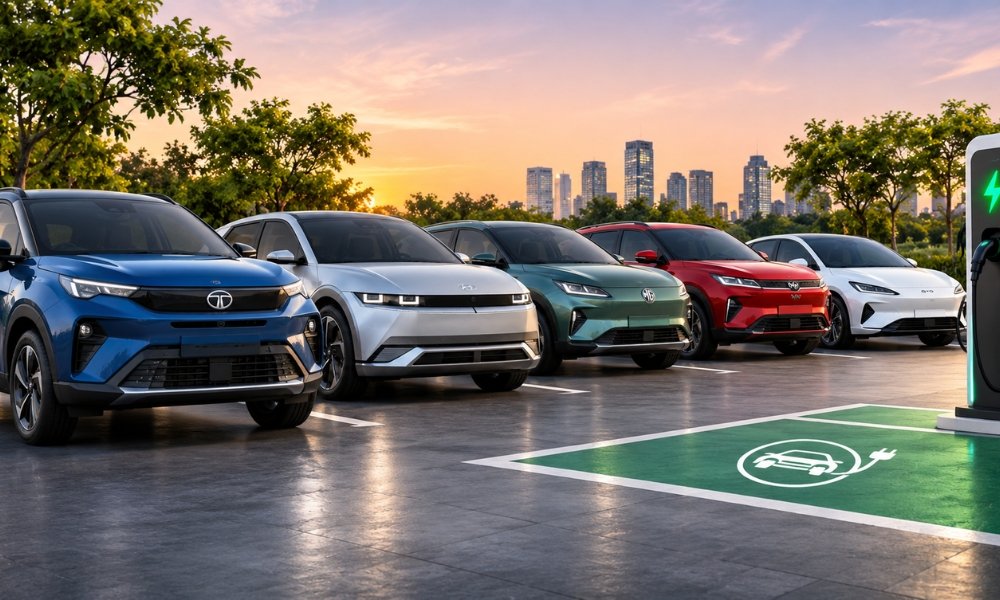
India’s electric passenger vehicle market recorded 36,911 retail sales in October 2026, remaining above the 30,000-unit mark for the fifth consecutive month. Sales increased 76% year-on-year (YoY), compared with 20,954 units in October 2025, according to Vahan registration data. Although October’s tally was 4% lower than September’s record 38,355 units, it was the second-highest monthly sales figure recorded in the Indian electric car market.
Tata Motors continued to lead the market, followed by Mahindra and JSW MG Motor. The strong performance of these manufacturers, along with rising contributions from VinFast, Kia and Maruti Suzuki, highlights the expanding choice of electric passenger vehicles available to Indian buyers.
Key Highlights
-
Total electric car sales in October 2026 stood at 36,911 units.
-
Sales increased 76% compared with October 2025.
-
Tata Motors led with 14,654 units and approximately 40% market share.
-
Mahindra secured second position with 8,541 units.
-
JSW MG Motor ranked third with 5,938 units.
-
January-October 2026 cumulative sales reached 2,93,877 units.
October 2026 Electric Car Sales: Brand-Wise Breakdown
Tata Motors maintained a comfortable lead over its competitors, accounting for around 40% of India’s electric passenger vehicle registrations. Mahindra strengthened its second position, while JSW MG Motor remained third despite recording slower year-on-year growth than its two larger rivals.
Here is the brand-wise breakdown of electric car sales in October 2026.
| Rank | Manufacturer | Sales | YoY Growth |
|---|---|---|---|
| 1 | Tata Motors | 14,654 | 78% |
| 2 | Mahindra | 8,541 | 86% |
| 3 | JSW MG Motor | 5,938 | 11% |
| 4 | VinFast | 2,570 | 1,710% |
| 5 | Kia | 1,395 | 85% |
| 6 | Maruti Suzuki | 1,199 | N/A |
| 7 | Hyundai | 759 | 42% |
| 8 | BYD | 737 | 4% |
| 9 | BMW | 462 | 27% |
| 10 | Tesla | 291 | 628% |
Source: Vahan retail registration data compiled by Autocar India. Figures are registrations, not manufacturer dispatches.
1. Tata Motors retains the top position with 14,654 units
Tata Motors continued to dominate India’s electric car market, registering 14,654 units in October 2026. This represented a 78% increase over 8,238 units in October 2025.
The manufacturer secured approximately 40% market share. Its October performance was also its second-highest monthly tally, following September’s 15,668 units.
The Nexon EV remained Tata’s biggest-selling electric vehicle. The updated Tiago EV and Punch EV also contributed to the company’s performance. Tata’s electric portfolio includes the Curvv EV and Harrier EV, alongside its other electric offerings.
For January-October 2026, Tata’s cumulative retail registrations reached 1,16,732 units, an 86% increase over the corresponding period last year.
2. Mahindra records its highest monthly EV sales
Mahindra secured second position with 8,541 electric SUV registrations in October, registering 86% YoY growth.
The company surpassed its previous monthly record of 8,200 units, recorded in September 2026. Its market share stood at approximately 23%.
Mahindra’s electric portfolio includes the BE 6, XEV 9e, XEV 9S and XUV 3XO EV. The company’s Battery-as-a-Service (BaaS) programme has also been extended to the XEV 9S and XEV 9e, offering buyers an alternative battery ownership arrangement.
Between January and October, Mahindra registered 67,023 electric vehicles, up 124% year-on-year.
3. JSW MG Motor remains in third position
JSW MG Motor recorded 5,938 electric vehicle sales in October 2026, representing an 11% increase over the 5,360 units sold during the same month last year.
The Windsor EV continued to be the manufacturer’s biggest-selling electric model. Its electric portfolio also includes the ZS EV, Comet EV, M9, Cyberster and recently introduced Hector Tomahawk EV.
Despite increasing its sales volume, MG’s market share declined from 26% in October 2025 to approximately 16% in October 2026. Its cumulative registrations for the first ten months reached 55,082 units.
4. VinFast records the highest growth
VinFast emerged as one of the biggest growth stories in October, registering 2,570 electric vehicles against just 142 units in October 2025.
This translated into 1,710% year-on-year growth, although the percentage was amplified by the relatively small sales base last year.
The Vietnamese manufacturer currently offers the VF6, VF7 and VF MPV 7 in India. Its October performance placed it fourth in the overall electric passenger vehicle sales rankings.
5. Kia crosses 1,000-unit mark again
Kia registered 1,395 electric vehicles in October, up 85% from 753 units in the year-ago period.
The Syros EV and Carens Clavis EV are important additions to its electric portfolio, while the EV6 and EV9 cater to the premium segment. Kia’s cumulative EV sales reached 7,029 units between January and October 2026, representing 223% growth.
Maruti Suzuki registered 1,199 e-Vitara SUVs, while Hyundai recorded 759 units. BYD followed closely with 737 registrations.
October 2026 Electric Car Sales: Five Key Market Trends
1. Five consecutive months above 30,000 units: India’s electric passenger vehicle market has maintained monthly sales above this threshold since June 2026. This indicates that demand has moved beyond occasional monthly spikes.
2. Tata and Mahindra strengthen their positions: The two manufacturers together accounted for approximately 63% of October’s total electric car registrations. Their expanding SUV and affordable EV portfolios have helped them maintain leadership.
3. Newer manufacturers are gaining attention: VinFast’s growth and Kia’s increasing registrations indicate that competition is expanding beyond established EV manufacturers.
4. Luxury EV demand is increasing: Luxury electric vehicle sales reached 868 units in October, up 53% from 566 units in October 2025. BMW led this segment with 462 registrations, followed by Tesla with 291 units.
5. Quarterly sales continue to improve: The third quarter of 2026 recorded 1,05,612 electric car registrations, compared with 88,036 units in Q2 and 63,318 units in Q1.
India’s Electric Car Sales in 2026: Month-Wise Performance
The monthly figures show that electric passenger vehicle registrations gained momentum throughout 2026. September recorded the highest monthly tally, followed by October.
| Month | EV Sales | YoY Growth |
|---|---|---|
| January | 21,563 | 62% |
| February | 16,294 | 55% |
| March | 25,461 | 77% |
| April | 25,982 | 76% |
| May | 28,415 | 93% |
| June | 33,639 | 120% |
| July | 34,709 | 94% |
| August | 32,568 | 61% |
| September | 38,335 | 107% |
| October | 36,911 | 76% |
India recorded 2,93,877 electric passenger vehicle registrations between January and October 2026, compared with 1,90,915 units during the corresponding period in 2025. This represents substantial growth in the segment.
What October’s EV Sales Mean for Indian Car Buyers
The latest sales figures point towards a wider selection of electric cars across different price categories. Buyers can now consider options ranging from the Tata Tiago EV and Punch EV to the Mahindra BE 6, MG Windsor EV, Maruti e-Vitara and Hyundai Creta Electric.
However, rising registrations alone should not determine a buying decision. Prospective EV owners should compare the manufacturer’s battery warranty, charging speed, certified driving range, availability of service centres and local charging infrastructure.
Battery-as-a-Service schemes can also reduce the initial purchase price, but buyers should calculate the recurring battery rental cost before choosing such an arrangement.
The October figures are retail registrations, which are different from wholesale dispatches. This distinction matters because dealer inventory and registration timing can create differences between the two sets of numbers.
Pros and Cons of India’s Growing Electric Car Market
Pros
-
More manufacturers are entering the electric passenger vehicle segment.
-
Buyers have a wider selection of electric SUVs, hatchbacks and MPVs.
-
Increased competition is encouraging manufacturers to introduce new ownership schemes.
-
Tata and Mahindra are expanding their electric vehicle portfolios.
Cons
-
Public charging infrastructure remains an important consideration for intercity travel.
-
Battery replacement can involve substantial long-term expenditure outside warranty coverage.
-
EV availability and service support differ between manufacturers and cities.
-
Some newer brands still need to establish wider after-sales networks.
Frequently Asked Questions
1. How many electric cars were sold in India in October 2026?
India recorded 36,911 electric passenger vehicle registrations in October 2026, according to Vahan data. This represented 76% growth compared with 20,954 registrations in October 2025.
2. Which company sold the most electric cars in October 2026?
Tata Motors led the Indian electric car market in October 2026 with 14,654 registrations. The manufacturer secured approximately 40% market share, followed by Mahindra with 8,541 units.
3. Which electric car manufacturer recorded the highest growth in October 2026?
VinFast recorded the highest year-on-year growth among the major manufacturers, with registrations increasing 1,710% to 2,570 units. The growth was partly due to its low sales base of 142 units in October 2025.
4. How many electric cars were sold in India between January and October 2026?
India recorded 2,93,877 electric passenger vehicle registrations during the first ten months of 2026. This was considerably higher than the 1,90,915 units registered during the same period in 2025.
5. Which was the second-largest electric car manufacturer in October 2026?
Mahindra secured second position with 8,541 electric SUV registrations. Its sales increased 86% compared with October 2025, and the company recorded its highest monthly electric SUV sales during the month.
6. Did electric car sales decline in October compared with September 2026?
Yes. October registrations declined approximately 4% from September’s 38,335 units to 36,911 units. However, October still recorded the second-highest monthly electric passenger vehicle sales figure in India.
Conclusion
India’s October 2026 electric car sales demonstrate that the market is maintaining strong momentum, with 36,911 registrations for the month. Tata Motors continues to control the largest share, while Mahindra is strengthening its position through its electric SUV range. Meanwhile, MG, VinFast and Kia are adding competition.
With cumulative registrations approaching the three-lakh mark in the first ten months, the Indian electric passenger vehicle market is on course for another strong annual performance. The next important indicator will be whether manufacturers can sustain monthly demand while expanding charging access and after-sales support.
Read More: