


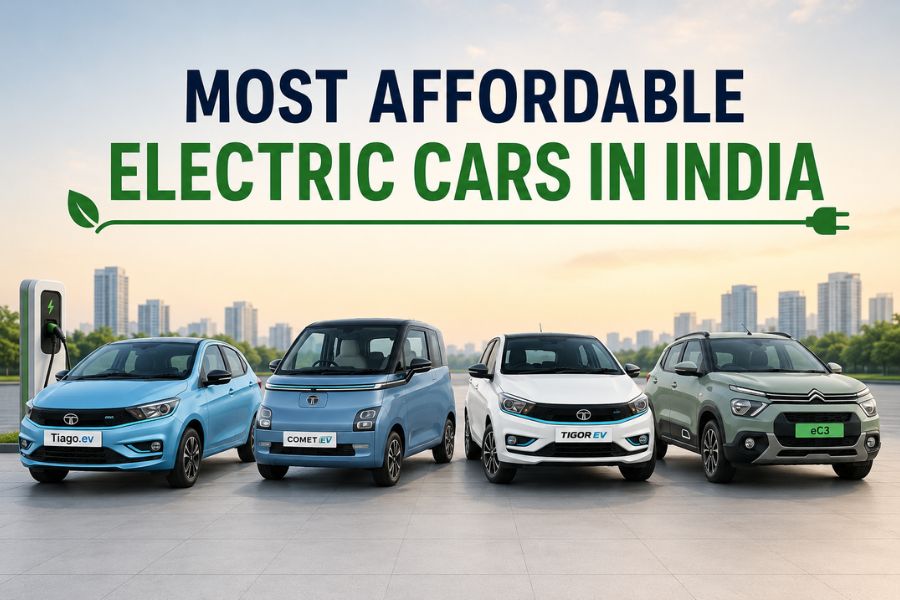
India’s budget EV segment has never looked this good. Just a few years ago, buying an electric car under ₹15 lakh felt like a compromise — you either got limited range, spartan features, or questionable build quality. That story has changed dramatically in 2026. Between a refreshed Tata Tiago EV that now starts below ₹7 lakh, a significantly upgraded Punch EV with class-leading range, and a few strong supporting acts, the sub-₹15 lakh EV space has genuinely come of age. If you’re an urban buyer with access to home or office charging, this guide will help you find the right electric car for your budget and lifestyle.
Key Highlights
- Tata Tiago EV now starts at just ₹6.99 lakh (or ₹4.69 lakh under the BaaS scheme), making it the most price-competitive electric car in the mainstream four-door segment
- The 2026 Punch EV facelift brings updated battery packs with improved range, and Tata has slashed prices by around ₹2.5–3 lakh compared to the previous model
- Battery-as-a-Service (BaaS) pricing is now available across Tata’s range, lowering upfront costs further
- The 2026 Tiago EV update brings six airbags as standard — up from two — along with a 360-degree camera and a completely new dashboard
- The 2026 Punch EV supports 65kW DC fast charging, adding a significant chunk of range in just 26 minutes
1. Tata Tiago EV — India’s Most Affordable Electric Car
Price: ₹6.99 lakh – ₹9.99 lakh (ex-showroom) | BaaS from ₹4.69 lakh
The Tiago EV has held the fort as India’s entry-level electric car since 2022, and the 2026 update has given it a meaningful generational leap. The refreshed model features a revamped fascia with sleek LED headlamps, fresh LED DRLs, a body-coloured closed grille, and connected LED tail-lamps — it genuinely looks like a car from this decade now.
Inside, the story gets even better. The new Tiago EV features a freestanding coloured instrument cluster, a new two-spoke steering wheel with offset Tata EV logo, a rotary gear selector, automatic climate control, and iRA connected-car technology across all variants. The big safety upgrade is equally noteworthy: six airbags now come as standard, replacing the dual-airbag setup from before, along with ESP with traction control, hill-hold assist, TPMS, and a 360-degree camera with blind-view monitor on higher trims.
The powertrain options remain the same — a 19.2kWh battery offering 226km of claimed MIDC range, and a 24kWh battery stretching that to 285km. The 24kWh pack now supports a higher charging speed of 30kW, up from 25kW previously. For most city buyers averaging 40–60km a day, even the smaller battery comfortably covers multiple days on a single charge.
For budget-conscious buyers considering EV ownership for the first time, the Tiago EV is the obvious starting point. Check out our [Tata Tiago EV vs MG Comet EV comparison on CarQuestIndia.com] to help you decide between India’s two most affordable electric cars.
Fact File
| Spec | 19.2kWh | 24kWh |
|---|---|---|
| Claimed Range (MIDC) | 226 km | 285 km |
| Power / Torque | 61hp / 110Nm | 75hp / 114Nm |
| Price | ₹6.99 lakh | ₹8.49–9.99 lakh |
2. MG Comet EV — The City Specialist
Price: ₹7.63 lakh – ₹10 lakh (ex-showroom)
The MG Comet EV exists in its own little category — there’s simply nothing else like it in the Indian market. This is a car designed almost exclusively for dense urban commuting, and in that role, it is remarkably effective. Its tiny footprint makes it effortlessly easy to squeeze into Mumbai or Bengaluru traffic, and finding a parking spot is rarely an issue.
The MG Comet is powered by a 17.3kWh battery offering 230km of MIDC-claimed range and produces 42hp and 110Nm of torque. The 2-door body style is unconventional by Indian standards, but the cabin manages to seat four adults in reasonable comfort for city trips.
The Comet’s charm lies not just in its practicality but also in its distinct personality. The quirky, boxy design and cheerful colour options make it a head-turner. On the downside, the 12-inch wheels struggle with rougher urban roads, and the limited battery capacity means it’s not the right tool for longer weekend drives.
If you’re a working professional commuting under 60km a day in a busy metro, the Comet EV deserves a serious look. It also makes strong sense as a second car for a household upgrading from a two-wheeler.
Fact File
| Spec | Value |
|---|---|
| Battery Size | 17.3kWh |
| Claimed Range (MIDC) | 230 km |
| Power / Torque | 42hp / 110Nm |
| Price | ₹7.63–10 lakh |
3. Tata Punch EV — The Sweet Spot of the Segment
Price: ₹9.69 lakh – ₹12.59 lakh (ex-showroom) | BaaS from ₹6.49 lakh
If you’re looking for the single most well-rounded budget electric car in India right now, the Punch EV is very hard to beat. The 2026 facelift brings updated battery packs with improved range figures, while Tata has simultaneously slashed prices by ₹2.5–3 lakh compared to the older model — meaning you get more car for less money. That’s a rare and welcome combination.
The Punch EV now offers a new 40kWh battery pack with 355km of C75-claimed range, ventilated front seats, a sunroof, and a 360-degree camera system. The entry-level 30kWh variants offer a MIDC-claimed range of 375km, while the DC fast charger can add 135km of range in just 15 minutes. For buyers stepping up from a conventional petrol SUV, this range and charging speed addresses the most common EV range-anxiety concerns.
The Punch EV features wireless Apple CarPlay and Android Auto, a 26.03cm touchscreen infotainment system by Harman, a 26.03cm digital instrument cluster, and iRA.ev with 60+ connected features including smartwatch connectivity. Six airbags, ESP, hill-hold assist, and ISOFIX come as standard. Tata Motors
The Punch EV competes with the [Citroen eC3 in terms of real-world usability — read our Punch EV vs eC3 comparison on CarQuestIndia.com] for a detailed breakdown.
Fact File
| Spec | 30kWh | 40kWh |
|---|---|---|
| Claimed Range (MIDC) | 375 km | 430 km (ARAI) |
| Power / Torque | 88hp / 154Nm | 129hp / 154Nm |
| Price | ₹9.69–10.99 lakh | ₹11.49–12.59 lakh |
4. Citroen eC3 — The Comfortable Underdog
Price: ₹11.99 lakh – ₹13.26 lakh (ex-showroom)
The Citroen eC3 rarely tops best-of lists, but it quietly delivers on the things that matter most to everyday Indian buyers — ride comfort, practical range, and real-world usability. Citroen’s legendary “Advanced Comfort” suspension tuning makes the eC3 feel noticeably more planted and cushioned over broken city roads than several rivals, which is a bigger deal in India than it sounds.
The 29.2kWh battery delivers a claimed MIDC range of 320km, with real-world numbers in the 200–230km range under mixed driving conditions — broadly comparable to the Punch EV at a similar price point. Power output is a modest 57hp and 143Nm, so performance is functional rather than exciting.
The eC3’s weaknesses are real: the feature list is sparse compared to Tata’s offerings, and the interior quality doesn’t quite justify the price in isolation. However, the eC3 frequently attracts strong dealer discounts, which can make it a significantly better-value proposition in practice. If you find a good deal, it’s worth taking seriously — especially for buyers who prioritise ride comfort and low running costs over feature count.
For first-time EV buyers comparing their options, our [complete buyer’s guide to electric cars under ₹15 lakh on CarQuestIndia.com] walks through ownership costs in detail.
Fact File
| Spec | Value |
|---|---|
| Battery Size | 29.2kWh |
| Claimed Range (MIDC) | 320 km |
| Power / Torque | 57hp / 143Nm |
| Price | ₹11.99–13.26 lakh |
5. Tata Tigor EV — The Sedan Option
Price: ₹12.49 lakh – ₹13.75 lakh (ex-showroom)
The Tigor EV has a specific, valid use case: it’s the only sedan on this list, and it solves the Tiago EV’s biggest practical limitation — a small boot. With a proper three-box body style, the Tigor EV adds meaningful luggage space, making it a more convincing family purchase for buyers who regularly load up the car for weekend trips or carry large bags for business travel.
Under the hood, the Tigor EV carries a 26kWh battery pack offering 315km of MIDC-claimed range and 75hp/170Nm — slightly higher torque output compared to the Tiago EV’s equivalent setup. The driving experience is refined, the ride is comfortable, and the cabin is well-specced for the price. Think of it as a Tiago EV with a longer body, a proper boot lid, and a touch more presence on the road.
The Tigor EV asks you to pay ₹2.5–3 lakh more than the top-spec Tiago EV Creative+ for that additional practicality. Whether that premium is justified depends entirely on whether you need the extra luggage capacity. For nuclear families and executives looking for a compact EV with sedan sensibility, it makes a compelling case.
Fact File
| Spec | Value |
|---|---|
| Battery Size | 26kWh |
| Claimed Range (MIDC) | 315 km |
| Power / Torque | 75hp / 170Nm |
| Price | ₹12.49–13.75 lakh |
Quick Comparison: All 5 Budget EVs at a Glance
| Car | Starting Price | Max Range (MIDC) | Body Style | Best For |
|---|---|---|---|---|
| Tata Tiago EV | ₹6.99 lakh | 285 km | Hatchback | First-time EV buyers |
| MG Comet EV | ₹7.63 lakh | 230 km | 2-door city car | Ultra-urban commuters |
| Tata Punch EV | ₹9.69 lakh | 430 km (ARAI) | Micro-SUV | Best all-rounder |
| Citroen eC3 | ₹11.99 lakh | 320 km | Hatchback | Comfort seekers |
| Tata Tigor EV | ₹12.49 lakh | 315 km | Sedan | Families needing boot space |
Pros and Cons
Tata Tiago EV
Pros: Lowest price, six airbags standard, comprehensive facelift, BaaS option
Cons: Modest real-world range, sedate performance, small boot
MG Comet EV
Pros: Extremely compact, great city manoeuvrability, quirky appeal
Cons: 2-door layout, smallest battery, poor ride on bad roads
Tata Punch EV
Pros: Best range in segment, fast charging, well-equipped, strong safety
Cons: Higher starting price, slightly bulkier urban footprint
Citroen eC3
Pros: Exceptional ride comfort, decent range, often well-discounted
Cons: Sparse features, dull performance, no DC fast charging
Tata Tigor EV
Pros: Proper boot, sedan body style, refined drive
Cons: Highest price among the five, hard to justify over Punch EV
Which One Should You Buy?
For most urban buyers, the Tata Punch EV is the standout recommendation in 2026. Its combination of improved range, fast charging, strong safety credentials, and now-reduced pricing makes it excellent value. The price cuts introduced with the facelift mean buyers get a car that was previously ₹15 lakh-territory technology for under ₹13 lakh.
If budget is the absolute priority, the Tata Tiago EV is a remarkable deal — the 2026 update has given it a genuinely impressive feature and safety upgrade while keeping the entry price at ₹6.99 lakh. First-time EV buyers in a metro city with home charging will find it hard to go wrong here.
The MG Comet EV earns its place for buyers who live and work within 60–70km daily and want something ultra-compact. The Citroen eC3 is worth considering if ride comfort matters most and you can secure a good dealer discount. The Tata Tigor EV is a niche pick for sedan loyalists who need the boot.
For those wondering about EVs beyond ₹15 lakh, [our guide to the best electric cars under ₹20 lakh on CarQuestIndia.com] covers the next tier of options including the Tata Nexon EV and MG Windsor EV.
Frequently Asked Questions (FAQs)
1. Which is the cheapest electric car in India in 2026?
The Tata Tiago EV starts at ₹6.99 lakh (ex-showroom) for the outright purchase option, and is available under the Battery-as-a-Service scheme starting at ₹4.69 lakh, making it the most affordable mainstream electric car on sale.
2. Is the Tata Punch EV worth buying over the Tiago EV?
If your budget stretches to ₹9.69 lakh or above, the Punch EV is almost always the better buy. It offers substantially more range, faster charging, an SUV body style, and a more feature-rich cabin. The Tiago EV makes sense only if budget is the primary constraint.
3. What is Battery-as-a-Service (BaaS) and should I opt for it?
Under BaaS, you buy the car without the battery, which lowers the initial price by 30–40%, and then pay a rental for the battery usage at approximately ₹2.5–₹3.5 per km. It’s ideal if you want lower EMIs, but the per-km cost adds up for high-mileage users. Calculate your monthly kilometres before opting for this scheme.
4. Can these budget EVs handle highway driving?
The Punch EV and Citroen eC3 are the most capable for occasional highway use, thanks to their 300km+ claimed ranges. The Tiago EV and MG Comet are best suited for city-primary use, with highway trips requiring planned charging stops.
5. What is the real-world range I can expect from these cars?
Real-world range is typically 70–80% of the MIDC-claimed figure under mixed driving conditions in India. For example, the Tiago EV’s 285km MIDC range translates to roughly 210–230km in real-world city driving. AC usage, traffic density, and driving speed all impact actual range.
6. Are EVs cheaper to maintain than petrol cars?
Yes, significantly. Electric motors have far fewer moving parts than combustion engines, which means lower servicing costs and no expenses on oil changes, filters, or clutch replacements. Running cost per kilometre for EVs charged at home is typically ₹0.8–1.2, compared to ₹6–8 for a petrol car.
Conclusion
The budget EV segment in India has undergone a remarkable transformation in 2026. With the Tata Tiago EV’s comprehensive facelift and price cuts, the Punch EV’s upgraded range and slashed pricing, and steady options from MG and Citroen, there’s genuinely something for everyone under ₹15 lakh. Home charging remains the key enabler — if you have that sorted, any of these five cars will serve you well as an urban daily driver with dramatically lower running costs than their petrol equivalents.
Read More: