


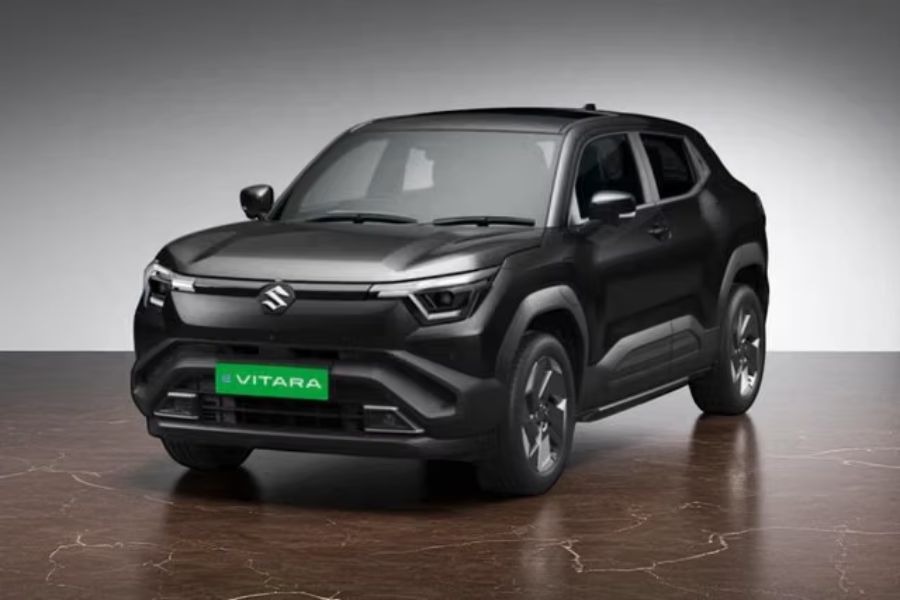
Maruti Suzuki is preparing to enter India’s fast-growing electric SUV market with the launch of its first pure-electric model, the e Vitara, on December 2, 2025. The EV will be manufactured at the brand’s Hansalpur facility in Gujarat, which also caters to global demand. In fact, over 7,000 units have already been exported since August, with the UK emerging as the top export market.
Here’s everything you can expect from Maruti’s upcoming electric SUV.
1. Expected Price of the Maruti Suzuki e Vitara
Likely starting range: ₹20 lakh–₹25 lakh (ex-showroom)
Maruti is expected to position the e Vitara in the thick of India’s midsize EV segment. The 49kWh variant is likely to start at around ₹20 lakh, while the 61kWh 2WD version could be priced close to ₹25 lakh at launch.
This puts the e Vitara directly against popular electric SUVs such as:
-
Tata Curvv EV (₹17.49 lakh–₹22.24 lakh)
-
MG ZS EV (₹17.99 lakh–₹20.50 lakh)
-
Hyundai Creta Electric (₹18.02 lakh–₹24.40 lakh)
-
Mahindra BE 6 (₹18.90 lakh–₹27.65 lakh)
Pricing may also overlap with newer entrants like the Vinfast VF6, which measures 4.2 metres and is priced between ₹16.49 lakh and ₹18.29 lakh.
2. Battery Options & Expected Range
The e Vitara will be offered globally with two battery packs, and both are expected for India.
Internationally available configurations (WLTP):
-
49kWh FWD – 144hp, up to 344km range
-
61kWh FWD – 174hp, up to 428km range
-
61kWh AWD (AllGrip-e) – 184hp, up to 394km range
Maruti is set to introduce only the FWD versions initially. The 61kWh model is expected to claim 500+ km ARAI range, thanks to India’s typically more lenient test cycle.
AWD variants will likely join the lineup later.
3. Interior, Features & Technology
The e Vitara’s cabin uses an asymmetrical, EV-specific design, giving it a more modern look compared to Maruti’s current SUVs. A continuous glass panel houses a dual-screen setup—one for the infotainment system and another for the digital cluster.
Notable features expected on higher variants:
-
360-degree camera
-
Level 2 ADAS
-
Wireless smartphone charging
-
Powered driver’s seat
-
Sunroof
-
Infinity audio system with subwoofer
-
Keyless entry and push start
Despite the quirky layout, ergonomics are user-friendly and most controls are easy to access.
4. Space, Comfort & Practicality
Inside, the e Vitara offers good space in the front row with supportive seats, though larger passengers may find the seat width slightly tight. Rear seat space is adequate, but headroom is modest.
A highlight is the sliding rear bench, which allows buyers to alternate between more legroom or more boot space.
Boot capacity (international model):
-
238 litres (seats pushed back)
-
306 litres (seats moved forward)
Maruti says the India-spec version will offer improved practicality thanks to revised under-floor storage.
5. Driving Experience: What to Expect
The e Vitara is tuned more for comfort than outright performance. The 61kWh 174hp FWD version feels brisk on paper with its claimed 0–100kph time of 8.7 seconds, but real-world acceleration is smoother and more relaxed than many rival EVs.
Driving impressions from the international model:
-
Smooth, predictable power delivery
-
Comfort-focused ride quality
-
Wind and tyre noise noticeable at higher speeds
-
Regenerative braking adjustment via touchscreen isn’t the most intuitive
Overall, the e Vitara should appeal to buyers prioritising efficiency, ease of use, and comfort over aggressive performance.
Launch Timeline & Rivals
The Maruti Suzuki e Vitara will officially debut in India on December 2, 2025. Once launched, it will take on a crowded and competitive segment that includes:
-
Hyundai Creta Electric
-
Tata Curvv EV
-
MG ZS EV
-
Mahindra BE 6
-
Upcoming Tata Sierra EV
Read More: