


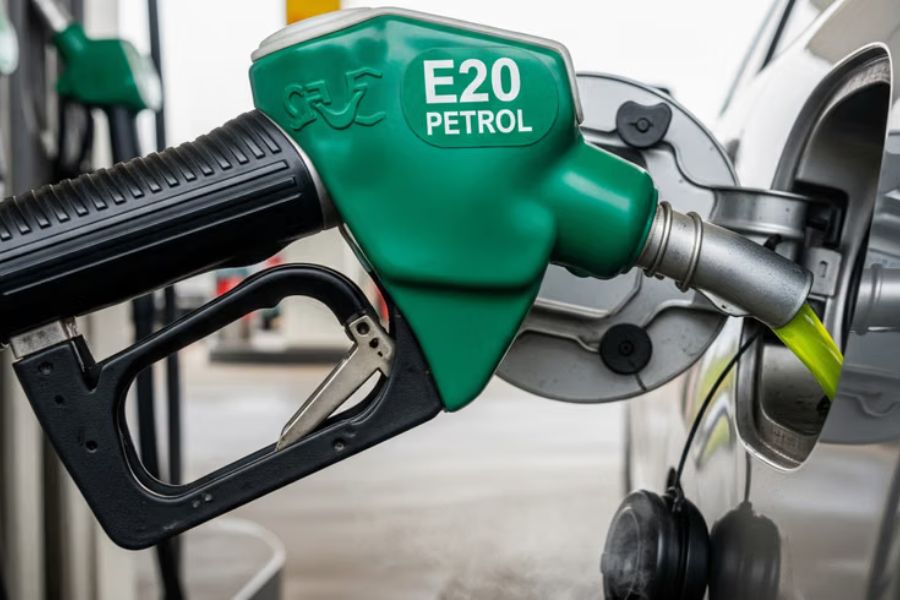
India’s Ministry of Petroleum and Natural Gas has officially mandated the nationwide sale of E20 petrol — petrol blended with up to 20% ethanol — with a minimum octane rating of 95 RON (Research Octane Number) across all states and Union Territories from April 1, 2026. The directive, issued on February 17, 2026, requires all oil marketing companies (OMCs) to comply with Bureau of Indian Standards (BIS) specifications. This marks a defining milestone in India’s Ethanol Blending Programme (EBP) and has direct implications for millions of vehicle owners across the country.
What Is E20 Petrol and Why Does Octane Rating Matter?
E20 petrol is a blend of conventional petrol and 20% ethanol — an alcohol-based biofuel produced primarily from sugarcane, maize, rice, and surplus grains. India first introduced E20 at select fuel outlets in April 2023 and has since expanded it as the primary petrol grade nationwide.
RON, or Research Octane Number, measures a fuel’s ability to resist “knocking” — a phenomenon where the air-fuel mixture ignites prematurely inside the engine cylinder, causing a pinging sound, reduced power output, and potential long-term engine damage.
- Higher RON = Better knock resistance = Engine protection
- Standard petrol in India previously had an octane rating of around 91–92 RON
- The new mandate raises the minimum floor to 95 RON
- Pure ethanol has a naturally high octane rating of approximately 108 RON
- Blending 20% ethanol into base petrol raises the overall octane rating by roughly 6 RON, pushing E20 fuel to an estimated 97–98 RON range
In simple terms: the new E20 fuel at your nearest pump will likely outperform the “premium” fuel grades that were sold separately just a year ago.
Key Details of the February 17, 2026 Government Notification
| Parameter | Detail |
|---|---|
| Mandate effective date | April 1, 2026 |
| Issued by | Ministry of Petroleum and Natural Gas |
| Fuel type | E20 (up to 20% ethanol blend) |
| Minimum octane rating | 95 RON |
| Quality standard | Bureau of Indian Standards (BIS) specifications |
| Applicable region | All states and Union Territories |
| Exemptions | Temporary, region-specific, for special circumstances |
The notification states that the central government retains the authority to permit temporary exemptions for specific regions in special situations and for a limited time — a safeguard designed to address potential logistical constraints in remote areas or Union Territories.
India’s Ethanol Blending Journey: A Five-Year Fast Track
India’s Ethanol Blending Programme (EBP) was launched in January 2003, but the real acceleration began after 2014. Here is how the programme has progressed:
- June 2022: India achieved 10% ethanol blending in petrol, five months ahead of the scheduled target date.
- 2023: The government advanced the 20% ethanol blending target to 2025–26 from the original 2030 deadline, encouraged by the early success.
- April 2023: E20 fuel introduced at select petrol stations.
- April 2025: Nationwide rollout of E20 as the standard petrol grade across approximately 90,000 fuel stations.
- April 1, 2026: Minimum 95 RON standard mandated alongside E20 to ensure fuel quality consistency.
According to the Oil Ministry, India has saved more than ₹1.40 lakh crore in foreign exchange since 2014–15 through petrol substitution, and payments exceeding ₹1.20 lakh crore have been made to farmers involved in ethanol feedstock supply chains.
What This Means for Your Vehicle
Modern Vehicles (Manufactured 2023–2025 Onwards)
Most cars and two-wheelers manufactured in India from 2023 onwards are E20-compliant. Automakers updated fuel system components — including corrosion-resistant fuel lines, rubber seals, and engine calibration — in preparation for the nationwide switch. Industry officials and PTI reports confirm that no major performance issues are anticipated for these vehicles.
A notable benefit: E20 fuel with higher octane content can deliver better acceleration and smoother combustion, particularly in modern high-compression engines.
Older Vehicles (Pre-2023 Models)
Owners of older vehicles should be aware of a few practical considerations:
- Fuel efficiency: A marginal drop of 3–7% in mileage is expected due to ethanol’s lower energy density compared to pure petrol.
- Component wear: Ethanol is hygroscopic — it absorbs moisture from the atmosphere. Older rubber gaskets, plastic fuel hoses, and metal fuel tanks not designed for ethanol exposure may experience accelerated wear over time.
- Engine knocking: Paradoxically, the higher 95 RON standard is actually beneficial for older engines, as it reduces the risk of knocking compared to the older 91–92 RON fuel.
What can owners do? Several vehicle manufacturers have begun offering E20 conversion kits for older models. Consult your authorised service centre for compatibility checks and recommended upgrades.
What About “Premium” Fuel Grades Like XP95?
From April 1, 2026, regular E20 petrol meeting the 95 RON baseline will become the standard grade at fuel stations nationwide. Brands like Indian Oil’s XP95 — which previously catered to premium fuel buyers — will either be repositioned or phased out, since the baseline product will match that specification.
The Environmental and Economic Case for E20 RON 95
Cutting Crude Oil Imports
India is the world’s third-largest oil importer and consumer. Every litre of ethanol blended into petrol reduces the volume of crude oil that needs to be imported. With E20 at scale, India expects to save approximately ₹43,000 crore annually in foreign exchange reserves, strengthening the current account balance.
Lower Emissions
E20 fuel burns cleaner than pure petrol. According to government data cited by industry sources, E20 can reduce carbon emissions by nearly 30% compared to E10 fuel. Ethanol’s oxygen content enables more complete combustion, reducing particulate matter and carbon monoxide output from vehicle exhausts.
Supporting Farmers and Rural Economy
Ethanol is derived primarily from sugarcane molasses, maize, and surplus food grains. Scaling up ethanol demand directly increases procurement from Indian farmers, supporting agricultural incomes. The government has already paid over ₹1.20 lakh crore to farmers as part of this supply chain over the past decade.
Renewable and Domestic Energy Security
Unlike crude oil, which is largely imported, ethanol is produced domestically from renewable agricultural feedstock. Expanding its role in the fuel mix reduces India’s vulnerability to global oil price volatility and geopolitical supply disruptions.
Why BIS Standardisation Is a Game-Changer
One of the most significant — yet underreported — aspects of this mandate is the requirement that E20 fuel must comply with Bureau of Indian Standards (BIS) specifications.
Ethanol is hygroscopic: it attracts and absorbs moisture from the environment. Without proper quality controls at blending, storage, and distribution stages, contaminated ethanol can cause corrosion in fuel injectors, clogged filters, and erratic engine behaviour — particularly in fuel-injected modern engines.
By enforcing BIS norms:
- Blending ratios will be standardised and verifiable
- Contamination risks at the supply chain level will be minimised
- Fuel quality will be consistent regardless of where in India you fill up — from metro cities to remote districts
This addresses a core concern raised by automotive experts and consumer advocacy groups since the E20 rollout began.
What’s Next: E27, Isobutanol Blending, and Beyond
The April 2026 mandate is not India’s final destination in fuel transition. The government is already preparing for the next phase:
- The Bureau of Indian Standards has been tasked with framing norms for E27 fuel (27% ethanol blend)
- The Automotive Research Association of India (ARAI) is studying the engine modifications required for higher ethanol blends
- Authorities are also exploring biofuel blending in diesel, including a potential 10% isobutanol mix
These developments signal that India’s fuel policy is on a clear long-term trajectory toward higher domestic biofuel content and reduced fossil fuel dependence.
Frequently Asked Questions (FAQs)
Q: Will E20 RON 95 petrol cost more than current petrol? The government has not announced any price change specifically tied to the RON 95 mandate. Since ethanol is domestically produced and the blending infrastructure is already in place, the transition is expected to be cost-neutral or marginally beneficial to consumers over time due to forex savings.
Q: Do I need to modify my car to use E20 RON 95? If your car was manufactured in 2023 or later, no modification is required. Owners of older vehicles should consult their authorised service centres. Some brands are offering conversion kits to improve compatibility.
Q: Is E20 available at all petrol pumps right now? Most of India’s approximately 90,000 fuel retail outlets were already dispensing E20 fuel after the April 2025 nationwide rollout. From April 1, 2026, the minimum 95 RON quality standard becomes mandatory across all these outlets.
Q: What if I accidentally get lower-quality fuel after April 1? The mandate allows temporary exemptions for specific remote regions. If you are in a major urban or semi-urban area, you should receive compliant E20 RON 95 fuel. The BIS compliance requirement provides an additional layer of accountability.
Q: Will E20 reduce my car’s performance? For modern E20-compliant vehicles, performance should be maintained or slightly improved due to the higher octane rating. For older vehicles, a slight efficiency reduction of 3–7% in mileage is possible, though engine knock protection will improve.
Key Takeaways
- India’s government mandated E20 petrol with a minimum 95 RON rating from April 1, 2026, via a February 17 notification
- Ethanol’s natural 108 RON raises E20 blend octane to an estimated 97–98 RON, well above the 91–92 RON baseline of old regular petrol
- BIS standardisation will ensure consistent fuel quality and reduce contamination risks nationwide
- Modern vehicles (2023+) face no major issues; older vehicles may see a 3–7% mileage dip and should get compatibility checks
- The move is part of a broader policy targeting energy security, emission reduction, farmer welfare, and reduced crude oil import bills
- India is already planning for E27 and isobutanol blending as the next step in fuel evolution
Read More: