


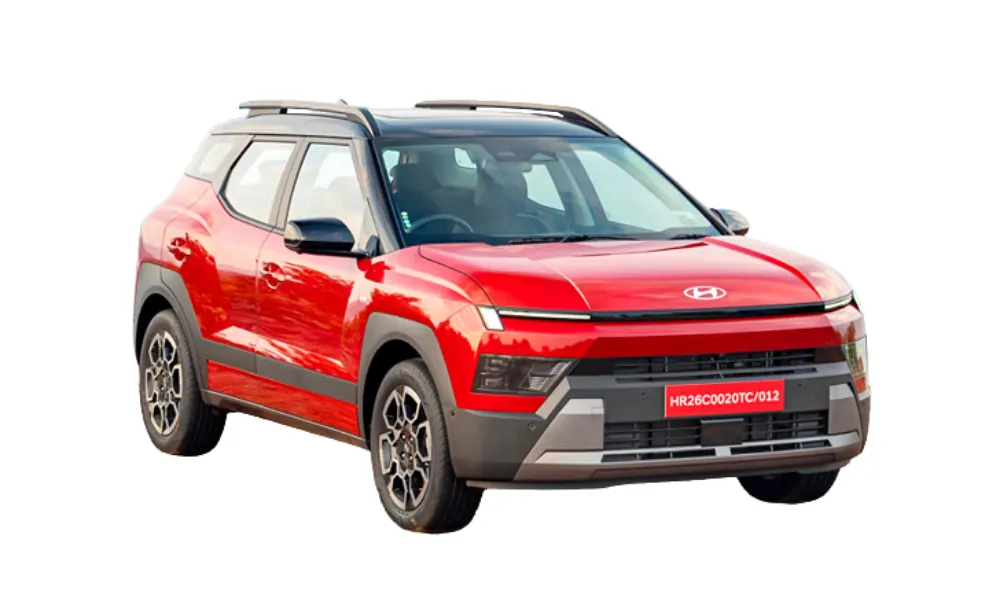
The Hyundai Bayon recorded 3,449 units in wholesale dispatches in October 2026, marking its first-month performance in the Indian market. Launched on October 26, 2026, the new midsize SUV contributed around 5% to Hyundai Motor India’s record monthly passenger vehicle dispatches of 62,799 units. Despite being available for only the final few days of October, the Bayon entered Hyundai’s top seven bestselling models for the month.
Its initial performance gives Hyundai another volume contributor in the competitive midsize SUV segment, where it will compete with the Maruti Suzuki Victoris, Grand Vitara, Kia Seltos and Tata Sierra.
Key Highlights
-
Hyundai Bayon recorded 3,449 wholesale units in October 2026.
-
Launched in India on October 26, 2026.
-
Accounted for approximately 5% of Hyundai’s October passenger vehicle dispatches.
-
Hyundai recorded its highest-ever monthly wholesales of 62,799 units.
-
Bayon is powered by a 1.5-litre naturally aspirated petrol engine producing 115 PS.
-
A factory-fitted CNG version is expected to arrive in January 2027.
Hyundai Bayon October 2026 Sales Performance
Hyundai’s new SUV ranked seventh in the company’s model-wise domestic dispatches, ahead of the Verna, Alcazar and Ioniq 5. The figure is particularly noteworthy because the Bayon entered the market towards the end of October. However, these numbers represent factory dispatches to dealerships, not confirmed retail registrations or customer deliveries.
Hyundai Bayon boosts October 2026 sales
Hyundai Motor India recorded domestic passenger vehicle wholesales of 62,799 units in October 2026, representing a 16.7% year-on-year increase over 53,792 units in October 2025. Including exports of 19,500 units, the manufacturer’s total monthly sales reached 82,299 units, its highest-ever monthly performance.
SUVs continued to be the biggest contributor to domestic volumes, accounting for 43,689 units, up 16% year-on-year. The Bayon contributed approximately 8% of these SUV dispatches and 5% of the company’s domestic passenger vehicle wholesales.
The new SUV also secured seventh position in Hyundai’s October model-wise sales ranking. While its first-month performance is encouraging, the next few months will provide a better indication of its sustained market demand.
Hyundai October 2026 model-wise sales
The Creta remained Hyundai’s bestselling vehicle in October, followed by the Venue and Exter. The Bayon entered the ranking at seventh position, while the Verna and Alcazar recorded comparatively lower volumes.
| Model | October 2026 units |
|---|---|
| Hyundai Creta | 17,955 |
| Hyundai Venue | 13,017 |
| Hyundai Exter | 8,509 |
| Hyundai Aura | 7,349 |
| Hyundai i20 | 5,528 |
| Hyundai Grand i10 Nios | 5,458 |
| Hyundai Bayon | 3,449 |
| Hyundai Verna | 775 |
| Hyundai Alcazar | 758 |
| Hyundai Ioniq 5 | 1 |
The Bayon’s seventh-place finish is a useful early indicator of its contribution to Hyundai’s portfolio. However, its 3,449 units should not be directly compared with the full-month figures of established models because it entered the market on October 26.
Hyundai Bayon price and variants in India
Hyundai launched the Bayon on October 26, 2026, with introductory prices starting at Rs 9.99 lakh. The SUV is available in seven trims: HX2, HX3, HX3+, HX5, HX6, HX8 and HX10.
The introductory ex-showroom Delhi price range extends from Rs 9.99 lakh to Rs 18.14 lakh, depending on the variant and transmission.
| Variant | Petrol manual | Petrol iVT |
|---|---|---|
| HX2 | Rs 9.99 lakh | Not available |
| HX3 | Rs 10.89 lakh | Not available |
| HX3+ | Rs 11.79 lakh | Not available |
| HX5 | Rs 12.44 lakh | Rs 13.84 lakh |
| HX6 | Rs 13.56 lakh | Rs 14.96 lakh |
| HX8 | Rs 15.09 lakh | Rs 16.54 lakh |
| HX10 | Rs 16.64 lakh | Rs 17.99 lakh |
Prices are introductory ex-showroom prices, Delhi, as of October 2026. Dual-tone variants cost extra.
The manual transmission is available across the range, while the iVT automatic is offered from the HX5 trim onwards. Buyers looking for an automatic should therefore budget at least Rs 13.84 lakh before registration, insurance and other charges.
Hyundai Bayon engine and performance
The Bayon uses a 1.5-litre, four-cylinder naturally aspirated MPi petrol engine producing 115 PS and 143.8 Nm of torque. Buyers can choose between a six-speed manual gearbox and Hyundai’s Intelligent Variable Transmission (iVT).
The automatic version receives additional features, including Dash Boost Mode, Sporty Drive Tech and paddle shifters. Eco, Normal and Sport driving modes are also available.
Hyundai says more than six lakh vehicles equipped with this 1.5-litre petrol engine have been sold in India since 2020. This gives the Bayon a familiar powertrain, although buyers seeking a turbo-petrol engine will need to consider alternatives.
The manufacturer has not established a real-world mileage figure in the cited launch information, so buyers should evaluate fuel efficiency after independent road tests become available.
Features and safety equipment
Technology is one of the Bayon’s major selling points. Selected highlights include dual 12.3-inch displays, wireless Android Auto and Apple CarPlay, a Bose premium sound system and more than 70 Bluelink connected features.
The SUV also introduces Hyundai’s generative AI voice assistant, incorporating technology from Perplexity and SoundHound AI. This allows conversational voice interactions for information and assistance.
Safety equipment includes six airbags, electronic stability control, hill-start assist and tyre pressure monitoring as standard. The top HX10 variant adds Hyundai SmartSense Level 2 Pro ADAS with 23 driver assistance features.
Hyundai says the Global K Enhanced platform has been engineered to meet five-star Indian safety standards. However, this should not be confused with an awarded crash-test rating. Bharat NCAP results were expected by the end of 2026, according to the November launch coverage.
What is next for the Hyundai Bayon?
Hyundai plans to expand the Bayon’s powertrain options with a factory-fitted CNG version in January 2027. This will make it the manufacturer’s first CNG offering in the midsize SUV category.
The addition could attract customers with higher monthly running requirements, particularly those prioritising fuel expenses. However, its pricing, CNG performance, boot-space implications and variant availability will need to be assessed after the official launch.
The company is also targeting combined annual sales of 2.5 lakh units for the Creta and Bayon in CY2027. This highlights the importance of the new SUV in Hyundai’s future domestic strategy.
Hyundai Bayon vs key rivals
The Bayon enters a crowded segment with established competitors. Its starting price puts it in contention with several midsize SUVs, while its higher variants overlap with more expensive alternatives.
| SUV | Main appeal |
|---|---|
| Hyundai Bayon | Connected technology and 1.5L petrol |
| Maruti Suzuki Victoris | Petrol, hybrid and CNG choices |
| Maruti Suzuki Grand Vitara | Strong-hybrid powertrain |
| Kia Seltos | Multiple engine and transmission choices |
| Honda Elevate | 1.5L petrol and spacious cabin |
| Tata Sierra | Modern design and multiple powertrain options |
The Bayon’s technology package and standard safety equipment are important strengths. However, its naturally aspirated petrol-only launch range is a limitation against rivals offering additional powertrain choices.
Pros and Cons of Hyundai Bayon
Pros
-
Competitive starting price of Rs 9.99 lakh.
-
115 PS petrol engine with manual and iVT options.
-
Six airbags and electronic stability control as standard.
-
Advanced Level 2 ADAS available on the top variant.
-
Generative AI voice assistant and dual-screen cockpit.
Cons
-
No diesel or turbo-petrol option at launch.
-
Automatic transmission is restricted to higher variants.
-
Official Bharat NCAP crash-test rating is not yet available.
-
Long-term fuel efficiency and ownership costs need evaluation.
Frequently Asked Questions
1. How many units of Hyundai Bayon were sold in October 2026?
Hyundai recorded 3,449 units of Bayon in factory dispatches during October 2026. The SUV was launched on October 26, making this its debut month in India. These figures represent wholesale dispatches to dealerships rather than retail sales.
2. When was the Hyundai Bayon launched in India?
Hyundai launched the Bayon in India on October 26, 2026. Bookings had opened on September 23, 2026, with an introductory starting price of Rs 9.99 lakh (ex-showroom).
3. What is the price of the Hyundai Bayon?
The Hyundai Bayon is priced between Rs 9.99 lakh and Rs 18.14 lakh (ex-showroom, Delhi, as of October 2026). It is available in seven trims, with manual and iVT automatic transmission options.
4. Does the Hyundai Bayon get a CNG option?
Hyundai has announced plans to introduce a factory-fitted CNG version in January 2027. It will become the company’s first CNG midsize SUV in India. Pricing, mileage and variant details are subject to the official launch announcement.
5. Which SUVs compete with the Hyundai Bayon?
The Hyundai Bayon competes with the Maruti Suzuki Victoris, Grand Vitara, Kia Seltos, Tata Sierra, Honda Elevate, Skoda Kushaq, Volkswagen Taigun and MG Astor. Its pricing, technology and petrol powertrain position it in the competitive midsize SUV category.
Conclusion
The Hyundai Bayon’s 3,449-unit opening is encouraging, particularly considering its late-October launch. Its technology package, 1.5-litre petrol engine and standard safety equipment give it a strong starting proposition.
However, sustained monthly dispatches will determine whether it can become a major contributor to Hyundai’s SUV sales. Buyers should compare the HX5 and HX6 trims with similarly priced rivals before booking. Those prioritising CNG running costs may find it worthwhile to wait for the January 2027 version.
Read More: