


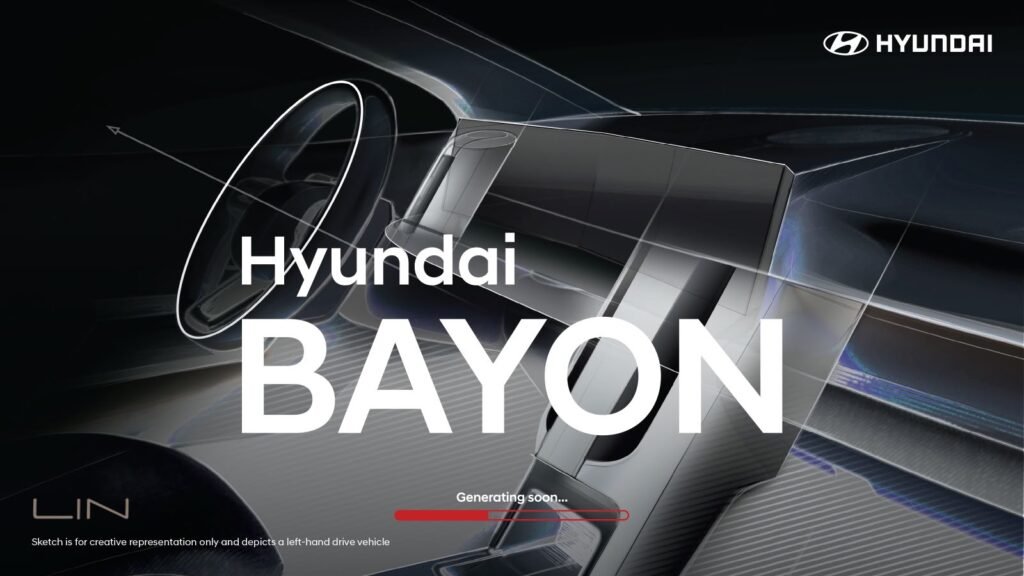
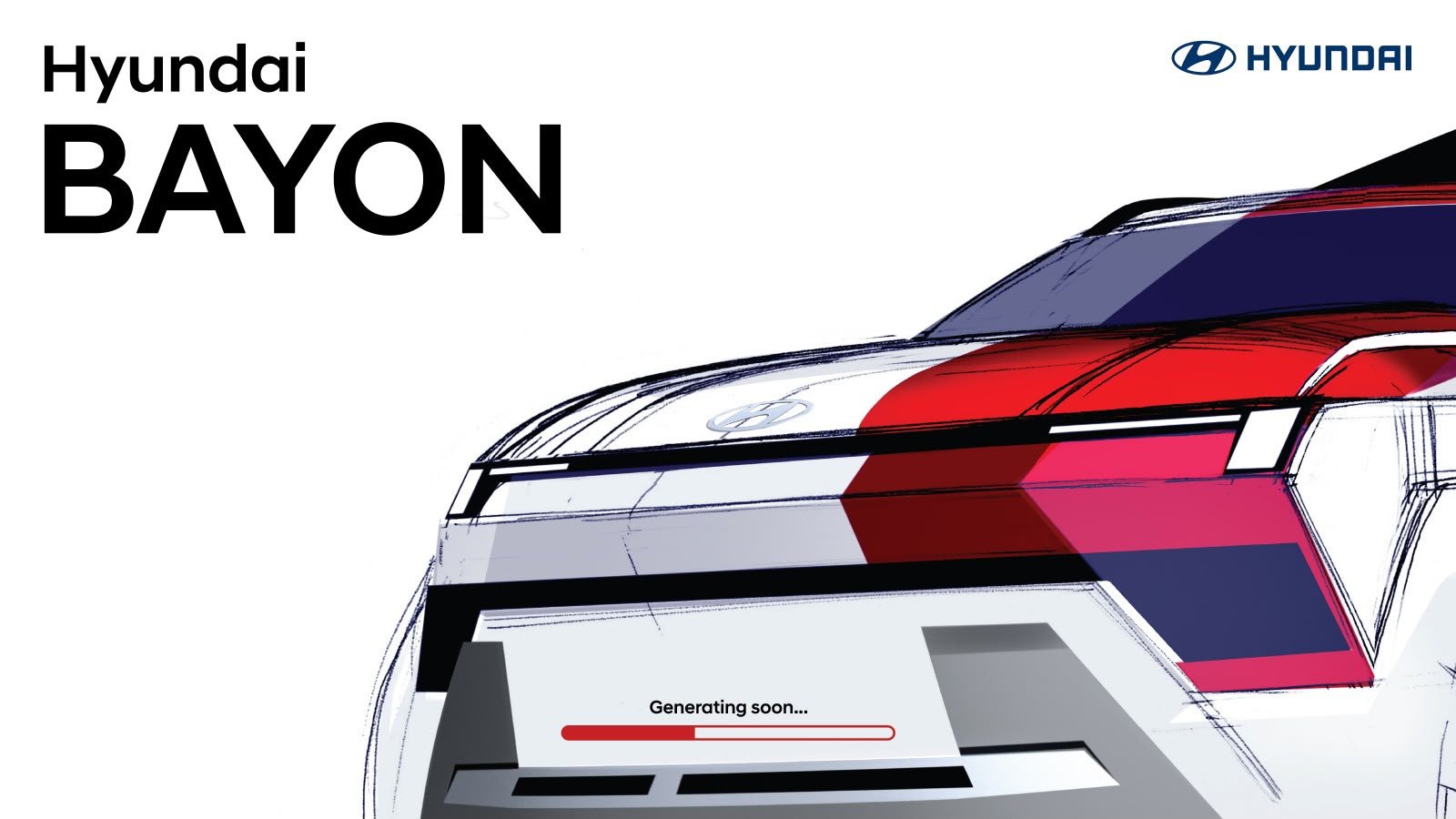

Hyundai has officially confirmed the Bayon name for its upcoming SUV in India, but as of September 2026, the company has not released official production design sketches of the India-spec model. What Hyundai has confirmed is that the Bayon will be a new global SUV developed for an evolving Indian market, with its full design, specifications and variant details expected to be announced closer to launch.
The announcement follows months of testing and spy sightings of an India-bound Hyundai SUV. Those prototypes indicate a more upright and SUV-like design than the European Bayon, with split lighting, a relatively flat roof, prominent wheel arches and a practical rear section. The new model is expected to sit between the Venue and Creta in Hyundai India’s SUV portfolio.
Key Highlights
- Hyundai Bayon has been officially confirmed as the name of Hyundai India’s upcoming SUV.
- The India-spec model is expected to sit between the Venue and Creta.
- Spy images indicate an upright SUV profile with split lighting and prominent wheel arches.
- Hyundai has not yet confirmed the engine, transmission, dimensions, prices or variants.
- The SUV is expected to make its market debut around the festive season, with reports pointing to October 2026.
- Potential rivals include the Maruti Suzuki Victoris, Tata Nexon, Kia Syros and other compact and midsize SUVs, depending on final positioning.
Hyundai Bayon Design: What the Latest Information Reveals
The biggest development is the confirmation of the Bayon name. Hyundai says the name is inspired by Bayonne, a city in France’s Basque region. The company is using the Bayon name to represent its new approach to intelligent mobility in India.
While official design sketches have not yet been published, multiple test vehicles have been photographed in India and abroad. These prototypes provide a fairly clear indication of the production SUV’s overall proportions.
The India-spec Bayon appears to have a taller and more upright stance than the existing European Bayon. The test vehicles feature a relatively flat roof, prominent wheel-arch cladding, roof rails and a more conventional SUV silhouette.
At the front, the SUV appears to use a split-lighting arrangement. Slim LED daytime-running lights sit higher on the fascia, while the main headlamp units are positioned lower. The rear appears to follow a similar horizontal lighting theme, with a relatively upright tailgate and roof spoiler.
This is significant because the India-spec model does not appear to be a simple rebadged version of the European Bayon. Hyundai seems to have adapted the design and proportions for Indian market requirements.
Hyundai Bayon India Launch Date
Hyundai has confirmed the Bayon name but has not announced an exact launch date.
Current reports point towards a festive-season introduction, with some reports expecting the launch around October 2026. Earlier reports had suggested a Q2 FY2027 arrival, showing that the timeline has shifted as development progressed.
Therefore, October 2026 should be treated as an expected timeline, not a confirmed launch date, until Hyundai announces the date officially.
Hyundai Bayon Engine and Transmission
Hyundai has not yet officially announced the India-spec Bayon’s powertrain specifications.
Several reports have discussed different possibilities during the development process. These include a naturally aspirated petrol engine, a new 1.2-litre turbo-petrol engine and a possible CNG version. Some reports have also mentioned the existing 1.5-litre naturally aspirated petrol engine. However, Hyundai has not confirmed which engines will be offered at launch.
This makes it too early to quote official power, torque, mileage or transmission figures.
The same applies to hybrid technology. Reports have discussed the possibility of electrification, but there is currently no confirmed India-spec hybrid powertrain announcement.
Interior and Features
The cabin is expected to follow Hyundai’s current technology-focused approach. Test vehicles and reports indicate a modern dashboard with digital displays, although exact screen sizes and equipment levels have not been officially announced.
Potential equipment could include a digital instrument cluster, touchscreen infotainment system, connected-car technology, wireless smartphone connectivity, automatic climate control, wireless charging and a sunroof.
Advanced safety technology is also expected to play an important role. Some test vehicles have been spotted with equipment that could indicate the availability of driver-assistance hardware, but Hyundai has not confirmed the final ADAS package for the production SUV.
Dimensions and Positioning
The Bayon’s final dimensions are yet to be officially revealed.
Earlier development reports described the vehicle as a compact SUV, while more recent reports suggest that the India-spec model could be around 4.2 metres long and positioned closer to the midsize SUV category. Autocar India has reported an expected length of around 4.18 metres.
This would put the Bayon above the sub-four-metre Venue in terms of overall size and potentially closer to products such as the Maruti Suzuki Victoris.
That positioning could also help Hyundai avoid creating a direct overlap with the Venue while giving buyers an option below the Creta.
Hyundai Bayon Expected Rivals
The final competition will depend heavily on pricing and dimensions.
| Model | Positioning | Powertrain options |
|---|---|---|
| Hyundai Bayon | Upcoming compact/midsize SUV | Yet to be confirmed |
| Maruti Suzuki Victoris | Midsize SUV | Petrol, hybrid and CNG options |
| Tata Nexon | Compact SUV | Petrol, CNG and EV |
| Kia Syros | Compact SUV | Petrol and diesel |
| Maruti Suzuki Fronx | Compact crossover | Petrol, turbo-petrol and CNG |
The Bayon’s expected size means its competitive set could span two segments rather than fitting neatly into one category.
Price and Variants
Hyundai has not announced the Bayon’s India price or variant structure.
Consequently, estimates currently circulating online should not be treated as confirmed pricing. The eventual price will depend on engine selection, localisation, standard equipment and the SUV’s positioning against the Venue and Creta.
Hyundai will also need to establish a clear gap between the Bayon and Creta to avoid excessive overlap within its own lineup.
Safety and Crash-Test Rating
There is currently no India-specific Bharat NCAP crash-test rating for the upcoming Hyundai Bayon.
The international Bayon is a different product specification, and its safety performance should not automatically be applied to the India-spec SUV. Hyundai’s final safety equipment, structural specifications and testing results for the Indian model will need to be evaluated separately once available.
Pros and Cons
Pros
- Distinctive SUV design based on extensive road-test sightings
- Expected to offer more space and road presence than the Venue
- Potentially strong Hyundai feature package
- Positioned below the Creta in the brand’s SUV range
- Could broaden Hyundai’s offering in the fast-growing mid-size SUV space
Cons
- Engine and transmission specifications are still unconfirmed
- Official price and variants have not been announced
- Bharat NCAP rating is not available yet
- Final positioning could result in overlap with the Venue or Creta
FAQs
What is the Hyundai Bayon?
The Hyundai Bayon is the name confirmed by Hyundai Motor India for its upcoming new SUV. The company describes it as a global SUV developed for the evolving Indian market.
When will the Hyundai Bayon launch in India?
Hyundai has not announced an exact launch date. Current reports indicate a festive-season launch, potentially around October 2026.
What will be the Hyundai Bayon price in India?
The official price has not been announced. Any prices currently reported online should be treated as estimates until Hyundai confirms the range.
Will the Hyundai Bayon get a CNG engine?
A CNG version has been reported as a possibility, but Hyundai has not officially confirmed a CNG powertrain for the production model.
Will the Hyundai Bayon be bigger than the Venue?
The India-spec Bayon is expected to be larger than the Venue, with reports indicating a length of around 4.2 metres. The final dimensions are yet to be confirmed.
Is the Hyundai Bayon the same as the European Bayon?
The India-spec model is related to the Bayon name and global product strategy, but spy shots indicate significant differences in proportions and styling compared with the European-market crossover.
Which cars will rival the Hyundai Bayon?
Depending on its final size and price, the Bayon could compete with models such as the Maruti Suzuki Victoris, Tata Nexon, Kia Syros, Maruti Suzuki Fronx and Toyota Urban Cruiser Taisor.
Conclusion
The Hyundai Bayon is shaping up as an important addition to Hyundai India’s SUV range, particularly because the company appears to be positioning it between the Venue and Creta rather than simply adding another sub-four-metre crossover.
The most important details are still pending. Hyundai has confirmed the name, but not the final specifications, price, engine lineup, variants or official production design. For buyers considering a new SUV in the ₹10 lakh to ₹20 lakh space, the Bayon is therefore worth watching, but a purchase decision should wait until Hyundai publishes the complete India-spec package.