


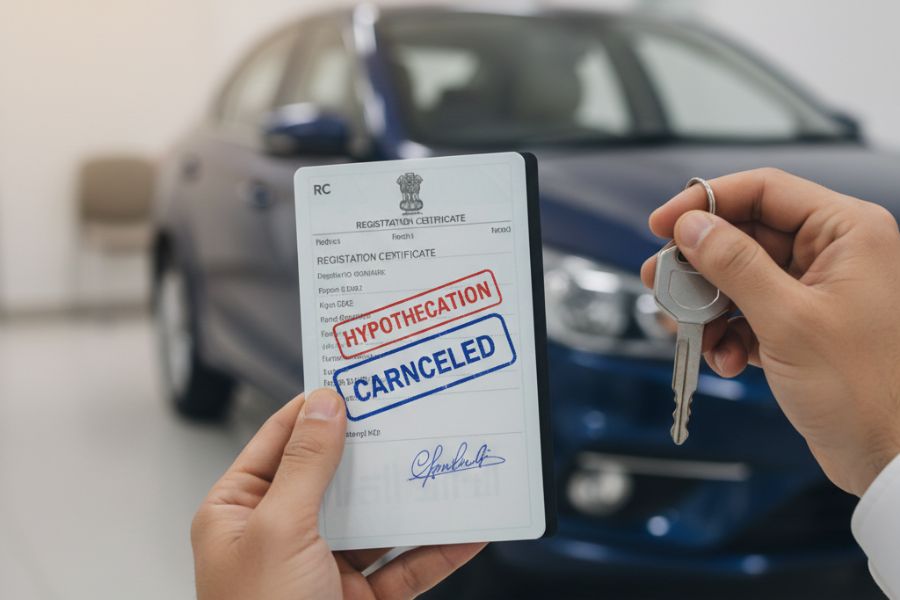
Congratulations on paying off your car loan! But wait – your journey isn’t complete yet. The hypothecation entry in your vehicle’s Registration Certificate (RC) still shows your financier as the owner. Removing this hypothecation is crucial to establish complete ownership of your vehicle. This comprehensive guide walks you through the entire process of hypothecation removal from your RC book after loan termination.
What is Hypothecation in RC?
Hypothecation is a legal charge created on your vehicle when you purchase it through a loan. The financier (bank or NBFC) is listed as the hypothecation holder in your RC, indicating that the vehicle is pledged as security against the loan. Until you clear this loan and remove the hypothecation, you don’t have complete ownership rights over your vehicle.
Why is Hypothecation Removal Important?
- Complete Ownership: Establishes you as the sole owner of the vehicle
- Selling Your Car: Buyers prefer vehicles without hypothecation for easier transfer
- Insurance Claims: Simplifies the claims process
- Legal Compliance: Mandatory under Motor Vehicles Act
- Higher Resale Value: Vehicles without hypothecation command better prices
- Loan Against Vehicle: You can pledge your vehicle for future loans
Documents Required for Hypothecation Removal
Before starting the process, gather these essential documents:
- No Objection Certificate (NOC) from the bank/financier
- Original RC (Registration Certificate) of the vehicle
- Form 35 (Application for addition/deletion of hire purchase agreement endorsement)
- Loan Closure Certificate from the financier
- Self-attested copy of PAN Card
- Self-attested copy of Aadhaar Card
- Passport-size photographs (2 copies)
- Address proof (utility bill, rental agreement, etc.)
- Cancelled cheque or loan account statement showing loan closure
Getting the NOC from Your Bank/Financier
The NOC is the most critical document. Here’s how to obtain it:
- Visit your bank branch or contact customer service
- Submit a written request for NOC after loan closure
- Some banks provide NOC automatically; others require a formal application
- The NOC should be on the bank’s letterhead with official seal
- Processing time varies from 7 to 30 days depending on the financier
- Keep multiple copies of the NOC for your records
Step-by-Step Process to Remove Hypothecation from RC
Method 1: Online Process (Recommended)
The online method is faster, more convenient, and available in most states through the Vahan portal.
Step 1: Visit the Parivahan Portal
- Go to https://parivahan.gov.in/parivahan/
- Navigate to “Online Services” > “Vehicle Related Services”
Step 2: Select Your State
- Choose your state from the dropdown menu
- You’ll be redirected to your state’s transport department website
Step 3: Register/Login
- Create an account if you’re a first-time user
- Login with your credentials
- Verify your mobile number and email through OTP
Step 4: Fill Application Form
- Select “Hypothecation Termination” or “NOC Updation”
- Enter your vehicle registration number
- Fill in the required details from your RC
- Upload scanned copies of required documents (NOC, RC, etc.)
- Document format: PDF or JPEG
- Maximum file size: Usually 2-5 MB per document
Step 5: Pay the Fee
- Pay the processing fee online (varies by state: ₹100-₹500)
- Payment modes: Net banking, credit/debit card, UPI
- Save the payment receipt
Step 6: Submit Application
- Review all details carefully
- Submit the application
- Note down the application/reference number
Step 7: Track Your Application
- Use the reference number to track status online
- Processing time: 7-15 working days
- You’ll receive SMS/email updates
Step 8: Collect Updated RC
- Once approved, you can download the updated RC online, or
- Visit the RTO to collect the physical updated RC
- Some states send the updated RC via registered post
Method 2: Offline Process at RTO
If online services aren’t available in your state or you prefer in-person submission:
Step 1: Visit Your Local RTO
- Go to the RTO where your vehicle is registered
- Visit during working hours (usually 10 AM to 5 PM, Monday to Friday)
Step 2: Obtain and Fill Form 35
- Collect Form 35 from the RTO counter or download from the website
- Fill the form with accurate details
- Ensure no overwriting or corrections
Step 3: Submit Documents
- Submit Form 35 with all required documents
- Attach original NOC from the bank
- Submit original RC for verification
- Provide self-attested photocopies of all documents
Step 4: Verification Process
- RTO official will verify all documents
- They may ask clarifying questions about your loan and vehicle
- Physical verification of the vehicle may be required in some cases
Step 5: Pay Processing Fee
- Pay the prescribed fee at the RTO counter
- Fee varies by state (typically ₹100-₹500)
- Collect the payment receipt
Step 6: Acknowledgment
- Collect the acknowledgment receipt
- Note the expected date for RC collection
Step 7: Collect Updated RC
- Return to the RTO on the specified date
- Typically takes 7-30 working days
- Bring your acknowledgment receipt
- Verify that hypothecation details are removed
State-Wise Processing Time and Fees
| State | Processing Time | Fee (Approx.) | Online Available |
|---|---|---|---|
| Maharashtra | 7-15 days | ₹200-300 | Yes |
| Karnataka | 10-20 days | ₹100-200 | Yes |
| Delhi | 7-14 days | ₹150-300 | Yes |
| Tamil Nadu | 15-30 days | ₹200-400 | Yes |
| Gujarat | 10-15 days | ₹100-250 | Yes |
| Telangana | 7-21 days | ₹200-350 | Yes |
Note: Fees and timelines are subject to change. Verify with your local RTO.
Common Challenges and Solutions
Challenge 1: Bank Delays in Providing NOC
Solution: Follow up regularly with the bank. Send written requests via email for documented proof. Escalate to the branch manager or regional office if necessary. Some banks charge a nominal fee for NOC issuance.
Challenge 2: Document Rejection
Solution: Ensure all documents are clear, legible, and properly attested. Use blue or black ink for signatures. Documents should not be older than 3 months.
Challenge 3: RTO Website Not Working
Solution: Try during off-peak hours (early morning or late evening). Use different browsers. Contact RTO helpline for technical support. Consider the offline method as backup.
Challenge 4: Vehicle Number Mismatch
Solution: Ensure the vehicle number on all documents matches exactly, including spacing and hyphenation. Correct any discrepancies with the bank before applying.
Challenge 5: Lost Original RC
Solution: Apply for a duplicate RC first, then proceed with hypothecation removal. This requires filing Form 26 and paying additional fees.
Tips for Faster Hypothecation Removal
- Apply Online: Online applications are processed faster than offline ones
- Submit Complete Documents: Incomplete applications cause delays
- Follow Up: Track your application status regularly
- Choose Off-Season: Apply during non-peak months (avoid March-April)
- Keep Copies: Maintain copies of all submitted documents
- Verify Details: Double-check all information before submission
- Bank Coordination: Maintain good communication with your bank
- Digital NOC: Request a digital NOC if available for faster processing
What Happens If You Don’t Remove Hypothecation?
While there’s no legal penalty for not removing hypothecation after loan closure, you may face:
- Difficulty in Selling: Buyers will insist on clear ownership
- Price Reduction: You may need to reduce your asking price
- Transfer Issues: Vehicle transfer becomes complicated
- Insurance Claims: May complicate claim settlement
- Future Loans: Cannot use the vehicle as collateral
- Legal Complications: Potential disputes regarding ownership
Cost Breakdown
Here’s a typical cost analysis for hypothecation removal:
- RTO Processing Fee: ₹100-₹500 (varies by state)
- NOC Charges from Bank: ₹0-₹500 (some banks charge)
- Form 35 Cost: ₹10-₹50 (if purchased from RTO)
- Photocopying/Scanning: ₹50-₹100
- Courier/Postal Charges: ₹50-₹100 (if applicable)
- Agent Fees (if using): ₹500-₹2000 (not recommended)
Total Estimated Cost: ₹200-₹1,500 (if done yourself)
Using Agents vs DIY
DIY Process (Recommended)
Pros:
- Cost-effective (saves ₹500-₹2000)
- Direct control over the process
- Better understanding of documentation
- No middleman issues
Cons:
- Time-consuming
- Requires multiple RTO visits (for offline)
- Learning curve for first-timers
Using Agents
Pros:
- Saves time and effort
- Handles documentation
- Familiar with RTO procedures
Cons:
- Additional cost (₹500-₹2000)
- Potential for fraud
- Less control over your documents
- May still require your presence
Recommendation: The process is straightforward enough to do yourself, especially with online options. Save money and maintain control by going DIY.
Frequently Asked Questions (FAQs)
1. How long does it take to remove hypothecation from RC?
Typically 7-30 working days depending on your state and whether you apply online or offline.
2. Can I sell my car without removing hypothecation?
Technically yes, but it’s extremely difficult. Most buyers insist on clear ownership, and you’ll likely get a significantly lower price.
3. Is there a deadline to remove hypothecation after loan closure?
There’s no legal deadline, but it’s advisable to do it immediately after receiving the NOC to avoid document expiry or loss.
4. What if my bank has closed or merged?
Contact the successor bank or the merged entity. They’re legally obligated to provide the NOC. You may need to show loan closure proof.
5. Can I remove hypothecation online in all states?
Most states offer online services through the Vahan portal, but some may still require offline submission. Check your state transport website.
6. Do I need to pay road tax again?
No, removing hypothecation doesn’t require road tax payment. You only pay the processing fee.
7. What if there’s an error in my updated RC?
Immediately approach the RTO with supporting documents. Apply for correction using Form 33 within 30 days.
8. Can I track my application status?
Yes, both online and offline applications can be tracked using your application/reference number on the state transport website.
9. Is physical verification of the vehicle required?
Generally not required for hypothecation removal, but some RTOs may ask for it in specific cases.
10. What if I’ve relocated to a different state?
You must remove hypothecation from the RTO where the vehicle is registered, not where you currently reside.
Post-Removal Checklist
After successfully removing hypothecation:
- ✅ Verify the updated RC has no hypothecation details
- ✅ Check that your name appears as the owner without any financier
- ✅ Make multiple copies of the updated RC
- ✅ Store the original RC safely
- ✅ Update your vehicle insurance with the new RC details
- ✅ Keep the NOC and loan closure certificate for future reference
- ✅ Update your records if the vehicle is used for business purposes
Conclusion
Removing hypothecation from your RC after car loan termination is a crucial step in establishing complete ownership of your vehicle. While the process may seem daunting initially, it’s quite straightforward when you have the right documents and follow the proper procedure. The online method has made it significantly easier and faster in recent years.
Don’t delay this important task – start gathering your documents today and complete the hypothecation removal process. With this comprehensive guide, you’re well-equipped to navigate the process smoothly and reclaim full ownership of your vehicle.
Remember, a vehicle with clear ownership not only gives you peace of mind but also commands better value in the resale market. Take action now and enjoy the satisfaction of being the undisputed owner of your car!
Disclaimer: The information provided in this article is for general guidance only. Rules, fees, and procedures may vary by state and are subject to change. Always verify current requirements with your local RTO before proceeding.