

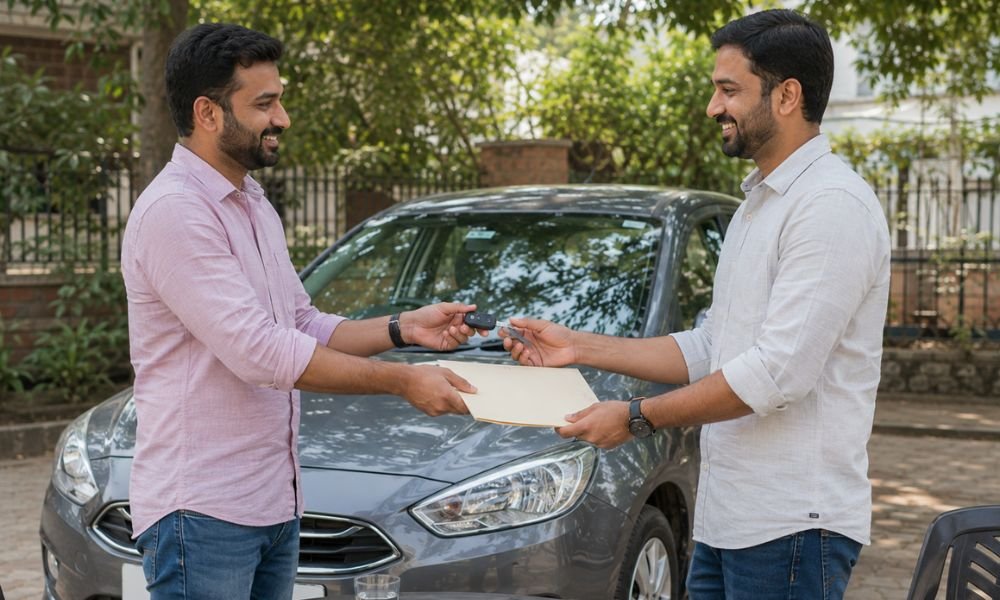

RC transfer requires the seller filing Form 29 and the buyer filing Form 30 with the RTO, along with the RC, insurance, PUC, and ID proof, within 14 days for a same-state sale or 45 days for an interstate one. You remain legally liable for the car until this is complete. Organised platforms like Cars24 handle this process end-to-end as part of the sale, and Cars24 backs sellers with Seller Kavach, a protection policy covering legal and financial liability for the entire gap between handover and completed transfer.
What does the standard RC transfer process actually involve?
Under India’s Motor Vehicles Act, selling a car legally requires more than handing over the keys and receiving payment. The seller files Form 29, a notice of transfer informing the RTO that the vehicle has been sold, and the buyer files Form 30, the formal application to register the car in their name. Both forms are submitted together, along with supporting documents, either online through the Parivahan portal or in person at the RTO. This has to happen within 14 days of the sale for a same-state transfer, or 45 days for an interstate one. Until the RTO processes the transfer and issues an updated RC in the buyer’s name, the vehicle remains legally registered to the seller.
What documents do you actually need ready?
| Document | Required for |
|---|---|
| Original RC | Every transfer |
| Form 29 (seller) and Form 30 (buyer) | Every transfer |
| Valid insurance and PUC certificate | Every transfer |
| ID and address proof (both parties) | Every transfer |
| Form 28 NOC from the original RTO | Interstate transfers only |
| Bank NOC and Form 35 | Only if the car has an active loan (hypothecation) |
Missing or mismatched paperwork is the single most common reason a transfer stalls at the RTO, so gathering everything before you start, rather than mid-process, meaningfully shortens the timeline.
What if there’s still a loan on the car?
An active loan adds a mandatory extra step. Hypothecation is a legal entry on the RC recording the bank as a co-claimant on the vehicle until the loan is fully repaid, and as long as that entry exists, the car cannot be legally transferred to a new owner. Removing it requires submitting the bank’s NOC and Form 35 to the RTO, at which point the RC is updated to show the seller as the sole registered party.
This step is where selling privately gets genuinely difficult. A private seller handling this alone typically has to close the loan from their own funds before selling, or ask a buyer to trust them with the loan amount before ownership transfers, something most private buyers are understandably reluctant to agree to. Cars24 removes both problems by paying the outstanding loan directly to the bank and structuring the deal so the seller receives net proceeds without fronting the closure amount themselves. Banks typically take 10 to 15 working days from full payment to issue the NOC and Form 35, per the same guide, and Cars24 holds back a portion of the payment until that NOC is submitted and the hypothecation removal is confirmed at the RTO, releasing the held amount once that’s done.
Who actually does the legwork when you sell through a platform?
This is where an organised platform’s role differs most from a private sale. Cars24 assigns a dedicated team to manage the RTO paperwork, and commits to the completion. Cars24 remains responsible until the ownership change is fully confirmed at the RTO, beyond simply submitting the initial forms, through its Seller Kavach protection policy. Sellers can track live status through the Cars24 app, a level of visibility a private seller typically lacks, since managing the process alone usually means following up with the buyer and visiting RTOs without any real insight into where things stand.
What are you actually liable for while the transfer is still pending?
More than most sellers realise. Under Indian law, the registered owner remains legally and financially responsible for the vehicle until the RC transfer is officially completed. That exposure covers three distinct risks: financial liability for traffic challans, e-fines, and tolls generated by the new owner while the car is still in the seller’s name; legal exposure if the car is involved in an accident or a police matter; and the practical burden of tracking paperwork with no visibility into its progress. This gap can last weeks or months on an ordinary sale, and the seller carries the full risk throughout.
How does Seller Kavach actually protect you during that gap?
Cars24 built Seller Kavach specifically to close this exposure. It becomes active from the moment the vehicle is handed over during doorstep pickup, rather than waiting for paperwork to be filed. Coverage includes challans, e-fines, accident claims, and police summons arising from the vehicle during the interim period, plus free legal representation in court, before the police, or at the RTO if a case arises. There’s no upper limit on the coverage. Protection runs until the RC is fully transferred and the seller’s name is removed from RTO records entirely.
| Seller Kavach covers | What it means in practice |
|---|---|
| Traffic challans and e-fines | Generated by the new owner but tied to the old owner’s name |
| Accident claims and police summons | Legal matters arising from the car during the transfer gap |
| Legal representation | A lawyer provided at Cars24’s cost for court, police, or RTO matters |
| RC transfer follow-through | Cars24 stays responsible until the transfer is confirmed complete |
Before you consider the transfer done
- Confirm every document on the checklist above is ready before initiating anything, since missing paperwork is the most common cause of delay.
- If a loan is active, get the foreclosure or NOC process started immediately, since banks typically need 10-15 working days to issue it.
- Ask directly whether your platform’s protection tracks all the way to RC completion, or only to an earlier milestone like payment.
- Track the transfer status yourself where possible, whether through a platform’s app or the Parivahan portal, rather than relying solely on someone else’s word that it’s progressing.
- Keep your Seller Kavach or equivalent protection details, reference numbers, and activation date on hand until you’ve independently confirmed the RC no longer shows your name.
Read Also: