


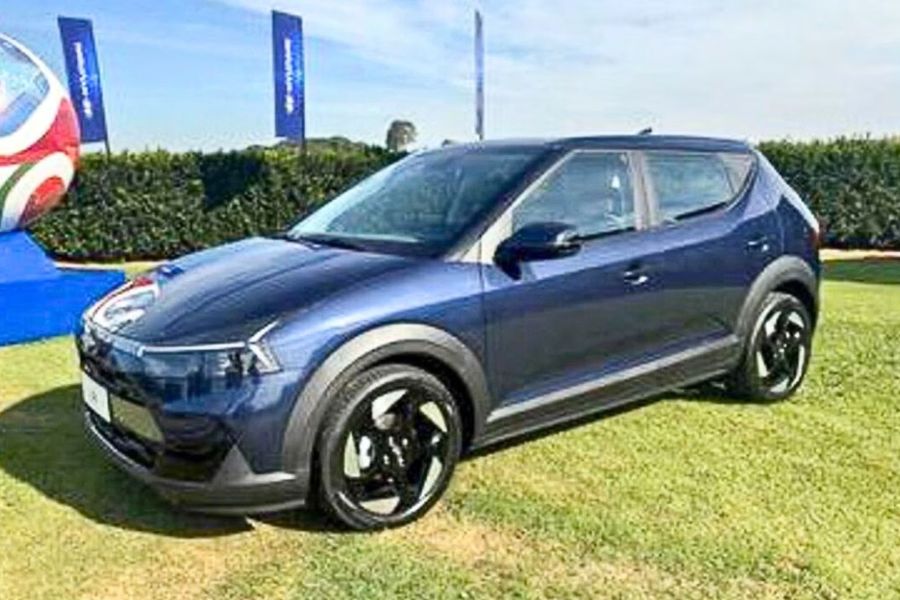
Just days before its official world debut at the 2026 FIFA World Cup, the fourth-generation Hyundai i20 has been fully leaked online — and it looks nothing like the hatchback you’ve known for the past 15 years. Leaked images from thekoreancarblog reveal a new-generation hatchback with a crossover-inspired design and a Venue-like dual connected screen layout inside. This isn’t a facelift. This is a complete reinvention — and Indian buyers have every reason to pay close attention.
Key Highlights
- The fourth-gen i20 makes a significant visual departure from all previous generations, replacing the swoopy hatchback stance with a more upright, almost boxy silhouette.
- Full-width LED light bars appear at both the front and rear, with distinctive Y-shaped DRLs drawing comparisons to the Lamborghini Revuelto’s lighting signature.
- The cabin features twin connected screens — likely 12.3-inch units — along with the new three-spoke steering wheel with the H written in Morse code, and a redesigned vertically oriented centre console.
- A ‘TGDi’ badge on the tailgate of the leaked unit confirms turbo-petrol engine availability in the line-up.
- India launch is expected around FY2028, after the Hyundai Bayon SUV arrives in the market.
A Design That Ditches the Curves — Completely
For over a decade, the Hyundai i20’s silhouette was defined by its flowing, swoopy lines. The fourth generation throws that formula out entirely. The new-gen model adopts a crossover-like look, with a more upright and almost boxy appearance when viewed head-on.
Generous plastic cladding on the bumpers and wheel arches reinforces the crossover aesthetic, a design trend borrowed directly from the SUV segment. Like it or loathe it, this is a deliberate strategic move. With compact SUVs eating into premium hatchback sales across the globe — and especially in India — Hyundai is giving the i20 an SUV-adjacent visual identity without actually making it an SUV. It’s a smart hedge.
In profile, the overall shape of the i20 has been retained, but with the new design elements, it reads like a completely new car. The wheels are aerodynamically designed, the greenhouse is squarer, and the hatchback now carries a stronger road presence compared to the current model while still retaining conventional door handles, something many buyers still prefer for everyday convenience.
Lighting: The Real Showstopper
If there’s one element that will define this generation’s visual identity, it’s the lighting. At the front, the hatchback gets a full-width LED strip that runs across the nose and connects both ends of the fascia, with Y-shaped daytime running lamps giving the car a much sharper appearance than the outgoing model. Lower down, separate projector headlamp units sit within their own housing. The rear gets a matching connected LED treatment, creating a symmetry that’s become Hyundai’s signature across its latest model lineup.
Interior: Venue-Level Tech Comes to the i20
The cabin overhaul might actually be more significant than the exterior redesign. Brazil, which will receive the car first, will have it with a dual-tone beige-over-grey interior colour scheme. It gets the same one-piece display from the India-spec Venue, confirming a massive digital instrument cluster and infotainment system.
Plenty of physical buttons and rotary dials have been retained on the steering wheel, the panel below the touchscreen, and the centre console — a welcome decision at a time when many manufacturers are stripping out tactile controls in favour of swipe-heavy interfaces. The beige and grey dual-tone interior does project a more premium feel, and early assessments suggest generous use of soft-touch materials on the door pads.
Features Expected in Higher Variants
The new-gen i20 could offer a 360-degree camera and ADAS capability, as seen on the Venue. It is also expected to continue offering a sunroof, wireless Apple CarPlay and Android Auto, a wireless phone charger, and connected car technology.
For Indian buyers comparing the new i20 against feature-rich rivals, this tech stack positions the fourth-gen model as a genuinely compelling option. If you’re already tracking alternatives, our best cars under ₹10 lakh in India buyer’s guide gives you a full picture of where the current premium hatchback segment stands.
Powertrains: Familiar Engines, Possible Hybrid Surprise
No official specifications have been announced alongside the leaked images, but the picture is becoming reasonably clear.
The new-gen i20 is expected to carry over the third-gen model’s 83hp 1.2-litre naturally aspirated petrol and 120hp 1.0-litre turbo-petrol engine options. For India specifically, the new-gen i20 is expected to retain the current model’s 88hp/115Nm 1.2-litre petrol engine mated to a 5-speed manual transmission or a CVT gearbox, while the N Line version could retain the 120hp/172Nm 1.0-litre turbo-petrol engine paired with a 6-speed manual or a 7-speed DCT gearbox.
The more interesting development is on the hybrid front. Hyundai is developing a new 1.2-litre turbo-petrol engine built with hybridisation in mind, which could feature in the fourth-gen i20. In 2025, Hyundai announced plans to bring 8 hybrid models to India, with the i20 likely being one of them. A hybrid powertrain would be a genuinely disruptive addition to the premium hatchback segment — and could reframe the i20’s value proposition entirely.
For context on Hyundai’s broader hybrid push in India, check out our best hybrid cars in India guide.
When Does It Come to India?
There’s no confirmed word yet on whether the fourth-gen i20 will come to India, where Hyundai is currently focused on launching a new Bayon-based crossover towards the end of 2026. However, the new-gen i20 is expected to arrive in India by FY2028, sharing its platform with the India-bound Bayon.
Hyundai currently manufactures the i20 in India and Turkey. With the arrival of the fourth-generation model, production will also commence at Hyundai’s Piracicaba facility in Brazil. India-spec production continuation is a strong indicator that the market won’t be skipped.
The current i20 is priced between ₹6 lakh and ₹10.39 lakh, while the sportier N-Line version ranges from ₹9.27 lakh to ₹11.59 lakh (ex-showroom, as of June 2026). Given the significant technology and feature upgrades, expect the fourth-gen model to push the price band higher — potentially nudging top variants beyond ₹12 lakh.
Pros and Cons
Pros
- Bold, modern design that addresses the “boring hatchback” problem head-on
- Venue-level tech including dual 12.3-inch screens coming to a smaller price bracket
- Likely ADAS integration makes it one of the safest options in the segment
- Hybrid variant possibility offers strong fuel efficiency prospects
- Physical controls retained — a practical win for daily usability
Cons
- Crossover styling cues with plastic cladding may divide loyalists
- India launch is 18–24 months away at the earliest
- Premium pricing expected — may blur lines with entry-level compact SUVs
- No official specifications confirmed as yet — still some uncertainty
How It Stacks Up: Competitors to Watch
| Feature | 4th Gen i20 (Expected) | Tata Altroz | Maruti Baleno |
|---|---|---|---|
| Infotainment Screen | 12.3-inch (dual) | 10.25-inch | 9-inch |
| ADAS | Yes (expected) | No | No |
| Turbo Engine | Yes (N Line) | Yes (i-Turbo) | No |
| 360° Camera | Yes (expected) | No | No |
| Hybrid Option | Possible | No | Yes (mild hybrid) |
| Expected Price (India) | ₹7L–₹13L+ | ₹6.6L–₹10.5L | ₹6.5L–₹9.8L |
The i20 appears set to leapfrog rivals on technology. If you’re planning a decision between these options before the new i20 arrives, our Tata Altroz vs Hyundai i20 comparison breaks down how they compare right now.
What This Means for the Premium Hatchback Segment
The fourth-gen i20 isn’t just a new car — it’s a statement. The premium hatchback segment remains fiercely competitive, with the biggest challenge coming from compact SUVs such as the Hyundai Exter, Tata Punch and Maruti Fronx. Hyundai’s answer isn’t to fight them on price alone — it’s to fight them on features, technology, and desirability.
The addition of connected lighting, a curved display, ADAS and a more upscale cabin could help the new i20 justify a higher price tag. And unlike rivals in the sub-₹10 lakh space, the i20 has always carried genuine aspirational value. The fourth generation doubles down on that.
If you’re weighing your options before the new i20 arrives, our best cars under ₹7 lakh guide covers what’s worth buying today.
Frequently Asked Questions (FAQs)
1. When will the fourth-gen Hyundai i20 be officially revealed?
The global debut is expected around the 2026 FIFA World Cup, which kicked off on June 11, 2026. An official unveil is expected imminently — possibly within days of the leaks surfacing.
2. Will the new Hyundai i20 come to India?
Hyundai has not officially confirmed India launch plans, but test mules have already been spotted on Indian roads. A launch is widely expected around FY2027–FY2028, likely after the Hyundai Bayon arrives first.
3. What engines will the new i20 offer in India?
The 1.2-litre naturally aspirated petrol (83–88hp) and 1.0-litre turbo-petrol (120hp) are expected to carry over. A hybrid variant using a new 1.2-litre turbo-petrol engine is also being developed, which could arrive in India as part of Hyundai’s broader 8-model hybrid push.
4. What will the new Hyundai i20 price be in India?
No official pricing has been announced. The current i20 starts at ₹6 lakh (ex-showroom). Given the tech upgrades, expect the fourth-gen model to start around ₹7–7.5 lakh, with top variants potentially exceeding ₹12–13 lakh.
5. What are the key interior upgrades in the fourth-gen i20?
The biggest change is the dual 12.3-inch connected screen setup (instrument cluster + infotainment), a new Morse-code ‘H’ steering wheel, a redesigned centre console, and a premium dual-tone beige-grey interior. ADAS, 360-degree camera, and wireless connectivity are expected on higher variants.
6. How does the fourth-gen i20 compare to the Tata Altroz and Maruti Baleno?
On technology, the new i20 is expected to lead the segment with its larger dual screens, ADAS, and possible hybrid option — features neither the Altroz nor the Baleno currently offers. Pricing will be the deciding factor once it launches.
7. Will there be an i20 N Line version?
Yes. The N Line is expected to continue with the 1.0-litre turbo-petrol producing 120hp and 172Nm, paired with either a 6-speed manual or 7-speed DCT gearbox.
Final Verdict
The fourth-generation Hyundai i20 is shaping up to be the most significant update in the model’s 15-year India journey. It’s bolder, tech-richer, and more feature-packed than anything the premium hatchback segment has seen. Whether the crossover-inspired styling resonates with Indian buyers is a conversation that’ll happen on the showroom floor — but on paper, Hyundai has addressed every major criticism of the outgoing car.
The wait until FY2028 may feel long. But if the final product lives up to what the leaks suggest, it’ll be worth it.