


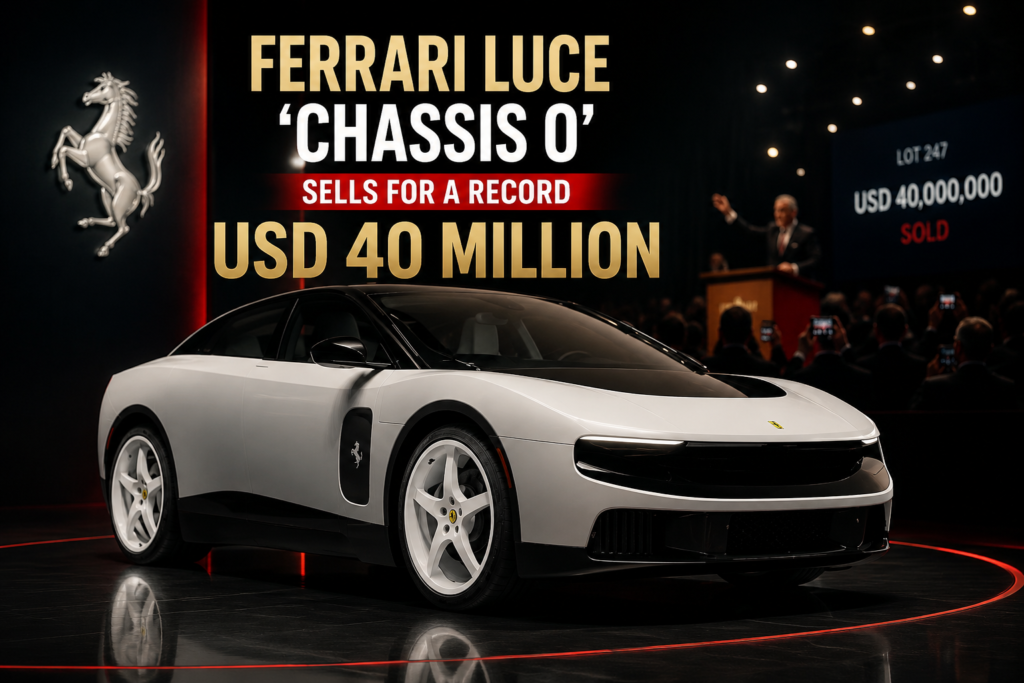
Ferrari has just rewritten the auction record books, and it didn’t take a vintage 250 GTO to do it. On 15 August 2026, at RM Sotheby’s Monterey sale, a brand-new car — the first production example of the all-electric Ferrari Luce, known as “Chassis 0” — hammered for a staggering USD 40 million. That’s not a typo. A car with a sticker price of roughly USD 640,000 just sold for 62 times its retail value, and every rupee-equivalent dollar of it is going to charity.
For an industry still arguing over whether Ferrari should even build an EV, this single bid answered a very different question: does the Ferrari badge still command absolute, unshakeable desirability in the electric era? Going by Monterey, the answer is a resounding yes.
Key Highlights
- Ferrari Luce “Chassis 0” sold for USD 40 million at RM Sotheby’s Monterey Auction on 15–16 August 2026
- It is the first production chassis (VIN ZFF21BUA8T0338000) of Ferrari’s first-ever fully electric car
- The sale is 36 times the pre-auction estimate of USD 1.1 million and 62 times the Luce’s standard retail price
- Buyer’s premium was waived, and 100% of proceeds go to the Ferrari Foundation for global education initiatives
- The winning bidder was Dr. Herbert “Herbie” Wertheim, a billionaire investor and philanthropist
- It is now the most expensive new car ever sold at auction, the most expensive EV ever sold publicly, and the most expensive charity car in auction history
- Delivery is scheduled for Q1 2027, once the car returns to Maranello for final touches
What Makes Chassis 0 Different from a Regular Luce
Every production run has to start somewhere, and Chassis 0 is quite literally that starting point — the first unit pulled off the Luce assembly line before customer deliveries began. Ferrari’s Tailor Made personalisation division and the in-house Ferrari Design Studio then turned it into a one-of-one showpiece.
Exterior and Interior Highlights
- A bespoke Madreperla semi-gloss paint, mixed exclusively for this car, with a pearlescent finish that shifts from green to violet depending on light angle
- Dedicated wheels, custom brake calipers, and unique badging set against an optical white backdrop
- A cabin trimmed in Perla Le Mans metallic leather with Grigio Corvara accents — the first Luce interior to move away from black as the dominant tone
- A numbered plaque confirming its position as the first chassis in the production sequence
Under the Skin: Ferrari Luce Specifications
| Specification | Detail |
|---|---|
| Powertrain | Quad-motor, 800V electric architecture |
| Power output | 1,035–1,050 bhp (772 kW) |
| Torque | 990 Nm (730 lb-ft) |
| 0–100 km/h | 2.5 seconds |
| Battery pack | 122 kWh |
| WLTP Range | Approx. 530 km |
| Boot space | 597 litres |
| Seating | Five-seat GT layout with rear-hinged “suicide” doors |
| Interior design | Co-developed with Jony Ive’s LoveFrom studio |
| Global starting price | Approx. €550,000 (~USD 640,000) |
Why Bidders Paid 62x the Sticker Price
Three things converged to push this sale into record territory:
- Historical significance — Chassis 0 marks Ferrari’s official entry into the EV era, a shift the brand has been building toward since its 2022 Capital Markets Day.
- Scarcity and provenance — There will only ever be one “Chassis 0,” and it carries a Tailor Made specification that can’t be replicated on a standard order.
- Charitable framing — With the buyer’s premium waived and 100% of funds routed to the Ferrari Foundation, serious collectors treated this less as a car purchase and more as a philanthropic statement with an extraordinary keepsake attached.
For context, the previous charity-auction benchmark was a Tailor Made Daytona SP3 that raised USD 26 million in 2025 — also bought by Wertheim. Chassis 0 cleared that mark by USD 14 million.
Pros and Cons of the Ferrari Luce as a Model
Pros:
- Genuine flagship-level performance figures for a five-seat GT
- Distinctive, retro-analogue cabin that breaks from screen-heavy EV design trends
- Strong residual value backing, given Ferrari’s brand equity and low production volumes
- 530 km WLTP range is competitive for a car this heavy and powerful
Cons:
- Divisive styling and the shift away from combustion has split loyal Ferrari enthusiasts
- No sunroof, and rear-hinged doors won’t suit everyone practically
- Global waiting lists mean allocation, not just money, decides who gets one
- Import duties will push India pricing well above the international starting figure
Frequently Asked Questions (FAQs)
1. How much did the Ferrari Luce ‘Chassis 0’ sell for? It sold for USD 40 million at RM Sotheby’s Monterey Auction, against a pre-sale estimate of just USD 1.1 million.
2. Who bought the Ferrari Luce Chassis 0? Dr. Herbert “Herbie” Wertheim, a billionaire investor and philanthropist, placed the winning bid.
3. Where does the money from the sale go? All proceeds go directly to the Ferrari Foundation, a registered charity supporting global educational initiatives.
4. What is the regular Ferrari Luce’s price? The standard Ferrari Luce starts at approximately €550,000 (about USD 640,000) globally, before any market-specific taxes or duties.
5. Is the Ferrari Luce coming to India? Ferrari has not confirmed an official India launch date yet. Industry estimates place a potential India price between roughly ₹5.2 crore and ₹8.5 crore before import duties, which could push the on-road figure considerably higher.
6. What makes Chassis 0 different from a standard production Luce? Chassis 0 is the first unit off the production line, finished through Ferrari’s Tailor Made programme with a bespoke paint, unique interior trim, and a numbered plaque that no other Luce carries.
The Bottom Line
The USD 40 million Chassis 0 sale isn’t really about one wealthy collector’s generosity, though the charitable angle deserves credit. It’s a market signal. Ferrari took its biggest brand risk in decades by going electric, and the world’s most serious collectors just told Maranello, in the loudest way auction rooms allow, that the prancing horse’s cachet hasn’t dimmed one bit. For everyday buyers and enthusiasts watching from the sidelines, the real story to track next is how the standard Luce — not the seven-figure showpiece — performs on order books and resale values once deliveries actually begin.
Read More: