


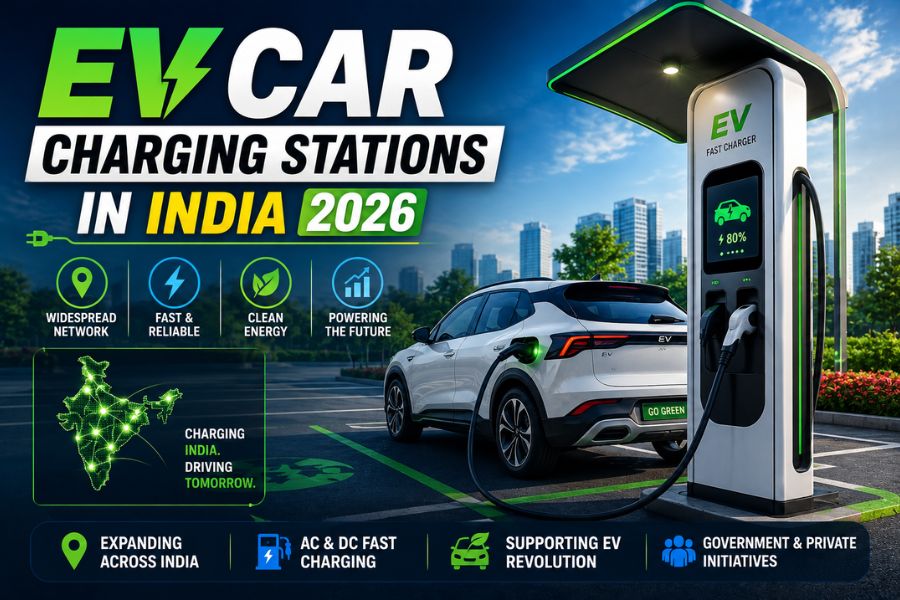
India’s electric vehicle revolution is no longer a distant headline — it is happening on the roads you drive every day. With EV registrations crossing 2.5 million units in FY 2025–26 and a 24% year-on-year growth rate, the next question every prospective and current EV owner is asking is the same: “Where and how do I charge my car?” If you are looking for a definitive, up-to-date guide to EV charging stations in India in 2026, you have landed in the right place.
The Big Picture: How Far Has India Come?
Not long ago, India had a mere 5,151 public EV charging stations. By mid-2025, that number had surged past 29,000 — a nearly sixfold increase in under three years. Karnataka currently leads all states with over 6,097 charging points, and in a surprising but welcome shift, Tier-3 cities and non-metro areas (12,040 stations) have now overtaken Tier-1 metro cities (9,702 stations) in total charger count.
The India EV charging market, valued at USD 487 million in 2025, is projected to reach USD 1,652 million by 2030 — growing at a compound annual rate of 27.67%. This is not speculative optimism; it is backed by ground-level deployment, government funding, and intensifying private-sector competition.
Government Push: PM E-DRIVE and Beyond
The central government’s PM E-DRIVE scheme has allocated INR 2,000 crore specifically for deploying 72,000 charging stations across the country. Alongside, USD 1,313 million was committed under the broader PM E-DRIVE framework between April 2024 and March 2026 to support multiple EV segments — from two-wheelers and three-wheelers to electric buses, trucks, and public charging infrastructure.
State governments have not lagged either. Delhi, Maharashtra, and Telangana have emerged as policy leaders, offering capital subsidies on charger hardware, preferential electricity tariffs for EV charging, and land concessions through industrial estates. Setting up a charging station requires no electricity distribution licence — EV charging is a de-licensed activity under the Electricity Act, 2003 — which has dramatically lowered the barrier for private investors and entrepreneurs.
The government’s 2030 targets are ambitious: electrify 30% of private cars, 70% of commercial vehicles, 40% of buses, and 80% of two-wheelers and three-wheelers. To reach those numbers, the Confederation of Indian Industry estimates India needs 1.32 million charging stations — meaning roughly 400,000 new installations are required every single year.
Who Is Building India’s Charging Network?
Tata Power
With over 6,700 public and fleet charging points spread across 630+ cities, Tata Power remains the most comprehensive charging incumbent in India. Its ambitious roadmap targets 750,000 home chargers nationwide and a robust public network to support India’s EV growth through the end of the decade.
ChargeZone
Now India’s largest EV charging network by charging points, ChargeZone crossed 15,000 charging points in 2026. On April 29, 2026, ChargeZone and TATA.ev jointly launched a Mega Charging Hub on the Mumbai-Pune Expressway at Khalapur — the 75th hub in their co-branded initiative — capable of delivering up to 720 kW of power. The two companies are working toward 100+ such Mega Charging Hubs along strategic national highways.
Statiq
One of India’s fastest-growing networks, Statiq crossed 10,000 charging points across 100+ cities by early 2026, adding approximately 3,000 new stations in 2025 alone. Statiq has partnered with TATA.ev for the MegaCharger rollout and with Bolt.Earth for interoperability — allowing users to access both networks through a single app.
Oil Marketing Companies (OMCs)
Fuel retailers are the dark horses of India’s charging expansion. IndianOil claims 13,614 chargers, BPCL operates 6,563, and HPCL has crossed 5,400 stations. HPCL’s landmark agreement with V-GREEN in December 2025 — to deploy EV charging across 24,400+ fuel retail outlets — is arguably the single most consequential distribution deal in India’s EV charging history. Overnight, it created the skeleton of a truly national charging network.
TATA.ev MegaChargers
TATA.ev has committed to doubling India’s charge points to 400,000 by 2027 through its “Open Collaboration 2.0” framework. The flagship 400 kW MegaCharger in Vadodara charges six vehicles simultaneously, adding up to 150 km of range in just 15 minutes — a number that is rewriting consumer expectations around charging speed.
Types of EV Charging: What Do the Levels Mean for You?
Understanding charging types helps you plan better and choose the right station for your situation.
AC Slow Charging (Level 1 & 2): Best suited for home charging and workplace stations. Charging times range from 6 to 12 hours for a full charge. Ideal if your car stays parked overnight.
DC Fast Charging (Level 3): The standard for public charging hubs. These chargers deliver between 30 kW and 150 kW and can add significant range in 45–90 minutes, depending on the vehicle’s onboard charger capacity.
Ultra-Fast / Mega Charging (180 kW–720 kW): The new frontier for highway charging in India. Stations like the ChargeZone-TATA.ev hub on the Mumbai-Pune Expressway operate at 720 kW, slashing wait times to levels comparable with a conventional fuel stop.
Battery Swapping: An alternative model gaining traction for two-wheelers and three-wheelers, particularly in high-utilisation commercial fleets. HPCL already operated 150 battery swapping stations before its V-GREEN partnership.
The Honest Challenges: Range Anxiety Is Still Real
India’s charging growth story has a sobering footnote. Despite the headline numbers, real-world user experience remains inconsistent.
The charger-to-EV ratio in India currently stands at approximately 1:235 — far behind global benchmarks of 1:6 to 1:20. Under FAME-II, 9,332 chargers were sanctioned but only 6,645 were operational by March 2026, a 29% non-operational rate driven by grid connectivity issues, equipment procurement delays, and site acquisition bottlenecks.
A 2026 survey by Deloitte India found that 43% of respondents cited lack of public charging infrastructure as a concern, 41% cited charging time, and 31% highlighted the absence of residential charging access. One real-world symptom: EV users in India typically navigate 17 to 20 different mobile applications to locate a functional charging point — a fragmentation problem the industry is only beginning to solve through interoperability agreements.
Average public charging times in India still range from 1.5 to 2 hours — significantly slower than the 30-minute global fast-charging benchmark. Grid instability, high temperatures, and voltage fluctuations compound the challenge, especially in non-metro areas where charger count is growing faster than grid quality.
What Is Changing Fast in 2026
Interoperability is becoming the norm. Partnerships like Bolt.Earth-Statiq, and TATA.ev’s unified IRA.ev app for multi-network access, are reducing the number of apps an EV owner must manage.
Highways are being prioritised. The focus has shifted from city-centric deployments to strategic highway corridors — Delhi-Jaipur, Mumbai-Pune, Mumbai-Ahmedabad, Pune-Nashik — ensuring that intercity travel by EV is increasingly viable.
Renewable energy integration. Solar-powered charging stations are gaining ground, aligning India’s EV push with its renewable energy commitments, including a record 44 GW of solar capacity added in FY2026.
Smart grid and AI-optimised charging. Statiq has announced targets to deploy 20,000 AI-optimised chargers with real-time status updates and dynamic load-sharing — a critical feature in a grid that still struggles with demand spikes.
Practical Tips for EV Owners Using Public Chargers in India
Use apps like Tata Power EZ Charge, Statiq, ChargeZone, or BPCL Urja to locate and pre-check charger availability before heading out. Always carry your RFID card if your network supports tap-and-charge, as app-based payments can occasionally be slow in areas with patchy connectivity. On highway trips, plan charging stops every 150–200 km and build in a buffer — aim for charging hubs co-located with restaurants or rest stops, such as the TATA.ev MegaCharger stations, so downtime doubles as a break.
For residential charging, DISCOM approval for a dedicated connection is the most important first step. Ensure your society or landlord is aligned before purchasing your EV — the experience of one Gurugram resident who found himself locked out of basement charging after shifting homes is far more common than it should be.
The Road Ahead: 2026 to 2030
India’s EV charging sector is at an inflection point. The numbers are growing, the investments are flowing, and the partnerships are hardening into real infrastructure. The India EV Charging Infrastructure Summit scheduled for July 2026 in Mumbai reflects the industry’s confidence that this is not a niche market anymore — it is a national infrastructure priority.
The gap between ambition and execution, however, remains wide. Bridging a 1:235 charger-to-EV ratio to even 1:50 within four years demands not just capital but coordination across DISCOMs, state governments, real estate developers, and charge point operators. The stations sanctioned under PM E-DRIVE have seen zero central expenditure as of March 2026 — a reminder that policy announcements and physical chargers are two very different things.
What gives cause for optimism is the private sector’s pace. When a company like HPCL can partner to deploy chargers across 24,400 fuel outlets, or when ChargeZone and TATA.ev can launch a 720 kW hub on one of India’s busiest expressways, the template for scaling is clearly being written — one charging port at a time.
Conclusion
EV charging infrastructure in India in 2026 is the story of a country running fast to close a gap it knows matters. For consumers, the network is usable today in urban areas and along major highways, but patience and planning are still required for everything in between. For investors and entrepreneurs, the opportunity is enormous — CII estimates the country needs over a million more charging stations in the next four years. And for India as a whole, getting this right is not just about electric vehicles. It is about cleaner air, lower oil imports, and a mobility future that is built in India, for India.