


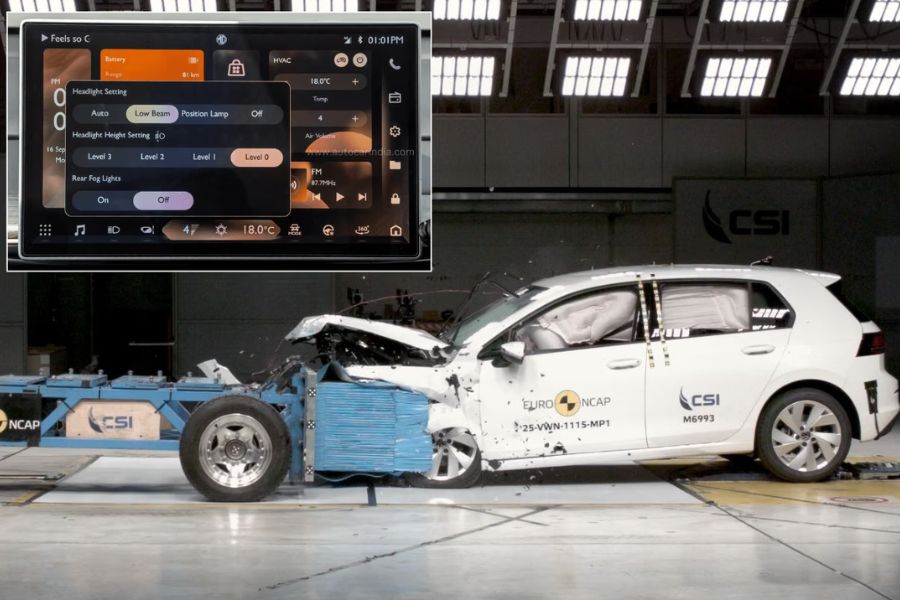
Euro NCAP has announced a sweeping revision to its vehicle safety assessment programme, scheduled to roll out in 2026. The upcoming protocol marks the most substantial transformation since 2009, aiming to better reflect real-world driving challenges and modern safety expectations.
The revamped system will evaluate vehicles in four key domains – safe driving, crash avoidance, crash protection and post-crash safety – with 100 points available in each category.
1. Putting Real-World Safety First: Usability, Distraction and Driver Awareness
The first major shift focuses on driver behaviour and distraction. Euro NCAP will now reward cars that use physical, easily accessible buttons for frequently used controls. This is a direct response to the industry-wide push towards touchscreen-heavy cabins, which can be distracting during everyday driving.
Advanced driver monitoring technology also becomes more important. Systems that continuously evaluate eye and head movements, adjust assistance based on driver alertness, or detect impairment from alcohol and drugs will score higher.
Additionally, vehicles will be assessed on their ability to recognise an unresponsive driver and bring the car to a controlled halt.
Occupant restraint systems will be reviewed in greater detail, including how well seatbelts and airbags adapt to different body types and seating positions, promoting inclusivity in safety performance.
2. Stronger Focus on Crash Avoidance: Real Scenarios, Fewer Frustrating Interventions
ADAS technologies will face tougher evaluation criteria. Tests will simulate a wider range of real-world interactions with pedestrians, cyclists, motorcyclists and other vulnerable road users.
Euro NCAP will penalise intrusive or unpredictable assistance features. In other words, lane-keeping and braking systems must be precise, smooth and predictable, instead of startling or frustrating drivers.
A new criteria set will reward systems that recognise pedal misapplication, helping prevent low-speed collisions – including scenarios such as accelerating instead of braking or cyclist dooring.
3. Enhanced Crash Protection: More Data, More Occupant Types
Crash protection testing expands to cover a broader spectrum of occupant sizes, ages and positions. Greater use of sled tests and computer modelling will help identify injury risks for adults, children and elderly passengers more accurately.
Pedestrian safety also receives attention, with a stronger focus on critical impact areas around the windscreen base and bonnet edges.
4. Better Post-Crash Safety: Faster Rescue and Safer EVs
The post-crash phase will now be evaluated more comprehensively. Vehicles will need to ensure exterior door handles remain operable after a crash, making it easier for emergency responders to access occupants.
For electric vehicles, new standards require automatic isolation of high-voltage batteries after an impact, along with timely battery fire warnings for drivers or rescue teams.
Safety-related emergency call systems will be checked for accuracy, including the ability to relay occupant information.
Bharat NCAP 2.0: India Preparing Similar Test Upgrade
India is also working on a significant evolution of its crash-test regime, with Bharat NCAP 2.0 expected to launch in 2027. The upgrade will reportedly introduce stricter build quality benchmarks and reward vehicles equipped with more sophisticated active safety technology.
Like Euro NCAP, the Indian update aims to capture real driving conditions more accurately, expanding its ratings beyond basic adult/child protection. The new model is likely to include five evaluation pillars, offering a more complete picture of overall vehicle safety performance.
What It Means for Car Buyers and Manufacturers
Euro NCAP’s 2026 overhaul signals a shift from traditional crash-only testing towards holistic road safety, where:
-
Distraction reduction
-
Driver behaviour monitoring
-
Predictive safety systems
-
EV-specific post-crash performance
…play a bigger role than ever before.
For automakers, the changes could lead to significant redesigns in cabin ergonomics, ADAS calibration and EV architecture.
For consumers, the new ratings promise clearer insights into how cars perform in everyday conditions, not just lab-based crashes.
Read More: