


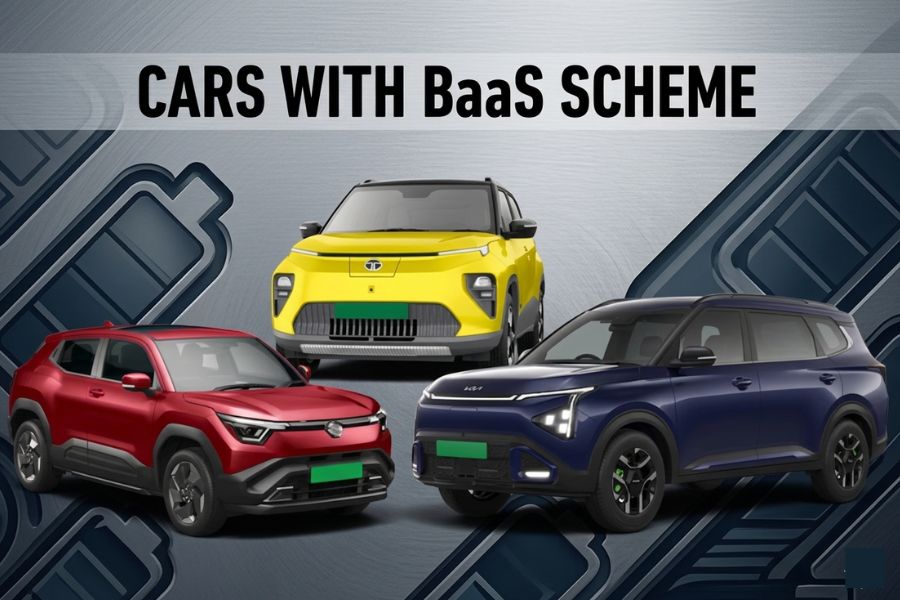
Every EV Available with a BaaS (Battery-as-a-Service) Scheme in India (June 2026)
Imagine buying a brand-new electric SUV for under ₹11 lakh — saving up to ₹5.5 lakh upfront, with no compromise on features. That’s exactly what Battery-as-a-Service (BaaS) is making possible in India right now. As high upfront costs continue to be the number-one barrier to EV adoption, a growing group of automakers is turning the traditional ownership model on its head. Rather than bundling an expensive battery pack into the vehicle price, BaaS lets you lease the battery separately and pay only for the kilometres you actually drive.
As of June 2026, four mainstream car manufacturers — JSW MG Motor, Tata Motors, Maruti Suzuki, and Kia — offer BaaS schemes across six distinct EV models in India. Whether you’re eyeing an entry-level city car or a premium family MPV, there’s now a BaaS-compatible option worth considering. This comprehensive guide breaks down every model, variant, subscription cost, and hidden consideration you need to know before signing on the dotted line.
Key Highlights
- 6 passenger EVs currently offered with BaaS schemes in India (June 2026)
- 4 automakers actively offering battery subscription plans: MG, Tata, Maruti Suzuki, and Kia
- Upfront savings range from ₹2.64 lakh (MG Comet EV) to ₹6.05 lakh (Kia Carens Clavis EV)
- Per-km rental fees range from ₹2.6/km (Tata Punch EV) to ₹4.5/km (MG ZS EV / Windsor Pro)
- BaaS is gaining momentum in India’s two-wheeler segment too, with Ather, TVS, Hero, and Honda joining the bandwagon
- India’s EV financing market is expected to require nearly US$30 billion over the next five years, with BaaS emerging as a key catalyst
What is Battery-as-a-Service (BaaS)?
BaaS is a financing and ownership model that decouples the battery from the vehicle at the time of purchase. You buy the car without the battery — paying a significantly lower upfront price — and instead subscribe to a battery rental plan, typically charged on a per-kilometre basis.
Think of it like a mobile phone plan: you own the handset, but the network (and in this case, the most expensive hardware component) is leased from the provider. The key advantage? Decoupling the battery from the vehicle reduces upfront costs by 35–40%, instantly making EVs more accessible to a wider audience.
For buyers who clock moderate annual distances, the model makes a compelling financial case. For high-mileage drivers, however, the per-km cost can add up quickly — making a careful break-even analysis essential before committing.
Related Read: Understanding EV Ownership Costs in India — A Complete Breakdown
All EVs Available with BaaS Schemes in India (2026)
1. MG Comet EV — The Most Affordable BaaS EV
BaaS Starting Price: ₹4.99 lakh + ₹3.2/km
The diminutive MG Comet remains one of India’s most affordable electric cars, and its BaaS scheme makes it even more accessible. All five variants are available under the subscription plan, with a flat upfront saving of ₹2.64 lakh across the board. The entry-level 17.3kWh variant starts at just ₹4.99 lakh — a remarkable price point for a fully electric, feature-rich urban runabout.
Worth noting: when MG first introduced BaaS for the Comet in 2024, the per-km fee was ₹2.5. It has since climbed to ₹3.2/km, a reminder that subscription fees are not locked in at purchase.
| Variant | Standard Price | BaaS Price | Upfront Saving |
|---|---|---|---|
| Executive 17.3kWh | ₹7.63 lakh | ₹4.99 lakh + ₹3.2/km | ₹2.64 lakh |
| Excite 17.3kWh | ₹8.73 lakh | ₹6.09 lakh + ₹3.2/km | ₹2.64 lakh |
| Excite 17.4kWh | ₹9.00 lakh | ₹6.36 lakh + ₹3.2/km | ₹2.64 lakh |
| Exclusive 17.3kWh | ₹9.73 lakh | ₹7.09 lakh + ₹3.2/km | ₹2.64 lakh |
| Exclusive 17.4kWh | ₹10.00 lakh | ₹7.36 lakh + ₹3.2/km | ₹2.64 lakh |
Best for: Urban commuters driving 30–50 km daily who want the lowest possible entry price into the EV segment.
2. Tata Punch EV — Cheapest Per-Km Subscription in India
BaaS Starting Price: ₹6.49 lakh + ₹2.6/km
Tata Motors entered the BaaS arena with the facelifted Punch EV, and it currently holds the distinction of offering India’s lowest per-km battery subscription fee at just ₹2.6/km. The entry Smart 30kWh variant drops from ₹9.69 lakh to ₹6.49 lakh under BaaS — a saving of ₹3.20 lakh. Tata has not yet revealed BaaS pricing for all Punch EV variants, so expect the full list to be announced soon.
| Variant | Standard Price | BaaS Price | Upfront Saving |
|---|---|---|---|
| Smart 30kWh | ₹9.69 lakh | ₹6.49 lakh + ₹2.6/km | ₹3.20 lakh |
| Other variants | TBA | TBA | TBA |
Best for: First-time EV buyers who want a practical, trusted brand with the most affordable per-km running cost under BaaS.
Related Read: Tata Punch EV Facelift Review — More for Less
3. MG Windsor EV — The Pioneer of Car BaaS in India
BaaS Starting Price: ₹9.99 lakh + ₹3.9/km
MG Motor is the company that effectively kickstarted the BaaS trend for passenger cars in India when it launched the Windsor EV in September 2024 with a battery subscription option baked in at launch. Today, the Windsor EV is available with both a 38kWh and a larger 52.9kWh battery. The per-km fee differs: ₹3.9/km for the standard pack and ₹4.5/km for the Pro variants. Upfront savings go up to ₹5 lakh on the Pro models.
| Variant | Standard Price | BaaS Price | Upfront Saving |
|---|---|---|---|
| Excite 38kWh | ₹14.10 lakh | ₹9.99 lakh + ₹3.9/km | ₹4.11 lakh |
| Exclusive 38kWh | ₹15.53 lakh | ₹11.42 lakh + ₹3.9/km | ₹4.11 lakh |
| Essence 38kWh | ₹16.53 lakh | ₹12.42 lakh + ₹3.9/km | ₹4.11 lakh |
| Exclusive Pro 52.9kWh | ₹17.38 lakh | ₹12.38 lakh + ₹4.5/km | ₹5.00 lakh |
| Essence Pro 52.9kWh | ₹18.60 lakh | ₹13.60 lakh + ₹4.5/km | ₹5.00 lakh |
Best for: Family buyers who want a roomy, connected EV and are comfortable with the mid-range subscription cost.
4. Maruti Suzuki e Vitara — India’s Most Trusted Brand Joins BaaS
BaaS Starting Price: ₹10.99 lakh + ₹3.99/km
Maruti Suzuki’s debut EV, the e Vitara, arrives with a BaaS option from the outset — a sign of just how mainstream the model has become. Three variants are available under BaaS, spread across two battery configurations (49kWh and 61kWh). The 61kWh variants attract a slightly higher subscription fee of ₹4.39/km. Crucially, the top-spec Alpha 61kWh drops from ₹20.01 lakh to ₹14.51 lakh under BaaS — a saving of ₹5.5 lakh, the highest rupee saving on a Maruti product ever.
| Variant | Standard Price | BaaS Price | Upfront Saving |
|---|---|---|---|
| Delta 49kWh | ₹15.99 lakh | ₹10.99 lakh + ₹3.99/km | ₹5.00 lakh |
| Zeta 61kWh | ₹17.49 lakh | ₹11.99 lakh + ₹4.39/km | ₹5.50 lakh |
| Alpha 61kWh | ₹20.01 lakh | ₹14.51 lakh + ₹4.39/km | ₹5.50 lakh |
Best for: Buyers who want Maruti’s widespread service network assurance along with the lowest possible entry price for a mid-size electric SUV.
Related Read: Maruti Suzuki e Vitara vs Hyundai Creta Electric — Which Should You Buy?
5. Kia Carens Clavis EV — The Only MPV with BaaS
BaaS Starting Price: ₹12.84 lakh + ₹3.3/km
In May 2026, Kia introduced the BaaS scheme for its Carens Clavis EV, which stands out as the only MPV available with battery subscription in India. Kia has kept the per-km rate uniform across both battery options — ₹3.3/km regardless of whether you choose the 42kWh or the longer-range 51.4kWh pack. The savings are substantial: ₹5.15 lakh on the mid-range HTK+ variant and a massive ₹6.05 lakh on the top-spec HTX E ER — the largest single upfront saving in India’s BaaS ecosystem right now.
| Variant | Standard Price | BaaS Price | Upfront Saving |
|---|---|---|---|
| HTK+ 42kWh | ₹17.99 lakh | ₹12.84 lakh + ₹3.3/km | ₹5.15 lakh |
| HTX E ER 51.4kWh | ₹21.99 lakh | ₹15.94 lakh + ₹3.3/km | ₹6.05 lakh |
Note: Full variant-wise pricing not yet released at time of writing.
Best for: Families needing 6–7 seat capacity who want the flexibility of a lower purchase price and a competitive per-km rate.
6. MG ZS EV — The Veteran Gets Its BaaS Moment
BaaS Starting Price: ₹13.00 lakh + ₹4.5/km
The ZS EV, MG’s first electric offering in India, received its mid-lifecycle update in 2022, but it was only in September 2024 that MG introduced a BaaS scheme for the midsize electric SUV. The ZS EV’s 50.3kWh battery pack attracts a ₹4.5/km subscription fee — the same as Windsor EV Pro — while the upfront saving of up to ₹5.24 lakh is the highest in MG’s electric line-up.
| Variant | Standard Price | BaaS Price | Upfront Saving |
|---|---|---|---|
| Executive 50.3kWh | ₹17.99 lakh | ₹13.00 lakh + ₹4.5/km | ₹4.99 lakh |
| Excite Pro 50.3kWh | ₹18.75 lakh | ₹13.51 lakh + ₹4.5/km | ₹5.24 lakh |
| Exclusive Pro 50.3kWh | ₹19.75 lakh | ₹14.51 lakh + ₹4.5/km | ₹5.24 lakh |
| Essence 50.3kWh | ₹20.75 lakh | ₹15.51 lakh + ₹4.5/km | ₹5.24 lakh |
Best for: Buyers wanting a premium, feature-loaded midsize EV with significant upfront savings, who drive a moderate annual mileage.
Quick Comparison: All BaaS EVs at a Glance
| Model | BaaS Starting Price | Per-Km Fee | Max Upfront Saving | Battery Size |
|---|---|---|---|---|
| MG Comet EV | ₹4.99 lakh | ₹3.2/km | ₹2.64 lakh | 17.3–17.4kWh |
| Tata Punch EV | ₹6.49 lakh | ₹2.6/km | ₹3.20 lakh | 30kWh |
| MG Windsor EV | ₹9.99 lakh | ₹3.9–4.5/km | ₹5.00 lakh | 38–52.9kWh |
| Maruti e Vitara | ₹10.99 lakh | ₹3.99–4.39/km | ₹5.50 lakh | 49–61kWh |
| Kia Carens Clavis EV | ₹12.84 lakh | ₹3.3/km | ₹6.05 lakh | 42–51.4kWh |
| MG ZS EV | ₹13.00 lakh | ₹4.5/km | ₹5.24 lakh | 50.3kWh |
Pros and Cons of BaaS for Car Buyers
Pros
- Significantly lower upfront cost — savings of ₹2.64 lakh to ₹6.05 lakh make EVs far more accessible
- No battery degradation risk for the owner — the OEM or BaaS provider handles battery health and replacement
- Lower loan amount — a cheaper base price means smaller EMIs and reduced interest burden
- Easier mental accounting — paying per km makes running costs visible and predictable
- Entry into premium EV segments — buyers can access larger, feature-rich EVs at near-budget price points
Cons
- Higher total cost of ownership for high mileage drivers — those driving 20,000+ km/year may pay more overall than a standard purchase
- Per-km rates can increase over time — as MG Comet buyers already found, fees are not permanently fixed
- Resale complexity — selling a BaaS vehicle requires either transferring the subscription or settling the battery cost, which can complicate second-hand transactions
- Limited to specific variants — not all trims of a model may be available with BaaS
- Brand and service lock-in — you’re tied to the OEM’s battery ecosystem for the life of the subscription
BaaS Beyond Cars: Two-Wheelers Lead the Charge
India’s BaaS revolution isn’t confined to passenger cars. Ather Energy launched BaaS in August 2025 (Rizta from ₹76,000, 450 Series from ₹84,000); TVS Motor introduced BaaS across its EV portfolio in March 2026 (Orbiter V1 from ₹49,999 with BaaS); Hero MotoCorp’s VIDA VX2 offers pay-per-km battery subscription from ₹0.96/km; and Honda’s e:Swap launched in Bengaluru, Delhi, and Mumbai.
This OEM participation signals mainstream market acceptance and suggests that the BaaS model will continue to expand into more vehicle segments — including commercial vehicles and potentially even mass-market hatchbacks — in the near future.
Related Read: Best Electric Scooters with BaaS Plans in India 2026
Should You Choose BaaS? A Buyer’s Framework
The answer depends almost entirely on how many kilometres you drive annually. Here’s a simple decision framework:
BaaS is likely worthwhile if you:
- Drive fewer than 12,000–15,000 km per year
- Are purchasing your first EV and want the lowest risk entry point
- Plan to keep the vehicle for under 5 years
- Are a city-based commuter with predictable, short daily trips
Standard purchase may suit you better if you:
- Clock 18,000+ km annually (the per-km fee compounds significantly)
- Want a clean, uncomplicated resale transaction
- Plan to own the vehicle for 7–10 years
- Drive long highway distances regularly
Related Read: EV vs Petrol Car: Which is Cheaper to Own in India in 2026?
Frequently Asked Questions (FAQs)
Q1. What happens to the BaaS subscription if I sell my EV? When selling a BaaS vehicle, you typically have two options: transfer the active subscription to the new buyer (with OEM approval) or pay a settlement amount to own the battery outright. The process varies by manufacturer, so it’s critical to read the subscription agreement carefully before purchase.
Q2. Can I convert my BaaS vehicle to full ownership later? Yes, in most cases. OEMs like MG and Maruti Suzuki allow you to buy out the battery at a pre-agreed residual value after a set subscription period. Check the specific terms with your dealer before committing.
Q3. Who is responsible for battery replacement or repair under BaaS? The OEM or its BaaS partner retains ownership of the battery, which means battery replacement due to degradation or defects typically remains their responsibility — a significant financial protection for the subscriber.
Q4. Is the per-km subscription fee fixed for the life of the contract? Not always. As seen with the MG Comet EV — where the fee rose from ₹2.5/km to ₹3.2/km after launch — subscription fees can be revised. Read the fine print carefully to understand revision clauses.
Q5. Which BaaS EV offers the best deal for a city commuter driving 40 km a day? For a 40-km daily commute (approximately 14,600 km/year), the Tata Punch EV at ₹2.6/km stands out for lowest running costs under BaaS. The annual battery subscription would work out to approximately ₹37,960 — which, when added to the BaaS vehicle price, still represents substantial savings versus buying at the full price for most buyers.
Q6. Are any luxury or premium EVs available with BaaS in India? As of June 2026, BaaS schemes are exclusively a mass-market phenomenon in India. Premium brands like Hyundai (Creta Electric), BMW, and Mercedes-Benz have not introduced BaaS plans for their EV line-ups.
Q7. Is BaaS available across all cities in India? BaaS availability generally mirrors the OEM’s dealer network. MG, Tata, and Maruti Suzuki have broad pan-India coverage. However, rural and Tier-3 city buyers should confirm local service infrastructure before opting for BaaS.
The Road Ahead for BaaS in India
India will require nearly US$30 billion in EV financing over the next five years, with BaaS emerging as a key catalyst. With more than 1,200 battery-swapping stations already operating nationwide and OEM after OEM launching subscription plans, BaaS is no longer an experiment — it’s quickly becoming a mainstream ownership alternative.
The next frontier? Interoperability. The India battery swapping market currently operates with a mix of open-network models and OEM-specific proprietary ecosystems, with no universally interoperable battery pack architecture existing across vehicles, packs, and stations. Once standards get resolved, BaaS could reshape EV financing as profoundly as EMI financing once reshaped the consumer electronics market.
For buyers sitting on the fence about going electric, a BaaS-equipped vehicle removes perhaps the single biggest psychological barrier — the daunting upfront cost — and replaces it with a pay-as-you-drive model that feels intuitive and manageable. That’s a compelling proposition, and one that’s only going to grow stronger in the months ahead.
Related Read: Top 10 Most Affordable Electric Cars in India 2026 Related Read: EV Charging Infrastructure in India — City-by-City Guide
Conclusion
BaaS is doing something no government subsidy or manufacturer discount quite managed to achieve before: making EVs feel financially approachable without compromising on the product itself. From the pocket-friendly MG Comet at ₹4.99 lakh to the spacious Kia Carens Clavis EV at ₹12.84 lakh, there’s now a BaaS-eligible electric car for nearly every buyer segment in India.
The key is to do the maths specific to your usage. If you drive less than 15,000 km a year and value a lower upfront investment, BaaS deserves serious consideration. If you’re a road warrior clocking 25,000 km annually, a standard outright purchase might still serve you better financially. Either way, understanding the BaaS landscape — which this guide has laid out in full — puts you firmly in the driver’s seat.