


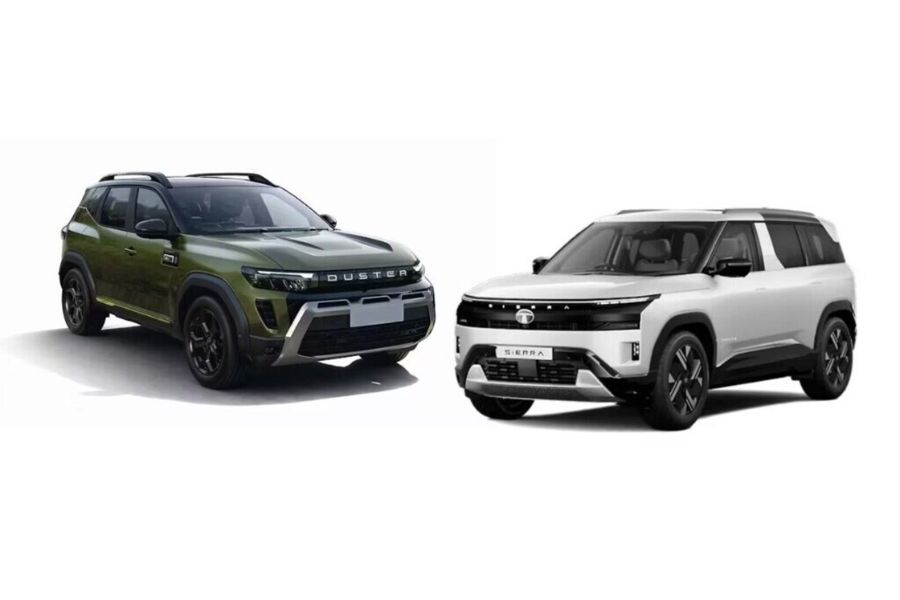
The Renault Duster has made a strong comeback in 2026, re-entering the highly competitive midsize SUV segment it helped establish back in 2012. With popular rivals like the Hyundai Creta, Kia Seltos, Tata Sierra, Maruti Suzuki Grand Vitara and Toyota Hyryder already dominating the space, the new-generation Duster faces a tough challenge.
Here’s a detailed comparison of the 2026 Renault Duster vs its key rivals based on dimensions, engine options and pricing.
Dimensions Comparison: Duster Stands Out for Practicality
The new Renault Duster measures 4,343mm in length, making it slightly longer than the Hyundai Creta but shorter than larger rivals like the Kia Seltos. It is also wider than the Creta and most Maruti Suzuki and Toyota SUVs, which translates to better cabin room.
The Tata Sierra is the biggest SUV in this comparison, offering the widest body, tallest stance and longest wheelbase. Meanwhile, the Skoda Kushaq and Volkswagen Taigun remain the most compact options in the segment.
In terms of ground clearance, the Duster offers 212mm, which is among the best in class and only slightly lower than the Honda Elevate’s 220mm.
Where the Duster truly shines is boot space. With 518 litres of luggage capacity, it offers the largest usable boot (up to the parcel shelf) among all midsize SUVs, making it ideal for long-distance travel and family use.
Engine and Performance: Strong Turbo and Hybrid Advantage
The 2026 Renault Duster comes with multiple powertrain options:
-
1.0-litre turbo-petrol (100hp, 160Nm)
-
1.3-litre turbo-petrol (163hp, 280Nm)
-
1.8-litre strong hybrid (expected soon, 160hp)
The 1.3-litre turbo engine is the most powerful turbo-petrol unit in the segment, outperforming rivals like the Creta, Seltos, Taigun and Kushaq.
The upcoming strong hybrid system is also expected to be more powerful than the hybrid setups in the Grand Vitara and Hyryder.
However, the Duster misses out on a diesel engine, which continues to be offered by competitors like the Hyundai Creta, Kia Seltos and Tata Sierra. Additionally, it does not get CNG or AWD options, unlike select variants of the Maruti Suzuki and Toyota SUVs.
In comparison:
-
Tata Sierra offers the most powerful diesel engine
-
Honda Elevate leads among naturally aspirated petrol engines
-
Grand Vitara and Hyryder focus on fuel-efficient hybrid tech
Price Comparison: One of the Best Value Offerings
The Renault Duster is priced very competitively in the segment.
-
Base turbo-petrol variants: ₹10.49 lakh to ₹13.49 lakh
-
Higher turbo-petrol variants: ₹12.99 lakh to ₹18.49 lakh
-
Strong hybrid: Expected launch by Diwali 2026
The Duster’s base turbo-petrol is priced lower than many naturally aspirated petrol variants of rivals like the Creta, Seltos and Grand Vitara.
Its higher-spec turbo variants are also among the most affordable in the segment, costing significantly less than equivalent versions of the Creta, Sierra and Taigun. At the top end, the Duster undercuts key competitors by over ₹1.5 lakh in some cases.
That said, the Citroen C3 Aircross remains the most affordable midsize SUV overall, followed by the MG Astor.
Final Verdict
The 2026 Renault Duster returns as a strong all-rounder with a focus on performance, space and value.
Key strengths:
-
Best-in-class boot space
-
Most powerful turbo-petrol engine
-
Competitive pricing
-
Upcoming strong hybrid option
Limitations:
-
No diesel engine
-
No CNG or AWD options
-
Faces strong competition from feature-rich rivals
Overall, the new Duster is a compelling option for buyers looking for a practical, powerful and value-for-money midsize SUV. While it may lack some fuel options offered by competitors, it delivers where it matters most—performance, space and pricing.
Read More: