


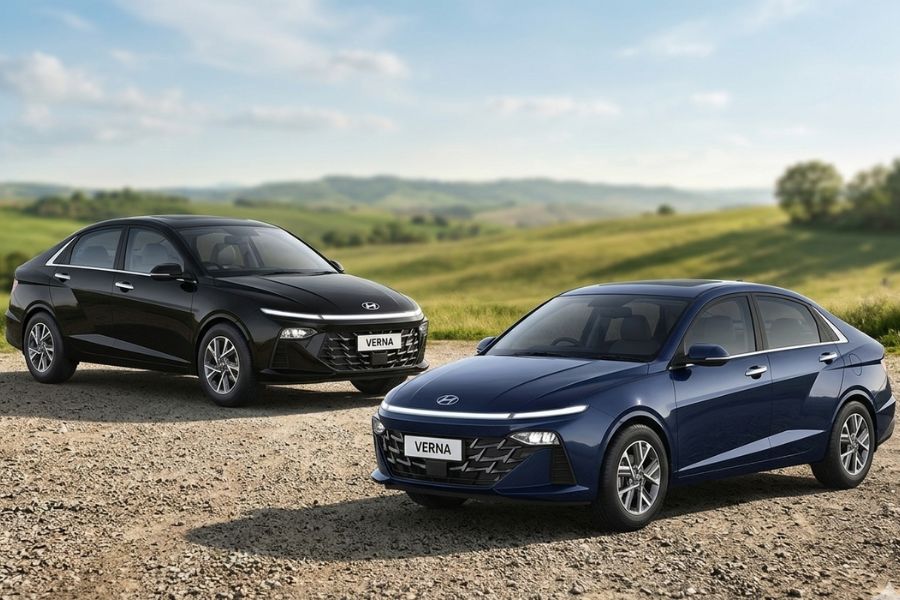
The 2026 update of the Hyundai Verna brings several cosmetic tweaks, additional features, and a revised variant lineup. While the sedan retains its existing engines and overall design language, Hyundai has focused on enhancing styling details, improving cabin technology, and introducing new convenience and safety features.
Here’s a detailed comparison of the new Hyundai Verna facelift vs the previous model to understand everything that has changed.
Exterior Changes: Subtle Styling Updates
Hyundai has made minor design revisions to keep the Verna looking fresh while maintaining its bold and futuristic styling.
At the front, the facelifted Verna now gets a dark chrome grille, replacing the earlier finish. The LED headlamps have been slightly revised, and the front bumper design has been updated with sharper detailing and a more sculpted lower section.
Another visual update comes in the form of newly designed 16-inch alloy wheels, which add a slightly sportier look to the sedan.
At the rear, the signature connected LED tail-lamps and boot-mounted spoiler remain unchanged, but Hyundai has redesigned the rear bumper. It now features silver accents and a diffuser-style lower element, giving the car a more premium appearance.
Hyundai has also introduced two new colour options with the update:
-
Classy Blue
-
Titan Grey Matte
Overall, the facelift focuses on small but noticeable design refinements rather than a complete overhaul.
Interior Updates: New Steering Wheel and Improved Display Graphics
The Verna continues with its dual-tone black and white interior, while the turbo-petrol variants retain an all-black sporty cabin theme.
One of the biggest changes is the new three-spoke steering wheel featuring Hyundai’s Morse Code ‘H’ logo, similar to what is seen on newer Hyundai models.
The sedan also continues with the twin 10.25-inch screens for the infotainment system and digital instrument cluster. However, the instrument cluster now features updated graphics, giving it a more modern interface.
Interestingly, Hyundai has not introduced the larger 12.3-inch screens seen in newer models because the Verna’s platform does not support the latest Nvidia-based electrical architecture used in some newer Hyundai cars.
New Features: Added Comfort and Safety
The 2026 update also brings additional comfort and safety features to the sedan.
Newly added convenience features include:
-
Powered front passenger seat
-
Driver seat memory function
-
Boss mode for the front passenger seat (allows rear passengers to move the seat forward)
These additions make the Verna more comfortable for rear-seat occupants and enhance the premium feel of the cabin.
In terms of safety, Hyundai has made an important upgrade. The top variant now comes with seven airbags, compared to six airbags earlier. The sedan also gains a 360-degree camera, further improving parking safety and visibility.
Engine and Transmission: No Mechanical Changes
Under the hood, the 2026 Verna continues with the same engine lineup as before.
Engine options include:
1.5-litre Naturally Aspirated Petrol
-
Power: 115hp
-
Transmission: 6-speed manual or CVT automatic
1.5-litre Turbo Petrol
-
Power: 160hp
-
Transmission: 6-speed manual or 7-speed dual-clutch automatic (DCT)
These engines are known for delivering a strong balance of performance, efficiency, and smooth drivability, especially the turbo-petrol version, which remains one of the most powerful engines in the segment.
Price and New Variant Lineup
The updated Verna is priced between ₹10.98 lakh and ₹18.25 lakh (ex-showroom).
With the facelift:
-
The base variant is around ₹18,000 more expensive
-
The top variant costs about ₹1.1 lakh more
Hyundai has also introduced a new variant naming structure. The updated lineup now includes:
-
HX2
-
HX4
-
HX6
-
HX6+
-
HX8
-
HX10
This naming format aligns the Verna with newer Hyundai models like the Hyundai Venue.
Verdict: Minor Refresh but More Premium
The 2026 update for the Verna is more of a feature and styling refresh rather than a full facelift. Hyundai has focused on improving the sedan’s premium appeal by adding convenience features, extra safety equipment, and subtle design tweaks.
With its powerful turbo engine, modern interior tech, and improved feature list, the updated Verna continues to compete strongly against rivals such as the Honda City, Volkswagen Virtus, and Skoda Slavia.
For buyers looking for a feature-rich midsize sedan with strong performance and modern styling, the refreshed Verna remains one of the most compelling choices in the segment.
Read More: